New England’s offshore wind ambitions were dealt a further setback as contract negotiations under way for most of the past year were extended again, potentially into 2026.
The reason is not difficult to guess: A June 30 filing (Massachusetts DPU 23-42) cites uncertainty created by substantial changes in federal energy policy since President Trump was inaugurated.
The parties now are targeting completion of negotiations on or before Dec. 31, 2025, and filing of contracts with state regulators on or before Feb. 25, 2026.
The joint offshore wind solicitation by Connecticut, Massachusetts and Rhode Island was an ambitious attempt to rebound from setbacks and frustrations each state had experienced individually as the industry ran into headwinds in its efforts to establish itself in the United States.
The coordinated effort sought up to 6 GW of capacity. When the bidding window closed in March 2024, 5,454 MW of capacity had been proposed. (See New England States’ OSW Procurement Receives 5,454 MW in Bids.)
Massachusetts selected 2,678 MW of capacity from three projects; Rhode Island selected 200 MW from one project; and Connecticut opted out. (See Multistate Offshore Wind Solicitation Lands 2,878 MW for Mass., RI.)
Vineyard Offshore then withdrew its bid for the 1,200-MW Vineyard Wind 2 proposal because Massachusetts would take only 800 MW of output and Connecticut would not take the other 400 MW. (See Connecticut Closes the Door on 2024 OSW Procurement.)
That left 791 MW from Avangrid’s New England Wind 1 proposal and 1,087 MW from the EDP Renewables/Engie joint venture SouthCoast Wind. The SouthCoast partners said in February that project could be placed on hold for as long as four years due to its uncertain prospects during the Trump administration. (See SouthCoast Wind to Take $278M Impairment as Delay Appears Likely.)
Rhode Island Energy is warning that it may terminate its conditional selection of 200 MW from SouthCoast if the negotiations are not successful by Oct. 31, 2025.
Meanwhile, two offshore wind projects serving New England are under construction: Vineyard Wind 1, which will feed 800 MW to Massachusetts, and Revolution Wind, which will send 300 MW to Connecticut and 400 MW to Rhode Island.
Both have had problems of their own: Ørsted has reported good progress in Revolution’s offshore construction, albeit at a higher cost than initially expected, but complications on land have pushed back its projected commercial operation date. (See Ørsted Takes $1.7B Impairment on US Offshore Wind.)
Vineyard Wind 1, a joint venture of Avangrid and Copenhagen Infrastructure Partners, once boasted it would be the first utility-scale wind farm in U.S. waters when completed in 2024. It fell behind schedule in 2023, then fell much further behind in mid-2024 because of defective turbine blades. (See Vineyard Wind 1 on Track to Produce Power by Year’s End and Prior to Trump Inauguration, Feds Lift Suspension on Vineyard Wind 1.)
Avangrid and Ørsted did not respond to requests for comment for this report.
The three southern New England states have had high hopes for offshore wind as a way of providing clean, affordable electricity while creating a new economic sector. After a series of contract cancellations, they banded together for the solicitation that now has stalled.
Their neighbors down the coast also have struggled with cancellations and failed solicitations.
In February 2025, New Jersey called off its latest solicitation midprocess after two developers withdrew proposals. (See N.J. Abandons 4th OSW Solicitation.)
In April 2024, New York had to cancel its 2022 solicitation after 20 months of work due to turbines not being available. (See N.Y. Offshore Wind Plans Implode Again.)
New York expected to announce contracts in the first quarter of this year for its 2024 solicitation but still has not done so as the third quarter begins. One of the four developers that offered proposals withdrew them a month after submitting them. Another has paused U.S. offshore wind development indefinitely. A third saw the federal review process halt for the project it proposed.
The transition from the strongly pro-renewables President Biden to the strongly pro-fossil and anti-renewables President Trump significantly boosted the risk and uncertainty facing U.S. offshore wind generation development.
As NetZero Insider reported before Trump’s inauguration, the president did not need to deliver a huge knockout punch against offshore wind to fulfill his campaign promise of halting it. All he had to do was magnify the existing levels of uncertainty and risk — the industry could then wither on its own, as investors withheld capital. (See Offshore Wind Industry Girds for 2025, Trump Presidency.)
Trump’s Day One order of a review of wind power permitting — along with his unpredictable leadership style and his tariff threats — has accomplished this. The impact was such that in May, 17 states and the District of Columbia filed a federal complaint (1:25-cv-11221) against Trump and key federal officials challenging the order.
In its motion to intervene in the case, trade organization Alliance for Clean Energy New York said billions of dollars of investments and hundreds of thousands of jobs are at risk through the delaying effect of the Day One memorandum, given the great number of federal approvals needed for projects and their vulnerability to unexpected delays.
“Due to the uncertainty as to when federal permitting will resume, investment in new projects has halted, and developers are not setting new construction timelines or entering into new construction or manufacturing contracts,” ACE NY wrote. “Demand for specialized materials, equipment and labor has plummeted.”
A few bright spots remain in the U.S. offshore sector.
The Department of the Interior removed the stop-work order it had slapped on Empire Wind 1, an 810-MW Equinor project beginning work off the New York coast. (See BOEM Lifts Stop-work Order on Empire Wind.)
And Dominion Energy’s 2.6-GW Coastal Virginia Offshore Wind remains on track for 2026 completion with limited cost increases. (See PJM Network Upgrades Boost Cost of Dominion OSW Project 9%.)
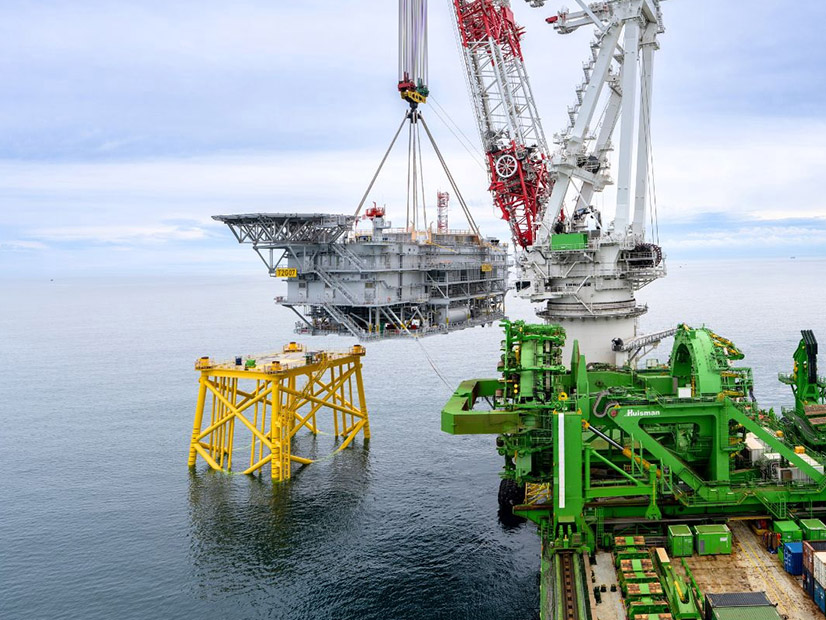
A spokesperson said June 30 that 108 of 176 foundations, 59 of 176 transition pieces and the first offshore substation have been installed; nearly 75% of deepwater export cables are in place; and the first turbine components have arrived at Portsmouth Marine Terminal, where they will be assembled later in 2025.