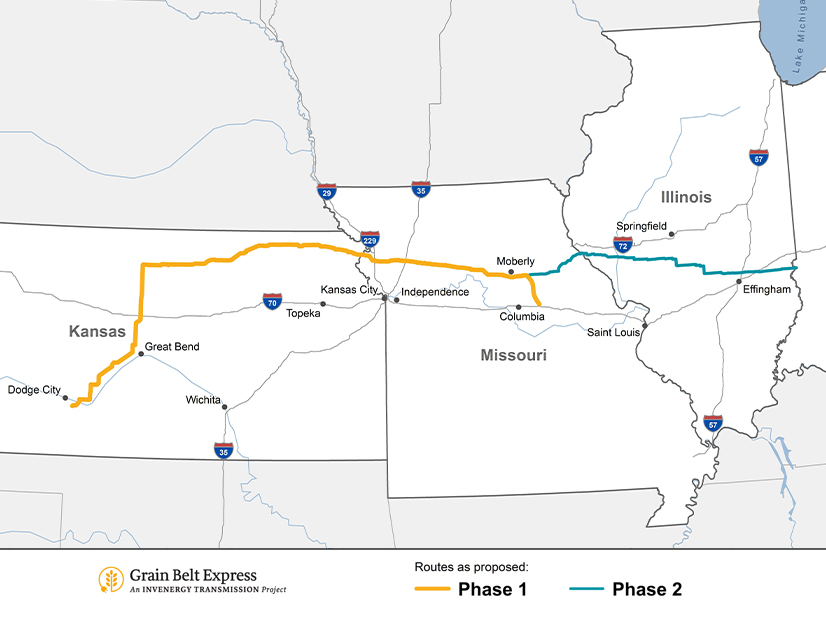
Missouri Attorney General Andrew Bailey says he has opened an investigation into Invenergy’s Grain Belt Express transmission project, an 800-mile, HVDC line spanning four states that has been under development since 2010.
Bailey told Invenergy in a June 27 filing that he “has reason to believe” Grain Belt’s developers have “used deception, fraud, false promise, misrepresentation, unfair practice or the concealment, suppression or omission of material fact in connection with its statements and actions” related to the project.
He sent a letter to the Public Service Commission on July 1 urging it to re-evaluate the project’s certificate of convenience and necessity by using its authority to “demand” updated long-term planning and revoke project approvals that are no longer in the public interest.
A PSC spokesperson told RTO Insider that the commission is reviewing the attorney general’s request and declined further comment.
Bailey said the Grain Belt application “relied on speculative and possibly fraudulent assumptions.” He said the developers’ calculations relied “significantly” on a carbon tax, pointing out that neither Missouri nor the U.S. government have carbon-reduction policies.
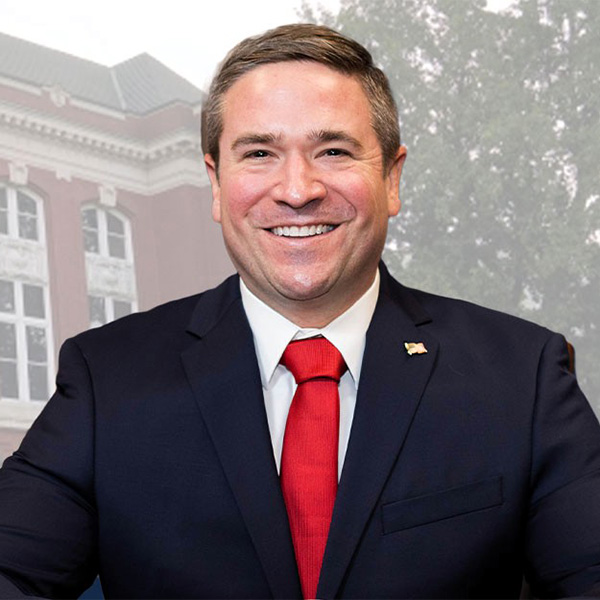
“Grain Belt’s speculative and faulty calculations based on anticipated carbon tax has more than likely inflated demand for this project and dramatically overstated any resulting benefit to Missourians, directly undermining any claims of demonstrated need, economic feasibility and public interest,” Bailey said in the letter to the PSC.
“We’ve been absolutely transparent with everybody involved,” Michael Polsky, Invenergy’s founder and CEO, told The New York Times. “Whatever investigation they want, we will fully cooperate. We have nothing to hide. We’ve done everything above board.”
A Grain Belt spokesperson called the investigation a “last-ditch and obviously politically driven attempt to delay construction” of the project when “our country is facing a national energy emergency,” as declared by President Donald Trump. (See What is and isn’t in Trump’s National Energy Emergency Order.)
“We should be building energy infrastructure in America, but the Missouri attorney general is instead playing politics with U.S. power,” the spokesperson said in an email. “Electricity demand is rising across the country, and we urgently need transmission infrastructure to deliver power. Projects like Grain Belt Express are the answer to providing all forms of affordable and reliable electricity to U.S. consumers.”
U.S. Sen. Josh Hawley (R-Mo.) has also weighed in with a letter to the Department of Energy in June asking Secretary Chris Wright to terminate a $4.9 billion loan guarantee issued by the Loan Programs Office in 2024.
Hawley, who has called Grain Belt Express a “boondoggle,” noted the department is moving forward with the draft environmental impact statement, “a key step in approving the loan.”
Invenergy says the $11 billion project will provide $52 billion in energy cost savings over 15 years, create 5,500 American jobs and power up to 50 data centers. A 2022 economic analysis conducted for Invenergy found that the project would result in $20 billion in total investment and create more than 20,000 temporary jobs and more than 400 permanent jobs in Illinois, Kansas and Missouri.
Invenergy says Grain Belt, a merchant open-access line, will move about 5,000 MW of a “diverse mix of energy” from Kansas across Missouri and Illinois to Indiana. The project will deliver cost savings and strengthen reliability for 29 states and D.C. and more than 40% of Americans, it said.
The project would create links between the SPP, MISO, Associated Electric Cooperative Inc. and PJM grids.
Kansas, Missouri, Illinois and Indiana have all approved the project. The Missouri PSC found the project would save the state’s customers as much as $18 billion, Invenergy said, and noted municipal utilities in 39 communities have contracts with it for power delivery and contractually guaranteed cost savings.
The project has faced pushback from Missouri landowners, who are opposed to a for-profit private entity using eminent domain. Bailey has criticized Grain Belt for filing nearly 50 eminent domain lawsuits against Missouri landowners.
In a blog post, Invenergy said “responsible transmission developers respect private property rights and make every effort to negotiate with landowners.” It said it has “among the strongest set of landowner protections and compensation packages, including a code of conduct and agricultural impact mitigation protocol.”
Invenergy says it has completed over 95% of land acquisition for Phase 1, the segment connecting Missouri and Kansas. The phase’s construction is scheduled to start in 2026.
Grain Belt’s developers received some good news July 1 when the D.C. Circuit Court of Appeals denied a rehearing request from a group of Illinois landowners. The court dismissed the lawsuit in April, finding the group had failed to demonstrate that they will suffer a “certainly impending” injury-in-fact (24-1213).
The landowners were appealing FERC’s order in February 2024 and a subsequent rejected rehearing request over the commission’s authorization of Grain Belt’s ability to charge negotiated rates for the HVDC project (ER24-59). (See Grain Belt Express Gets Partial Approval for Negotiated Rate Authority from FERC.)
Grain Belt has been under development since 2010, when the now-defunct Clean Line Energy first proposed the transmission line. After years of regulatory, legal and political hurdles, Clean Line sold the project to Invenergy. (See Invenergy Renewing Push for Grain Belt Express.)