IESO opened stakeholder discussions on new rules for storage facilities and hybrid resources that will introduce a single bi-directional resource model and enable the provision of regulation service.
The initiative, part of the ISO’s Enabling Resources Program (ERP), initially will focus on electricity storage and hybrid generation-storage resources, with a later “stream” to develop rules for aggregations of distributed energy resources (DERs).
“It’s an important step for preparing Ontario for the required resources needed to meet the system needs that have been identified through the ISO’s [Annual Planning Outlook],” David Short, senior director for the ERP, said during a kickoff presentation July 24. “More and more storage resources [are] being installed and operating, and at a scale that really requires us to develop the design of a good participation model to fully allow them to participate in meeting those system needs.”
“We are hot off the heels of Market Renewal, and ERP is the next high-priority capital project for the ISO,” said Maral Kassabian, senior manager of ERP implementation. “Its objective is to more fully enable resources to participate in the ISO markets, to enhance market efficiency and support the safe and reliable operation of Ontario’s bulk power system.”
The “Phase 1” rules, which IESO hopes to have in place as soon as 2027, will build on the interim storage model from 2018 and the co-located model implemented in 2023.
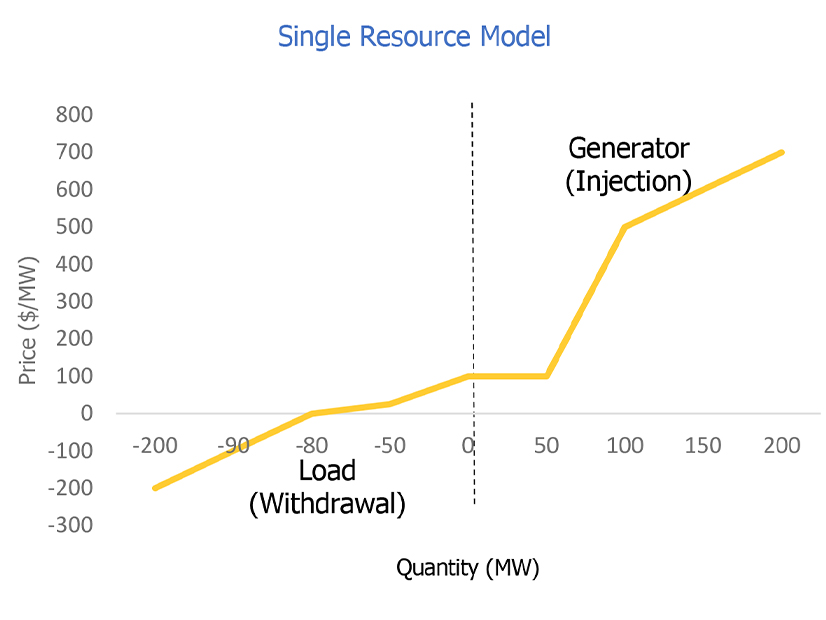
It will replace the current two-resource model — which separates the withdrawal portion of the resource as a load and the injection portion as a generator — with a single resource model with a continuous offer curve. When withdrawing, the resource will operate as a “negative generator,” and when injecting, it will be a “positive generator,” as in other jurisdictions, IESO said.
The new rules will apply to single-site, dispatchable battery storage greater than 1 MW that is connected to transmission or distribution. Other types of storage technologies will be considered in a subsequent phase.
Included in the proposal is a new parameter, the initial state of charge (SoC), measured in MWh, that market participants will submit for the day-ahead market.
The new rules will apply to the recent Long-Term 1 (LT1) and Expedited Long-Term (ELT) storage procurements, as well as Northland Power’s 250 MW/1,000 MWh Oneida Energy Storage. (See IESO Purchasing 3,000 MW of Energy and Capacity.) Oneida began operating in May, more than doubling Ontario’s energy storage capacity.
Storage facilities with existing contracts with IESO will continue participating as they currently do in the markets until their contracts expire.
Storage as Operating Reserves
The rules will seek to co-optimize storage’s provision of both energy and operating reserves (OR).
The ISO is considering allowing storage to contribute to OR by injecting energy, stopping its withdrawals from the grid or “branching” from withdrawal to injection. (See Operating Reserve Prices Surge in Ontario.)
The new rules would allow storage resources to submit up to five price-quantity pairs hourly for each class of operating reserve (10-minute synchronized reserve, 10-minute non-synchronized reserve and 30-minute non-synchronized reserve).
Under current rules, a resource that offered a maximum price-quantity injection of 200 MW and a maximum withdrawal of -200 MW would not be able to offer more than the 200 MW as OR. Under the proposed branching rules, the resource could provide a maximum of 400 MW.
IESO is proposing a 100 MW/minute static energy ramp rate to “leverage the fast-ramping capability of storage upon dispatch but also limit operational concerns from extreme ramping on system balancing.”
Cycling Daily Energy Limit
The ISO is considering a new parameter, the cycling daily energy limit (CycleDEL), for use in both day-ahead and pre-dispatch calculations. It will be based on the current MaxDEL, the maximum amount of energy a storage resource can inject daily.
CycleDEL will be the number of daily cycles submitted by the market participant at registration multiplied by the operating range of the battery (the difference between the maximum SoC and minimum SoC).
Storage operators would be allowed to increase the limits they offer at registration but not reduce them.
“I do like the idea of having a registered value and then the ability to change it during … real time,” said Noralyn Vasquez, of Atura Power.
She noted that batteries’ warranties have limits on cycling. “In addition, the more you cycle the facility, it does degrade the Megapacks,” she added.
“Having these limits in the day-ahead [market] allows us to mitigate any buyback risk if we’re getting scheduled more often in the DAM relative to what we really can do in the real time,” she added. “So, it’s a good feature.”
Feedback Sought
The ISO requested feedback by Aug. 21 on a range of topics, including telemetry requirements and derates of resources.
IESO plans a second meeting on the storage rules in October with a design memo on optimization in the fourth quarter.