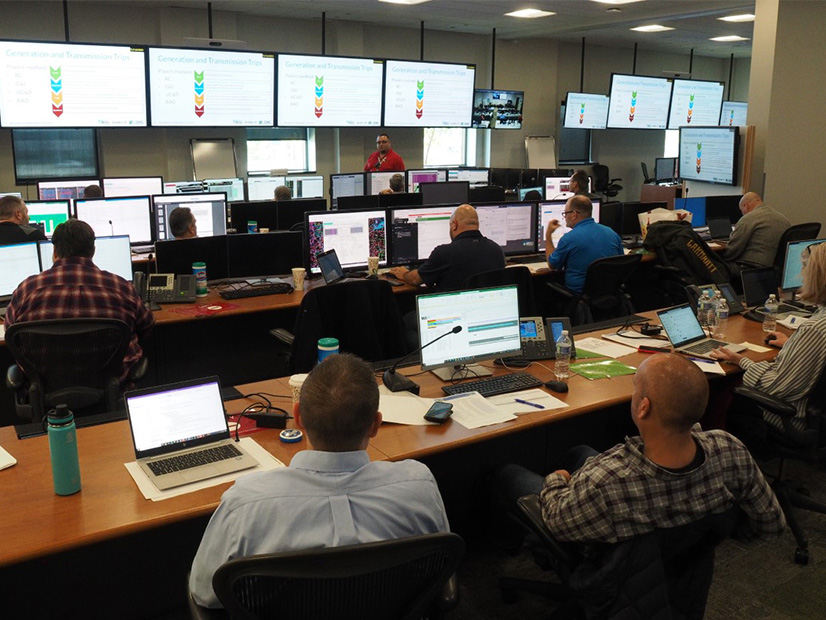
GridEx VIII, a security exercise, will see changes both visible and behind the scenes that are designed to match real-world developments in the past two years, an official with the Electricity Information Sharing and Analysis Center (E-ISAC) told members of NERC’s Reliability and Security Technical Committee.
Speaking at the RSTC’s quarterly meeting Sept. 11, GridEx Program Manager Jesse Sythe outlined some of the updates to the biennial training event scheduled for Nov. 18-19. These include new participation options for the distributed play portion: In addition to the traditional full-scale exercise, participants can choose a simplified “GridEx-in-a-box” option designed for smaller planning teams and organizations new to the exercise, or a streamlined “tabletop” scenario for entities unable to participate in a real-time program.
All three participation options will be based on the same scenario, Sythe said, and will involve physical and cybersecurity threats to grid infrastructure inspired by real-world events. While he did not provide the full scenario, he said it will involve climate change impacts such as wildfires and heat domes, along with attacks coinciding with a major world sporting event. This element was added in light of the 2026 FIFA World Cup and 2028 Summer Olympic games, both of which will be held in the U.S.
Planners also have incorporated new tools for the scenario, including a new social media and news simulation tool, ATSsim Media, to provide a smoother and more realistic experience for participants. The new tool incorporates social media bots to “create some noise and … background chatter” that might be heard during a real security event.
Like GridEx VII, the scenario timeline comprises four separate “moves”: the first four hours of the event (move 1), hours 4-8 (move 2), hours 24-28 (move 3) and a week after the main action (move 4). This element debuted in GridEx VII, and planners decided to bring it back based on favorable participant reactions.
“Folks seemed to really like that; [it] lets you look through recovery a little more in depth than we have in previous GridExes and shift to more of a discussion-based exercise for that final phase,” Sythe said.
Committee to Post EV White Paper
Committee members unanimously voted to approve a paper submitted by the RSTC’s Electric Vehicle Task Force outlining “potential risks and benefits of integrating EVs with the grid.”
As EVTF Vice Chair Syed Ali reminded attendees, the group submitted a draft of the paper at the committee’s June meeting for a 45-day comment period. (See NERC RSTC Tackles Priority Projects in Quarterly Meeting.) The final draft was updated to take the committee’s feedback into account and to address “policy impacts” on the EV industry.
The highest-priority risks identified in the paper include difficulty in forecasting EV characteristics, a lack of available charging profiles, inability of current models to represent charging and discharging behavior, inadequate studies of the impact of EVs on the grid, and lack of information sharing among manufacturers, utilities and end-use customers. Ali said the EVTF’s next product will be mitigations for these and other risks.
Members also approved a reliability guideline submitted by the System Planning Impacts from Distributed Energy Resources Working Group (SPIDERWG) addressing the impact of DERs on underfrequency load shedding program design. As part of its triennial review process, SPIDERWG determined the document remained applicable, effective and useful to registered entities in addressing risks. The new guideline includes “minimal revisions … based on SPIDERWG’s review and comments” from industry after a 45-day comment period earlier in 2025.
Finally, members agreed to post another guideline relating to the commissioning of inverter-based resources for a 45-day comment period, and to accept for internal comment a paper on the ability of current standards and engineering practices to address emerging large loads. The paper will be ready for comment in late September or early October, NERC Engineer for Power Systems Modeling and Analysis Jack Gibfried said.