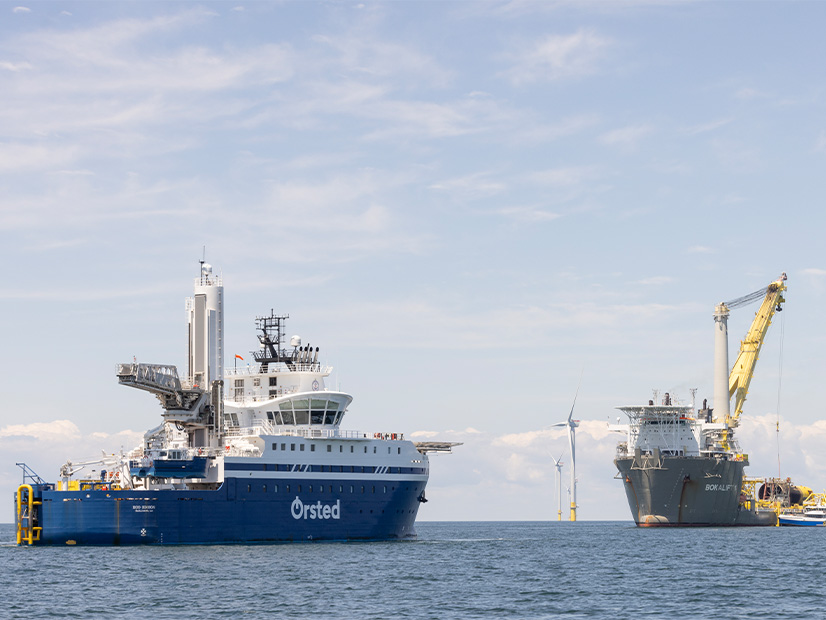
Ørsted reported a net loss for the third quarter, attributed to the continuing financial challenges for its U.S. offshore wind portfolio, but it also said those projects are progressing well toward completion.
Revolution Wind is 85% complete and on track for commercial operation in the second half of 2026, the company said, while Sunrise Wind is 40% of the way to operational status in the second half of 2027.
Quitting either one now would be almost as expensive as finishing them, CEO Rasmus Errboe said Nov. 5 during a conference call with financial analysts, so the plan is to wrap them up and refocus offshore wind development efforts in other parts of the world.
The picture is different with U.S. onshore renewables, for which the company made a separate business unit on Oct. 1. Errboe said it has a pipeline of 6 to 7 GW of projects that will qualify for federal tax credits through 2029, and there are ample opportunities in the market.
The past few months have been eventful for the company: It completed a $9.3 billion rights issue that helped shore up its finances but tanked its stock price; it announced plans to shed a quarter of its personnel; and it reached a $6 billion deal to sell a 50% stake in the 2.9-GW Hornsea 3 project. (See Ørsted to Slash Workforce, Refocus on European OSW and Ørsted to Raise $9.3B, Self-finance Sunrise Wind.)
This last development, announced Nov. 3, should protect Ørsted’s investment-grade credit rating, CFO Trond Westlie said during the conference call.
Ørsted has three priorities now, Errboe said: continue the significant progress it has made in strengthening its capital structure; wrap up its 8.1-GW offshore wind construction portfolio; and prioritize value over volume as it focuses offshore wind development in Europe and certain Asian-Pacific markets.
Offshore wind has had troubles in much of the world because of its cost and supply chain problems, but attempts to launch a U.S. market have been especially problematic, even before Donald Trump was elected to a second term as president. Ørsted has suffered billions of dollars in losses and impairments on its U.S. projects.
But Ørsted also is the most prolific developer in the U.S. offshore wind market, operating the first offshore wind farm in the Americas (Block Island Wind), completing the first utility-scale project (South Fork Wind), and pressing ahead with Revolution and Sunrise, two of the five projects being built in U.S. waters.
Those seven projects appear likely to be the entirety of the U.S. offshore wind sector for years to come, given the hostility of the Trump administration and the time needed to reboot the industry should such an attempt be made during a future administration.
During the call, financial analysts asked about the prospects of further attacks on Revolution or Sunrise by the Trump administration, which hit Ørsted with a stop-work order in August. Ørsted sued the administration in September and won the right to resume work. (See Judge Lifts BOEM’s Stop-work Order on Revolution Wind.)
That was only an injunction, one analyst pointed out. What if the court case drags on beyond the end of construction, and the administration is able to block operation or force a decommissioning?
Errboe would not speculate. He said the injunction allows work to continue and Revolution to begin operations. He said Ørsted continues a dual approach to the Trump administration on Revolution — litigation and negotiation — as best it can.
Another analyst asked why the construction timeline for Revolution stretches into the second half of 2026, as the components are progressing quickly to completion.
Every segment of the project’s cable, both of its offshore substations and each of its 65 turbines need to be energized individually, Errboe said, and that takes time.
At peak operation, Revolution will send 400 MW of electricity to Rhode Island and 304 MW to Connecticut. The 924-MW peak output of Sunrise is contracted to New York.
The remainder of the U.S. offshore wind sector is Equinor’s 810-MW Empire Wind 1, progressing toward a 2027 operation date; Dominion Energy’s 2.6-GW Coastal Virginia Offshore Wind, targeting operation in 2026; and Avangrid’s 800-MW Vineyard Wind, which has encountered extensive delays but made substantial progress.
Ørsted reported a net loss of $260 million largely from higher U.S. tariffs and the stop-work order. It would have been worse, Westlie said, except that interest costs decreased.
This compares with an $800 million profit in the third quarter of 2024, but $780 million of that was from a reversal of some costs that had been expected to accrue from Ørsted’s 2023 cancellation of the Ocean Wind project in New Jersey.
Looking at the year to date, the picture improves: Ørsted reported a profit of $1 billion for the first three quarters of 2025, compared with $939 million in the same period of 2024.