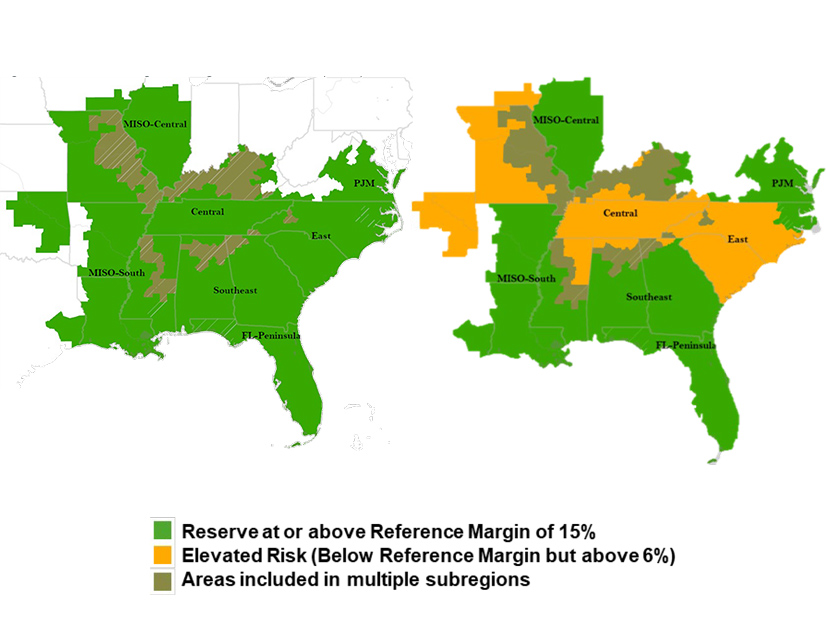
Two SERC Reliability subregions face elevated risk of energy shortfalls if they experience severe conditions this winter, though all subregions should have enough resources under normal conditions, according to the regional entity’s recently released 2025 Winter Reliability Assessment.
SERC releases its WRA each December as a companion to NERC’s WRA, providing “a deeper regional dive into topics” relevant to the Southeast and covering the months of December, January and February. NERC’s assessment, released Nov. 18, found “pockets of elevated risk” across North America due in part to demand growth outstripping generation additions since last winter. (See NERC Winter Reliability Assessment Finds Many Regions Facing Elevated Risk.)
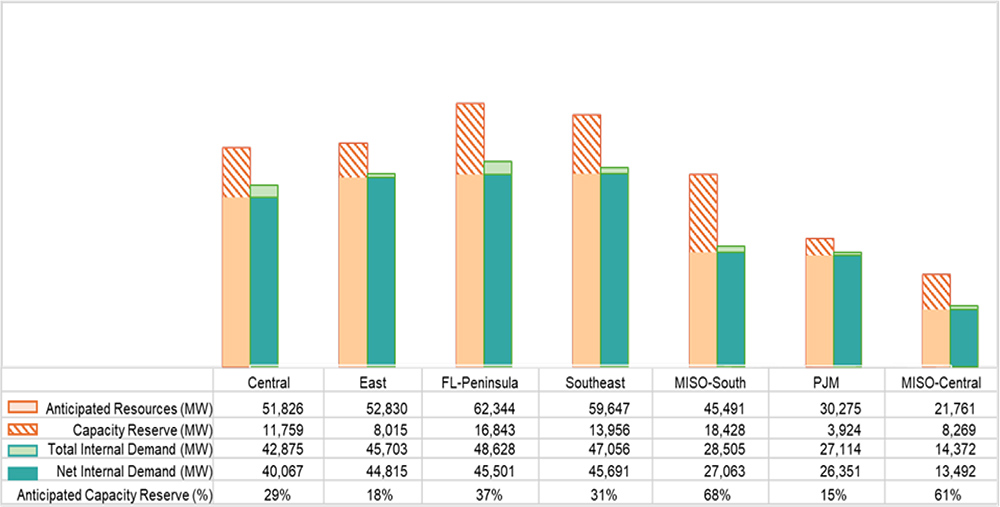
In a Dec. 11 webinar accompanying the release of SERC’s assessment, the RE’s Senior Reliability Advisor Heather Polzin said the report’s findings are largely consistent with those of NERC’s WRA. All of SERC’s seven subregions are at or above the 15% minimum reference margin under the region’s 50/50 load forecast, which denotes a 50% chance that the actual load will be higher or lower than predicted. Five are expected to meet the reference margin in the 90/10 forecast, meaning a 10% chance that the actual load is higher than predicted.
The two exceptions are the Central subregion — which includes all or parts of Alabama, Georgia, Iowa, Kentucky Mississippi, Missouri, North Carolina, Oklahoma, Tennessee and Virginia — and the East, which includes North and South Carolina. Both regions were assessed as “elevated” risk under the 90/10 scenario because their reserves are projected at 7% for Central and 8% for East. These figures are below the 15% minimum to be considered low risk, though above the 6% reserve considered high risk.
Polzin reminded listeners of the increasing frequency of extreme weather in recent years; the assessment included data from the National Oceanic and Atmospheric Administration showing the five-year average annual cost of climate disasters grew from around $58 billion in 1980 to more than $500 billion in 2024. Referring to recent winter storms, she warned that utilities may not be as lucky as they have been in the past.
“In Winter Storm Elliott, although it didn’t last an especially long time, the storm’s immense size meant that … entities couldn’t obtain assistance from those that they might normally have counted on,” Polzin said. “During Winter Storm Uri, they were fortunate that the storm was not more widespread, so that a lot of power could be imported from east to west … but grid entities need to plan and prepare for a storm that could be both large and long-lasting, in which they may not have access to emergency resources.”
Across the SERC footprint, utilities reported nearly 317 GW of generating capacity for the winter season. Natural gas makes up about 178 GW, with coal accounting for 60 GW and nuclear 43 GW. Hydropower follows with 12 GW, pumped storage with 9 GW, oil with 6 GW and wind at 2 GW. Energy storage, biomass, solar and other generation all make up 1 GW or less.
SERC’s team also performed an independent transmission assessment for both the 50/50 and 90/10 load forecasts, incorporating planned transmission and generation outages for winter. The team concluded that wide-area weather-related transmission events were unlikely and subregions “are expected to perform reliably” during the season. Although “SERC East and SERC Southeast had certain scenarios that triggered additional contingency analysis,” utilities in both subregions have mitigation strategies to address those contingencies.