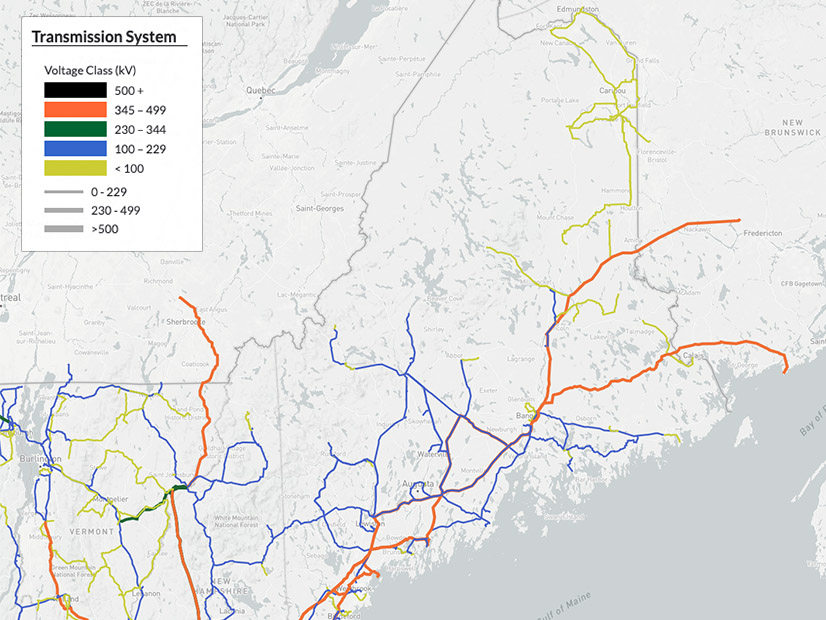
The Maine Public Utilities Commission, in collaboration with the regulators of four other New England states, has issued a request for proposals to procure clean energy in northern Maine and 1,200 MW of transmission to connect it to the ISO-NE grid.
While northern Maine is notable for its significant onshore wind potential, much of the area is not directly connected to ISO-NE; it is part of the Eastern Interconnection through New Brunswick.
As states look to add clean energy to meet growing demand and decarbonize the grid, northern Maine has the potential to be a major area of clean energy growth, but the lack of transmission remains a significant barrier.
The RFP is intended to be complimentary to ISO-NE’s first Longer-term Transmission Planning (LTTP) procurement, which aims to reduce transmission constraints in Maine and establish a new interconnection point to help enable the development of 1,200 MW of onshore wind. The RTO intends to select a project from this procurement by September 2026. (See ISO-NE Provides More Detail on Responses to LTTP Procurement.)
Building on the ISO-NE procurement, the Maine PUC issued its RFP on Dec. 19 in coordination with Connecticut, Massachusetts, Rhode Island and Vermont. The solicitation is contingent upon the success of ISO-NE’s procurement; the PUC wrote that the transmission proposals would need to connect to the RTO “at the northern terminus of the facilities constructed as a result of ISO-NE’s [LTTP] solicitation.”
The RFP allows project bidders to submit standalone transmission or generation projects, or joint projects. The PUC wrote it “will give preference to projects that provide the lowest delivered cost of contract products and exhibit an ability to harmonize the generation and transmission components.”
Proposals are due Feb. 27. The PUC expects to decide on the bids by the end of May 2026. The commission noted that the RFP is intended to align with the timeline of the 2026 ISO-NE cluster request window, which is scheduled to open in October 2026.
Transmission and generation project in-service dates should roughly coincide with the in-service dates of the proposals for the ISO-NE LTTP procurement, the PUC said. The estimated in-service dates for the bids received by the RTO range from the fourth quarter of 2032 to the third quarter of 2035.
The PUC wrote it “is coordinating with other New England states in the evaluation of proposals and consideration of a joint selection in which all or some other combination of the coordinating states would participate.”
The RFP seeks to procure energy and renewable energy credits over a 20-year power purchase agreement. The procurement also allows project developers to include energy storage systems in their proposals.
“Proposals to include an energy storage system must demonstrate how the storage system will be designed and utilized to maximize use of the transmission line and reduce costs for ratepayers,” the PUC wrote.
On the transmission side, proposals “must be capable of delivering at least 1,200 MW of energy to the ISO-NE system from the generation component to the LTTU [Longer-term Transmission Upgrade] northern terminus in the Pittsfield, Maine, area.”
The PUC conducted a similar transmission and generation procurement in 2021 and 2022, selecting a transmission project submitted by LS Power and an onshore wind project submitted by Longroad Energy. However, the commission terminated the process in late 2023 after LS Power said it no longer could meet the fixed contract price.
LS Power attributed the cost increase in part to a delay caused by Maine’s efforts to include Massachusetts in the procurement at a late stage in the process. “The introduction of Massachusetts as a participant added delay due to the need to negotiate contracts in Massachusetts and have such contracts filed for approval in a contested case before the Massachusetts Department of Public Utilities,” the company wrote in 2024 following the termination.
“After a year of delay, without signed contracts in either state, and having no certainty that contracts that would support project financing were even achievable, we could no longer hold our price or schedule,” the company added.
By coordinating with other states from the outset, the PUC’s second attempt at a northern Maine procurement may be able to avoid some of the risks that derailed its first attempt.