Stakeholders Delay Vote on Manual 1 Revisions
PJM’s Operating Committee deferred a vote to endorse revisions to Manual 1: Control Center and Data Exchange Requirements to give more time to review language removing a requirement that actual meter test results should be provided to the RTO. (See “PJM Seeks Quick Fix on Data Communications,” PJM Operating Committee Briefs: Dec. 4, 2025.)
PJM’s Ryan Nice said staff’s thinking in recommending the removal is that meter calibration and test results tend to be conducted by third-party specialists and are better addressed through resources’ interconnection service agreements. Nice said the tests represent a small part of how PJM models and validates resources’ output.
Stakeholders raised concerns that without PJM directly receiving the results of those tests, it would assume the data is accurate unless it is informed of a problem.
The proposed language also reflects NERC reliability standard CIP-012-2 (Cybersecurity – communications between control centers) requiring plans to “mitigate the risks posed by unauthorized disclosure, unauthorized modification and loss of availability of real-time assessment and real-time monitoring data in transit between applicable control centers.”
The revisions would detail the RTO’s PJMnet system for internal communications, require that members submitting distributed network protocol links provide their own data maps and definitions, and clarify that PJM will not consume or process data not needed for its own purposes, which Nice said is intended to underscore that PJM is not a generic data repeater for its members.
Manual Language to Implement AARs Endorsed
PJM presented a first read on revisions to Manual 3: Transmission Operations and Manual 3A: Energy Management System Model Updates Quality Assurance to conform with FERC Order 881, which requires the implementation of ambient-adjusted line ratings (AARs).
The Manual 3 changes include adding short-term emergency ratings to the Thermal Operating Guidelines, maintenance responsibilities for rating set lookup tables, and an option for transmission owners to resort to AARs or seasonal ratings during a dynamic line rating outage. The manual would set PJM’s transmission facilities rating database as the data source for lines with short-term emergency ratings.
The Manual 3A revisions would add two sets of 5-degree bands to the Transmission Facility Ratings Database for day and night, ranging between -55 degrees and 130 degrees F. The database would be available for all eDART users. Conditional rating tables would be added to cover loss of cooling, directional ratings and proxy stability limits.
Annual Recertification
PJM is planning to include member officers in its notifications around the commencement of the annual recertification process owing to an increase in the number of final warning letters and breach notices sent in 2025.
In response to feedback from stakeholders, the RTO did not include officers in the 2025 recertification process, but found many companies were less responsive. PJM determined that the omission of officers contributed to RTO staff having to make additional efforts to reach out to members.
Members are required to update their sector selection, affiliate disclosure, company information and contact managers by April 17. Market participants are also required to disclose their principals.
By the end of April, market participants should submit an officer certification form, risk management policies and audited financials for 2025.
December Operating Metrics
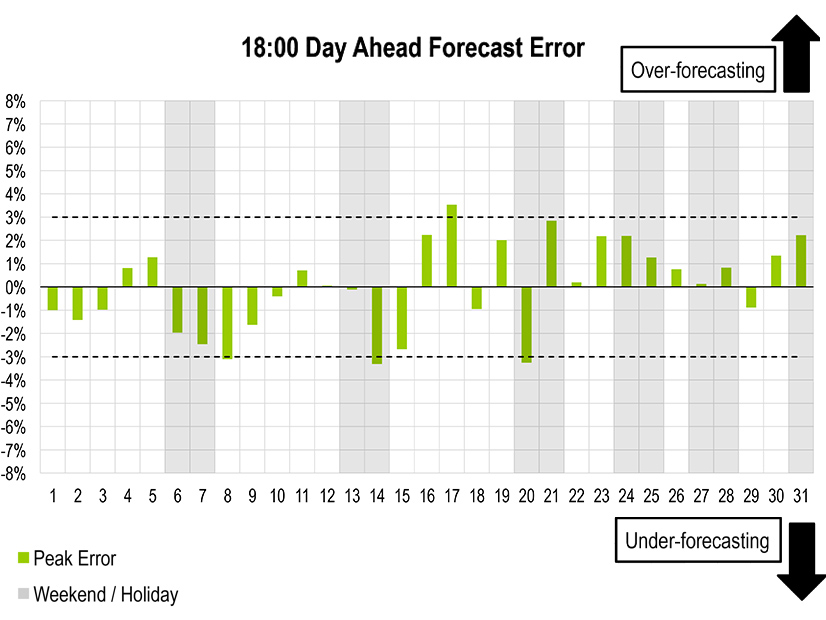
PJM’s Marcus Smith said load forecast performance was strong across the December 2025 holidays, a point of focus in recent years as the intersection between gas procurement cycles and difficult-to-predict holiday loads has led to strained system conditions.
The average hourly forecast error for the month was 1.78% and the average peak forecast error was 1.57%. Peak loads on several days exceeded the RTO’s 3% error benchmark: Dec. 17 was over-forecast by 3.53% due to high temperatures; Dec. 8 was 3.1% under-forecast due to high cloud coverage; cool temperatures on Dec. 14 led to a 3.31% under-forecast; and the Dec. 20 peak was 3.25% higher than expected due to cold and windy weather.
December saw three spin events, three shared system events, one high system voltage action, three cold weather alerts and 26 post-contingency local load relief warnings. Smith said the month was 5 degrees colder than the average of the past three Decembers and recorded the highest December peak load on Dec. 22.
A spin event Dec. 5 was initiated at 7:30 p.m. and lasted 4 minutes and 25 seconds. There were 2,350 MW of generation assigned and 373 MW of demand response, of which 49% and 69% responded, respectively.
Another event was declared the following day at 5:05 a.m. and lasted 7 minutes and 44 seconds. There were 2,350 MW of generation and 218 MW of DR assigned, with 79% and 91% responding.
The third event fell Dec. 28 at 5:07 p.m. and lasted 9 minutes and 46 seconds. There were 2,012 MW of generation assigned and 642 MW of DR, of which 76% and 89% responded.
The RTO faced below-zero temperatures and high snowfall during a winter storm that passed through the region Dec. 12-16. The peak load during the storm was 136,467 MW at 8:20 a.m. Dec. 15.
PJM’s Paul Dajewski said temperatures were lower than forecast during much of the storm and some generators were dispatched but ran into emissions limits preventing them from operating. Staff considered requesting waivers from those limits under the Federal Power Act Section 202(c).
The storm was the first winter event where gas generators were able to signal fuel supply concerns through an indicator on Markets Gateway, which several resources used to update PJM on their status. Four cause codes were added to eDART to increase the granularity of tracking gas-related outages.
Synchronized Reserve Inquiry
The Independent Market Monitor presented the latest results of its ongoing inquiry into the causes of synchronized reserve underperformance, this time looking at a 2,720-MW deployment Nov. 11. While PJM reported an 83% response rate, the Monitor argued PJM should consider reserves that overperform their assignment, which would increase the response rate to 104%. (See “Monitor Presents Synchronized Reserve Performance Inquiry,” PJM Operating Committee Briefs: Dec. 4, 2025.)
Communications have become a smaller driver as PJM has implemented new protocols for sending dispatch instructions to resources; however, parameters and personnel issues have become more pronounced. The single-largest cause of underperformance was parameter issues, followed by hardware issues and software.