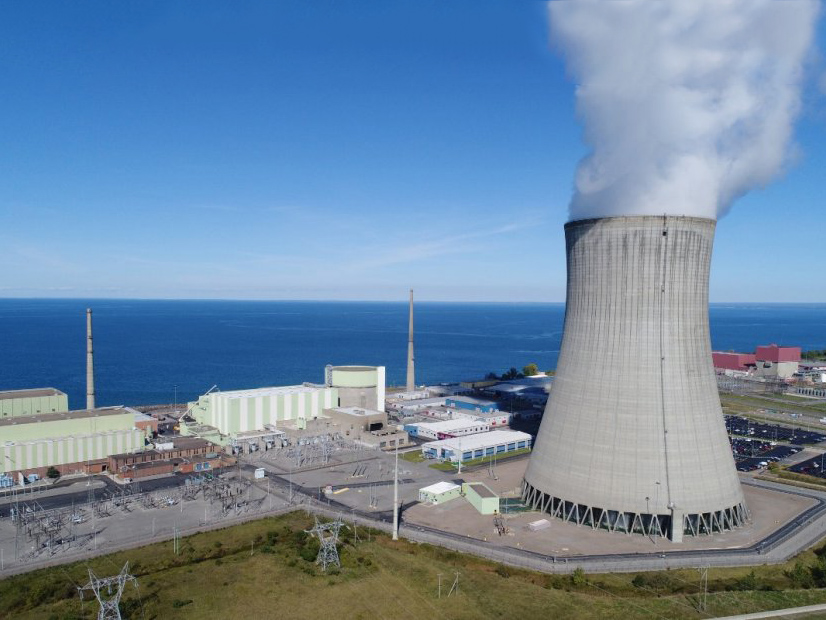
New York’s governor is calling for a “Nuclear Reliability Backbone” of more than 8 GW of the emissions-free baseload power as part of an all-of-the-above energy solution.
The plan was among the more than 200 initiatives Kathy Hochul (D) floated Jan. 13 as part of her State of the State Address, the annual forum in which governors present their agenda and priorities for the coming year and its legislative session.
Hochul in 2025 directed the New York Power Authority (NYPA) to develop at least 1 GW of advanced nuclear capacity. Now she is directing the state Department of Public Service (DPS) to facilitate a cost-effective pathway to an additional 4 GW of new nuclear capacity.
“Go big or go home,” Hochul said.
New York’s existing commercial reactor fleet totals only 3.3 GW.
A confluence of factors faces New York and its policymakers: The state’s power portfolio is aging and shrinking as the demands placed on it are expected to grow. NYISO has identified reliability violations developing as soon as mid-2026. But the long-running effort to develop renewable generation is lagging behind schedule and is only going to get more difficult under President Donald Trump.
By turning to nuclear energy, Hochul is betting that the many public- and private-sector efforts underway to reduce the staggering cost and tortoise pace of recent U.S. nuclear development will be successful. Limiting rate increases for residents of a state with some of the highest utility costs in the nation has been a theme for the governor, and she reiterated it in her address.
New York ratepayers already contribute around a half-billion dollars a year to subsidize Constellation Energy’s four reactors.
To submit a commentary on this topic, email forum@rtoinsider.com.
Along with technical, regulatory, supply chain and fuel supply hurdles, any U.S. nuclear renaissance will need widespread host-community support.
NYPA has begun laying the groundwork for this.
It said Jan. 7 that eight upstate communities expressed interest in becoming host communities.
But many people and organizations remain opposed to new nuclear development because of the costs and hazards associated with it.
“The proposal for 5 GW of new nuclear capacity is a dangerous misdirection for state energy policy,” Food and Water Watch said. “Nuclear power is a foolishly expensive and antiquated approach to meeting the state’s energy demand needs.”
Public Power NY called it a disastrous plan and doubled down on its call for NYPA to set a higher goal for renewable energy development.
The Alliance for Clean Energy New York suggested the effort to expedite nuclear development be applied as well to renewables: “New Yorkers need affordable electrons now, not in the decade-plus it will take until new nuclear could be operational. Renewables paired with storage are the cheapest way to deliver more electricity for New Yorkers today.”
Advanced Energy United said: “We are optimistic about the governor’s plan to move on a suite of advanced energy solutions that are ready to go now that will keep the lights on while protecting consumers.”
The newly formed Future Energy Alliance is squarely in favor. Constellation, which is part of the broad industry-labor-business coalition, said: “Constellation is proud to support this work and to advance the next generation of nuclear technology that can deliver long-term energy stability and broad economic benefits for communities across the state.”
Hochul offered several other ideas relevant to the energy sector in the larger book of proposals that accompanied her Jan. 13 address. Most are directly keyed to affordability and transparency for ratepayers or other consumer-focused measures.
But she also is advancing Excelsior Power, a new initiative that will direct utilities to treat grid flexibility as a key resource and expand incentives to encourage their customers to participate in demand flexibility programs. This is expected to reduce the need for costly system upgrades.
Hochul wants to reduce the infamous red tape that frustrates energy and housing developers and, by the state’s own analysis, causes projects to take up to 56% longer to get from concept to groundbreaking than in peer states. New York has made some progress on this, but delays remain. NYPA and the New York State Energy Research and Development Authority will be directed to update their regulations to speed clean energy development.
Hochul is addressing the human aspect of new nuclear technology with NextGen Nuclear New York, a workforce development effort for the people who will build and operate nuclear plants.
She also is directing the DPS to launch Energize NY Development, an initiative to streamline how large load customers connect to the grid. It will speed up interconnection, she said, and it explicitly will require that projects either cover the costs they create or supply their own energy if they create very large demand without also creating very large job creation or other public benefits.
Other proposals would boost protection of the state grid from cyber threats; adjust rules for aid to school districts to encourage on-site renewable energy development; establish a sales tax exemption for EV charging stations; and expand efforts to encourage agrivoltaics.
But energy was almost a side note in Hochul’s speech, which focused on quality of life, human rights and affordability issues and drew varying levels of applause from the heavily Democratic audience.
2026 may witness an even more intricate balancing act than is normal in Albany: Hochul, who won the deep-blue state by a surprisingly narrow margin in 2022, is facing a primary challenge from the left and a general election challenge from the right, plus skirmishes with the Trump administration along the way.