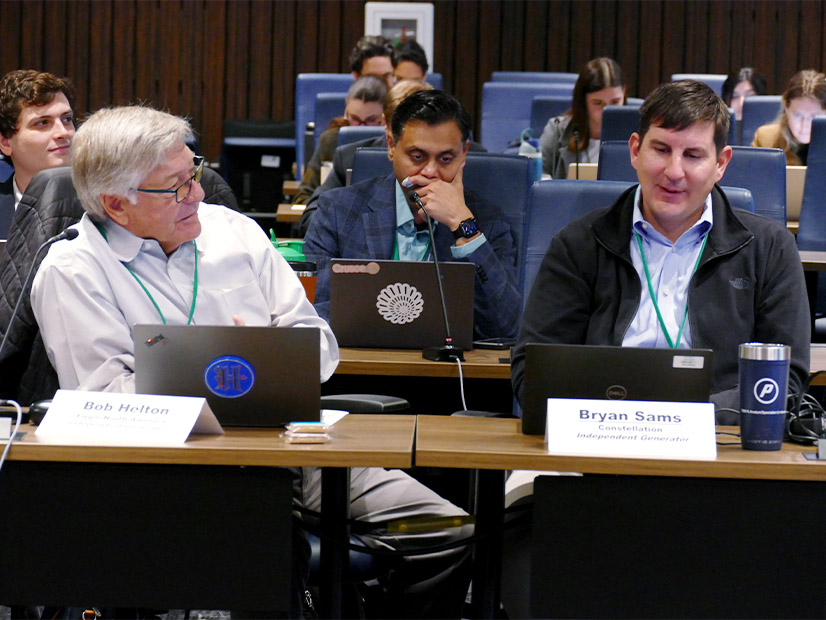
AUSTIN, Texas — ERCOT stakeholders used their first Technical Advisory Committee meeting of 2026 to mark the committee’s 30 years of existence and achievements, sharing memories of their work together and recognizing members past and present.
“It has been an honor and privilege to serve on this committee and contribute to the greatest competitive retail and wholesale power market in the world,” Reliant Energy Retail Services’ Bill Barnes said during TAC’s Jan. 21 meeting.
The committee, composed of several subcommittees and working groups, recommends policies and procedures to ERCOT’s Board of Directors and is responsible for prioritizing projects through protocol revision requests, system change requests and guide revisions.
SPP staff went through their files and found the names of 64 members who have served at least five years on the committee. Mark Dreyfus, who represents the city of Eastland and other municipalities as part of TAC’s consumer segment, said he knew all the people on the list, calling some “giants of the industry.” He reserved singular praise for one past member: Reliant’s John Meyer.
“I hope there are statues to him in the office building,” Dreyfus said. “He led the stakeholders when we developed these processes and when we developed the original protocols, and he really deserves all our honor and recognition. If you don’t know him, it would be really good to talk to somebody and find out what he was about and why he took the time to create this process.”
American Electric Power’s Richard Ross, the only member with 25 years of service, said over the phone that TAC and ERCOT’s stakeholder process “really does cast a very big shadow.”
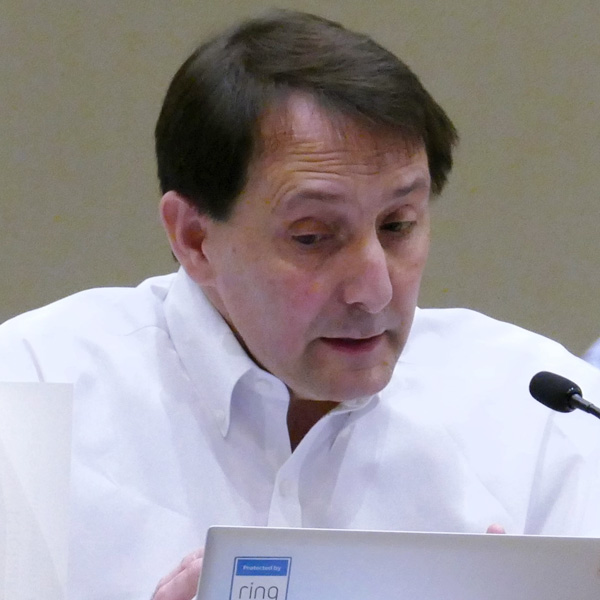
“It cast a shadow to the north and had a heavy influence on my experience with trying to get SPP’s stakeholder process set up in much the same way, with the way we so transparently change rules and give everyone a free opportunity to comment and debate,” Ross said. “If you ever looked at the process in SPP, you would see a great deal of similarities from things that we copied from.”
Barnes recalled the “completely ridiculous process” in the zonal market that predated the current nodal framework, where the zones’ boundaries would be redefined every year. He said “millions and millions of dollars amongst companies” would change hands.
“It was incredibly contentious and also extremely entertaining to be a part of,” he said. “One particular year … it literally moved a large coal plant from one zone to the other. I just remember Richard [Ross] playing a very critical part of the final vote, which I think it probably took three or four attempts to get through.”
Ironically, Ross gave up his seat this year and has been replaced by AEP’s Erin Rasmussen, one of three new TAC members.
“I’m watching from afar this year, but thank you for 25 years,” Ross said. “Keep up the good work.”
Engie’s Bob Helton, another TAC veteran, saw his 18 years of service elevated to 19 in real time when ERCOT staff found a Robert T. Helton mentioned in the files.
“This has to be wrong, okay? It can’t be. I’m not old enough to have done it,” Helton said. “I’ve served with pretty much everybody that’s on that list and I’ve served with a lot of very, very good people. We’ve made a lot of good decisions to make this market, as Bill said and it’s been noted, as the best in the country. We’ve gone through a lot of adversity. We’ve had some fun.”
Large Load Issues Pile Up
When TAC got down to the more mundane business at hand, ERCOT staff told members that the grid operator’s large load interconnection queue had dropped from 237.2 GW to 232.5 GW in January after several cancellations in December.
The great majority of requests (199.3 GW, or 85.7%) are for standalone facilities.
“We do expect that there may be some additional projects that are cancellations as well,” ERCOT’s Agee Springer said, noting that large loads do not need to explain why they are pulling projects from the queue.

The grid operator plans to introduce a quarterly stability assessment (QSA) for large loads in February to support those preparing to energize. It would be one of the first times ERCOT has published a structured QSA framework for tracking readiness and energization of large loads, according to consulting firm Electric Power Engineers.
“You need to pay attention to the QSA’s dates. [Large loads] are coming much faster than you think,” Longhorn Power’s Bob Wittmeyer, chair of the Large Load Working Group, told the committee.
ERCOT’s Jeff Billo told members that staff will reveal a draft framework of the proposed batch interconnection process for large loads during a Feb. 3 workshop. These large loads are currently studied individually, but under the batch process, they would be grouped and evaluated all at once. (See ERCOT Finds Stakeholder Support for Batch Process for Large Loads.)
Billo said ERCOT will likely request a good-cause exception from the Public Utility Commission after a recent rule change that requires large loads go through a full interconnection study similar to those generators undergo. Assuming the board approves the process, staff will have to file protocol changes to codify the batch studies.
“This is necessarily moving quickly because there are a lot of projects, a lot of these large load projects that are being developed,” he said. “The customers who are developing those want certainty as to how this is going to work, how this is going to impact their project, so we want to try to provide that.”
Smith, Henson to Lead TAC
Members re-elected Jupiter Power’s Caitlin Smith and Oncor’s Martha Henson as TAC’s chair and vice chair, respectively, for 2026. It will be Smith’s third year leading the committee.
“I’m planning on this being my last term,” she said.
Smith noted TAC’s accomplishments during the year, topped by getting the Real-time Co-optimization Battery (RTC+B) project’s last items “across the finish line” before it went live. She pointed also to stakeholders’ endorsement of ERCOT’s first 765-kV projects and growing TAC’s relationship with the board.
“We have done a lot … but we’re looking at a lot of work, namely [dispatchable reliability reserve service (DRRS)] and the load ride-through requirements we need to get done by the first half of the year. So, it’s not all fun and games, but [I’m] excited.”
Tier 1 Project on Combo Ballot
TAC’s unanimously approved combination ballot, or its consent agenda, included a $117.4 million transmission build that was reclassified as a Tier 1 project and needing board approval.
South Texas Electric Cooperative submitted the project, which will accommodate a 300-MW ammonia plant near Victoria on the Texas Gulf Coast, costing an estimated $65.5 million. ERCOT’s Regional Planning Group analyzed eight options and chose one of four short-listed alternatives, all with higher price tags.
Staff attributed the cost increase and reclassification to the higher 138-kV rebuild capability standard on AEP’s portion of the project. AEP’s Doug Evans said tariff rates on some steel and aluminum items increased between 15 and 50%, also increasing cost estimates.
The project is expected to be in service in June 2028.
The combo ballot also included the withdrawal of a change to the Nodal Operating Guide (NOGRR264) for an earlier iteration of the DRRS product (See RTC Deployed, ERCOT Takes on New Challenges in 2026); TAC’s subcommittee and subgroup leadership for 2026; and three protocol changes (NPRRs) and two revisions to the Planning Guide that, if approved by the board, will:
-
- NPRR1304: Incorporate the Other Binding Document “Procedure for Identifying Resource Nodes” into the protocols to standardize the approval process.
- NPRR1305: Add the Other Binding Document “Counter-Party Credit Application Form” into the protocols to standardize the approval process.
- NPRR1311: Correct an error in the real-time reliability deployment price adders’ calculation for ancillary services when ERCOT is directing firm load shed during a Level 3 energy emergency alert in the RTC+B’s protocols, ensuring final ancillary services prices cannot exceed $5,000/MWh.
- PGRR127: Outline the additional generators that may be added to the planning models to address the generation shortfall introduced by the implementation of House Bill 5066’s requirements and increased load growth. The PGRR would also add a supplemental generation sensitivity analysis for Tier 1 Regional Planning Group project evaluations to minimize the effects of the additional generation on transmission project evaluations.
- PGRR132: Clarify that new resources must interconnect to ERCOT through a new standard generation interconnection agreement.