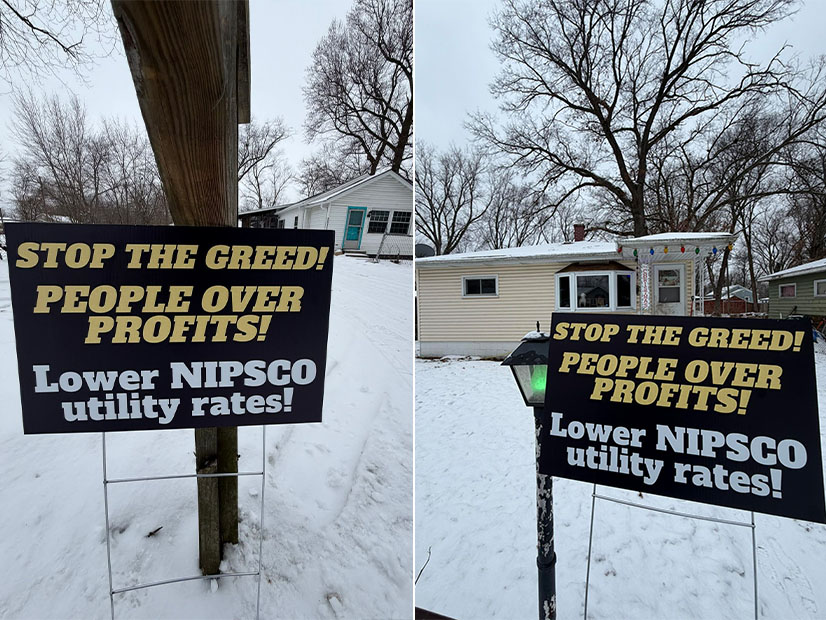
In multiple Facebook groups, Indiana residents say their gas and electricity bills have skyrocketed — sometimes quadrupling — since the start of winter.
They share bills detailing more than $1,000 in gas and electric expenses, often with hundreds of dollars’ worth of gas delivery charges. They discuss using woodstoves to heat homes, grilling out in the cold, switching to propane and closing vents in little-used rooms.
Small businesses, churches and cat rescue shelters issue fundraising pleas to defray utility costs. Those comments are interspersed with allegations of price gouging, class action lawsuits and appealing directly to President Donald Trump for relief.
But a consumer advocacy group says the affordability crisis dogging Northern Indiana Public Service Co.’s ratepayers is the product of an indulgent state legislature.
Kerwin Olson, executive director of Indiana consumer and environmental advocacy organization Citizens Action Coalition, said the affordability crisis was built on state law that has been too accommodating to utilities for more than a decade. Indiana law is “incredibly pro-utility” and “forces customers to pay for anything and everything,” he said.
“We’ve for a long time been pointing to incredibly favorable legislation that all but mandates the Indiana Utility Regulatory Commission approve these increases,” Olson said in an interview with RTO Insider.
Olson said that even before a July 2025 rate increase for NIPSCO, customers had already been subjected to the largest increases in 20 years.
Indiana’s unaffordability journey can be traced to Indiana Senate Bill 25, enacted in 2011, that granted utilities incentives for already made investments or those they were required to make, shifting all costs of federal mandates to ratepayers — all without a least-cost energy rule, Olson said.
SB 251 was followed by 2013’s Senate Bill 560, which created a tracker that allows recovery of “billons and billions” in infrastructure projects through automatic rate hikes outside of rate cases, he said.
By 2019, the legislature had enacted House Bill 1470, which again involved a tracker to make it easier for Indiana utilities to recover up to 80% of the costs of transmission, distribution and storage system improvements.
“What we’ve seen with Indiana utilities, especially with NIPSCO, is significant, significant capital investment,” Olson said.
State law, including two bills from the House of Representatives in 2023 and 2025, has also rendered the IURC “all but a rubber stamp,” allowing NIPSCO to recover “extraordinary amounts of capital investments” in gas pipelines, transmission and distribution, and clean energy projects after it committed in 2018 to phasing out coal generation.
Olson said that’s on top of ratepayers still covering the costs of older generating assets.
“The challenge is folks are still paying for the old while they’re paying for the new,” he said, adding the Indiana statehouse has never addressed how to deal with stranded costs through securitization or other “creative” means.
Statehouse Scrambles on New Bill
Facing pressure, the House drafted and passed House Bill 1002 in January. The bill would introduce a performance-based ratemaking structure among Indiana utilities, linking their annual revenue and profit to their ability to meet the needs of residential consumers.
Under the plan, utilities would be placed on multiyear plans for rate increases that include “incentives and disincentives in target areas such as service restoration, reliability and affordability.” The bill would also extend grace periods on service cutoffs in the hottest and coldest months and offer levelized billing options to customers.
The bill is before the Indiana Senate for consideration.
Olson said HB 1002 “is sort of a tacit agreement” that the spend-and-receive model isn’t working in Indiana. He said it’s the first indication that Indiana lawmakers could shift to performance-based increases and more predictable bills, and away from trackers that have “pancaked cost upon cost upon cost.”
“We can certainly be doing more than HB 1002,” Olson said. “But for once, we have a bill that is pro-consumer. I’m encouraged with how the conversation is going. I can tell you the statehouse is hearing these folks loud and clear.”
Olson warned that progress would be slow and take time to reach the IURC. Nevertheless, he predicted a paradigm shift in the state to move “away from simply rewarding utilities for spending money.”
In the meantime, Olson sympathizes with residents receiving bills that rival or eclipse mortgage payments.
“It is absolutely outrageous. We saw this coming; we were warning this day was right around the corner. We have been sounding the alarm, not only about the legislature, but also the NIPSCO rate case and in general over the years,” he said. “That’s a shame because people are hurting.”
Olson also said for NIPSCO’s service territory, cost spikes caused by data centers haven’t entered the equation.
“Data centers are not the No. 1 reason right now. They will be,” he said. But Olson said the current situation in NIPSCO isn’t induced by data center plans, though they are “absolutely driving up bills.”
In response to the affordability crisis and RTO Insider’s request for comment, NIPSCO has repeatedly advertised its budget billing plan, which spreads the cost of average usage over 12 months. It is meant to provide a consistent monthly statement, except in May, when the utility conducts reviews to adjust for over- or underpayments.
Ahead of winter, NIPSCO warned that heating bills would be 16% higher in the 2025/26 season than in the previous year.
And rates are not done increasing. In March, NIPSCO is slated to roll out the second phase of a two-part hike allowed by the IURC in June 2025. The commission allowed a total 16.75% increase in electric bills to support NIPSCO’s infrastructure projects.
NIPSCO said the rate mark-up will fund more than $2 billion in capital investments to transition its generation to a more “balanced” portfolio and $769.5 million for critical infrastructure upgrades, including replacing aging poles and lines, constructing new substations, and modernizing grid facilities to improve reliability.
Beyond that, the IURC allowed gas rate hikes in 2022, 2023 and 2024 and an electric rate increase in 2023. Before the 2025 rate increases, NIPSCO’s residential customers paid the highest electric bills in Indiana.
The IURC in November 2025 opened an investigation into possible billing discrepancies with customers’ natural gas meters. However, that investigation focuses solely on errors with gas meter readings, not NIPSCO’s exponentially growing gas delivery charges or other billing aspects.
IURC: ‘We Recognize the Burden’
The IURC declined to comment on its ongoing investigation. External Affairs Specialist Ben Gavelek also declined to comment on “any potential commission actions or future investigations.”
The commission is encouraging any customer who has concerns about the accuracy of their bill to call its Consumer Affairs Division, Gavelek said.
The IURC is “an advocate of neither the public nor the utilities” and is “required by statute to make decisions in the public interest to ensure the utilities provide safe and reliable service at just and reasonable rates,” he said.
“With that stated, the commission understands that these are challenging and unprecedented times for many Hoosiers, and we recognize the burden that higher utility bills can have on customers. Keeping this in mind, our role continues to be the careful examination of the evidence in each specific proceeding to ensure utilities are making prudent decisions as they meet their obligation to provide safe and reliable service,” Gavelek said.
However, he added that the Indiana General Assembly determines policy directives and sets the considerations that the commission must follow and weigh in each case. Gavelek said that includes Indiana’s “Five Pillars” statute, which obligates the commission to consider “reliability, resiliency, stability, environmental sustainability and affordability” in ratemaking.
Rep. Ed Soliday (R), chair of the legislature’s Utilities, Energy and Telecommunications Committee, did not comment on RTO Insider’s question on whether past legislation may have had unintended consequences on ratepayers and whether he thinks HB 1002 goes far enough to rectify the issue.
Instead, Soliday and other area Republican representatives’ press office shared a press release from Rep. Alaina Shonkwiler (R), who authored HB 1002.
“Our utility framework has served communities well for many decades, but as technology, policies and generation types advance, we must update our regulatory process to continue to meet ratepayers’ needs,” Shonkwiler said in the late January release. “This legislation moves us to a performance-based system that holds utilities accountable for the outcomes we want — strong reliability, improved resilience and better affordability.”
NIPSCO: Rates Approved by IURC
Acknowledging the outcry, NIPSCO has said higher bills are the result of cold weather, gas prices and infrastructure costs. In January, CEO Vince Parisi told local news stations that unusually low winter temperatures were the driving force behind the bill increases.
“We understand that some customers are seeing higher‑than‑normal winter bills, and we want them to know we hear them. We know this is frustrating, and our priority is to support customers, answer questions and help them stay connected,” NIPSCO said in a statement to RTO Insider.
NIPSCO said its gas delivery charges “support the operation, maintenance and safety of the entire natural gas system, including transmission and distribution mains, service lines, regulator stations and emergency response.” The utility said they increase when more gas is used and pointed out that the charges are approved by the IURC.
The utility did not answer RTO Insider’s question as to whether it is rolling new investments into bills that previously were not recovered.
The utility has not made a post on its Facebook page since Dec. 28, 2025. Before then, the utility often issued inclement weather advisements through posts; the page stayed silent during a late January winter storm. Recent posts have attracted angry comments from customers.
NIPSCO also said rising data center load is not impacting bills.
“Any data center development in our service territory will be served under the NIPSCO Generation LLC structure, a model built specifically to ensure that large, energy-intensive customers do not shift costs onto residents or local businesses,” NIPSCO said.
When NIPSCO decides to evaluate small modular reactors, some of those costs could also get tacked on to ratepayer bills. Senate Bill 424 allows utilities to pass along some of the pre-construction costs to their customers — even if the nuclear generation is never finished.
NIPSCO said it’s internally evaluating SMRs for its integrated resource planning but so far has not had customers pay for development or other associated costs.