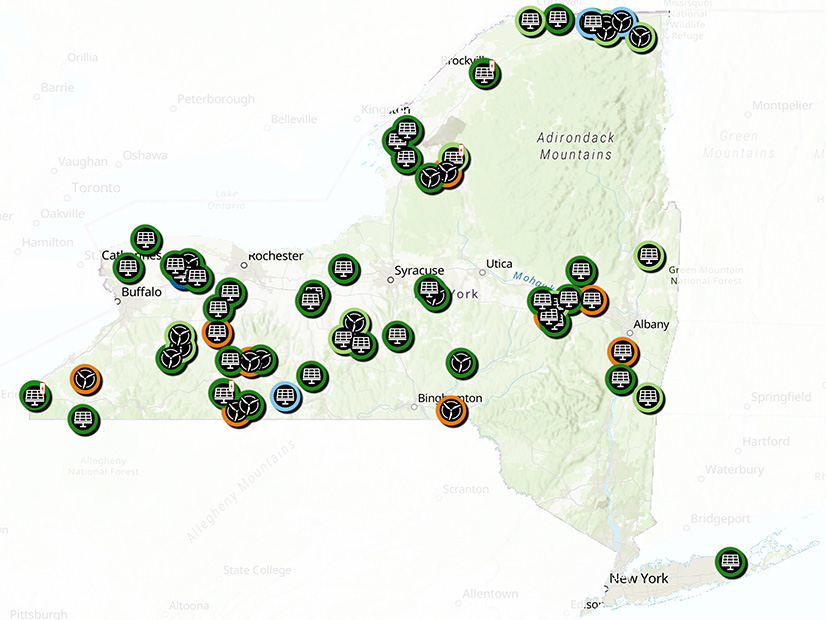
New York has finalized regulations intended to reduce the timeline and cost of modernizing the state’s grid.
The Public Service Commission on Feb. 12 approved rules (Case 24-M-0433) drafted in response to the state’s 2024 Renewable Action Project Interconnection and Deployment (RAPID) Act.
It is a continuation of earlier efforts to make New York an easier place to develop the infrastructure that is central to state leaders’ vision of an electrified and decarbonized state.
By state officials’ own admission, New York has been a slow and expensive place to carry out the politically fraught business of clean energy and transmission development.
Because of this, along with the national and global factors weighing on energy development, the state is well behind schedule meeting the statutory goals of its landmark 2019 climate law, the Climate Leadership and Community Protection Act (CLCPA).
The first big milestone of the CLCPA is 70% renewable energy by 2030. As of 2024, the state was at 23.6%, and renewables development only got harder in 2025. (See N.Y. Reports Minimal Increase in Renewable Power.)
An early step to address this was the creation in 2020 of the Office of Renewable Energy Siting (ORES), designed to consolidate the many state regulatory layers facing large-scale renewable proposals and, if needed, to override local regulatory authority.
The RAPID Act expanded ORES by giving it similar authority over transmission projects and renaming it the Office of Renewable Energy Siting and Electric Transmission. (See NY Energy Summit: Making the RAPID Act Live up to its Name.)
It remains known as ORES, commonly spoken as OH-rezz, rather than ORESET, which could be pronounced as oh-RE-set, which might convey the wrong message.
Voices on all sides of the renewable energy landscape have said ORES has been successful but not perfect in its efforts, and some have wished it could do more or less, depending on their feelings about renewables and community self-governance.
The RAPID Act lets ORES do more.
The PSC said the regulations it approved Feb. 12 will reduce permitting time for transmission projects by up to 50%.
“These regulations will be essential to the state’s need to integrate new, clean generation and replace our existing aging infrastructure to meet rising electric demand,” PSC Chair Rory Christian said in a news release.
The PSC order and the news release announcing it do not summarize or draw highlights from the new Article VIII of state Public Service Law, which fills 483 pages.
Instead, the news release emphasizes the state’s continued commitment to environmental protection and stakeholder engagement. Discussion at the Feb. 12 PSC meeting followed the same theme before the PSC voted unanimously to approve the rules.
Over the past 22 months, Department of Public Service staff drafted the regulations, held 20 in-person and two virtual public comment sessions on them, twice extended the deadline for written comments until more than 2,000 had been submitted, revised the rules based on that input, took more than 400 comments on the revised version and further tweaked the language before presenting it for the Feb. 12 vote.
There is a hint of irony in naming something “rapid” and then putting it through such a lengthy process.
But things can move slowly as competing priorities are balanced, and “rapid” can be relative or subjective. ORES is an example: It legitimately can be called faster or more streamlined than what it replaced, but “fast” is in the eye of the beholder.
Before the vote, Christian fired off a series of questions at ORES Executive Director Zeryai Hagos intended to counter the many criticisms of ORES leveled by home rule proponents and renewable energy opponents.
Christian knew the answers, certainly, but wanted them stated for the record.
Does ORES take land by eminent domain? How does it use application fees? Does it allow development over landowners’ wishes? Is it a rubber stamp for renewable energy projects?
Hagos shot down each one.
“I would strongly disagree with the term ‘rubber stamp,’” Hagos said. “We frequently hear the exact opposite sentiment from applicants and investors who are engaging in this type of development from around the country. The truth is that ORES has developed an extremely comprehensive application review process that holds developers accountable, successfully limiting environmental and community impacts.”
ORES has rejected only one application, and that was because the project had lost property rights, not because the proposal was flawed or neighbors opposed it. Of the other 38 applications submitted, 29 have been approved, eight are under review and one has been withdrawn.
So on its surface, the record is skewed heavily in favor of renewables. But the record says nothing of the process behind the numbers.
Hagos said ORES has issued 51 notices of incomplete application so far: “We say ‘no’ and we say ‘redo this’ frequently to applicants. … To date, each application submitted to the office has been turned away at least once through a notice of incomplete application.”
Further, many plans never get past the pre-application stage and are not reflected in ORES’ 29-1-1 record.
“The clear publication of uniform standards and conditions in the regulations directly allows the developers to eliminate bad projects before they ever come in,” Hagos said. “Pre-application can take upwards of two years for a motivated applicant. We think it can get down to a year if they do everything in parallel, as quickly as possible.”
After questioning Hagos, Christian alluded to the difference between faster and fast: “One thing I want to make clear — ‘expedite’ doesn’t mean doing less. And you’ve made it very clear that the new regulations actually will require additional work in most instances.”