Solar and wind resources could generate up to 85% of California’s electricity by 2045, according to a report being drafted by the state’s Energy Commission.
CEC staff presented the findings at a Feb. 19 workshop on SB 100, the law requiring that renewable and zero-carbon resources supply 100% of retail sales and electricity procured in California by 2045.
The findings are part of a joint agency draft report on SB 100 that has not been published. The commission expects to publish the report in April, Senior Information Officer Stacey Shepard told NetZero Insider.
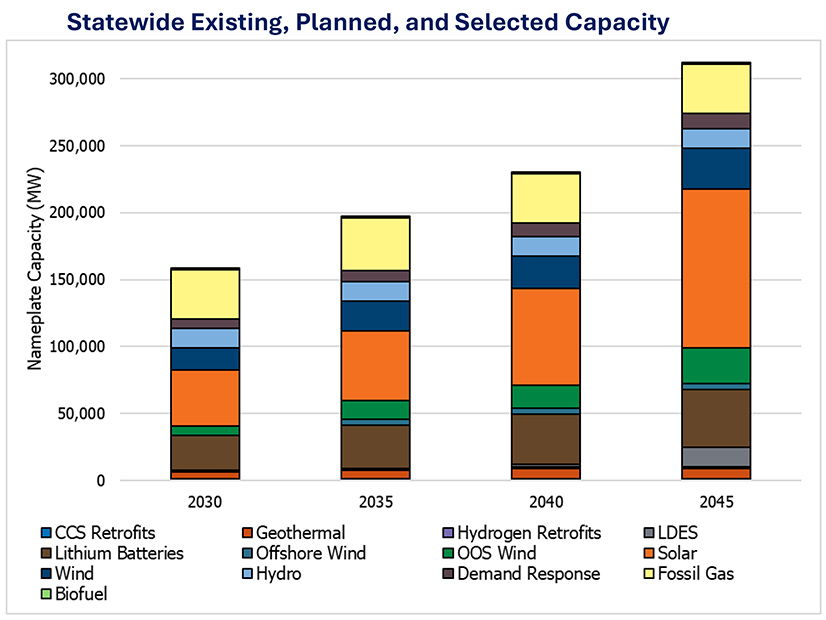
At the workshop, CEC staff presented a reference scenario in which the total system capacity increases from 150 GW in 2025 to 310 GW in 2045, with most of the new resources coming from solar (97 GW), energy storage (45 GW) and wind (24 GW in-state, 27 GW out of state).
“However, all scenarios do have a need for some other sort of resources in addition to solar and storage,” Hannah Craig, lead modeler for the CEC, said at the workshop. “Some scenarios are building carbon capture and storage, and some scenarios are building geothermal, and a lot of scenarios are building in-state wind.”
Natural gas could provide as little as 3% of the state’s energy, according to the presentation.
The federal One Big Beautiful Bill Act increased the cost of the modeled resources by 20 to 30%, Craig said. Staff observed that the model selected more clean, firm resources, such as geothermal and carbon capture and storage, moving “a little bit away from wind and solar [because] those resources are no longer receiving” subsidies under the Inflation Reduction Act, Craig said.
Solar curtailment would no longer be limited to spring in California, according to the model. Instead, curtailment increases throughout the year because of the widespread deployment of solar resources, along with changing import patterns, Craig said. “So out-of-state imports are dropping in the spring and summer, but they’re rising in winter, and the model really does depend a lot on those imports being able to show up in winter.”
California also becomes a net electricity exporter in the model, Craig added.
One potential hole in the model is that it does not currently include forecasted data center loads, and data center growth is one of the biggest uncertainties for California’s grid, CEC Vice Chair Siva Gunda said at the workshop.
Data center load in the state could reach 25 GW by 2045 under some scenarios, Gunda said. However, the demand scenarios used for the SB 100 report use the 2023 integrated energy policy report demand forecast, which doesn’t include this level of new data center load, CEC staff said.
CPUC President Alice Reynolds asked if the upcoming expansion of Western markets would affect the model’s resource mix.
“The more that we can integrate California with the West, the more that we can tap into synergies,” Craig replied. “It’s just a little bit easier for the model because there’s different renewable profiles happening all across the West. There is a lot of value in being able to ship that power and meet some of your winter needs with out-of-state wind.”