Thirteen blue states are suing the Trump administration for reversing Biden administration funding commitments worth $7.6 billion for energy and infrastructure projects.
California Attorney General Rob Bonta filed the complaint (26-cv-01417) Feb. 18 in U.S. District Court in the Northern District of California. He was joined by the attorneys general of a dozen other states as plaintiffs.
They name the U.S. Department of Energy, the U.S Office of Management and Budget, DOE Secretary Chris Wright and OMB Director Russell Vought as defendants.
The plaintiffs ask the court to declare the funding cuts unconstitutional on the grounds the president cannot reverse funding appropriated by Congress or target opponents. They seek reversal of the grant terminations and abandonments, and they want an injunction against similar cuts in the future.
The grant terminations were announced Oct. 2 as President Donald Trump and his Republican allies in Congress were locked in a budget standoff with Democrats. (See DOE Terminates $7.56B in Energy Grants for Projects in Blue States.)
Some of the cuts would spill over into Republican-led states or congressional districts, but all were centered in 16 “blue” states won by then-Vice President Kamala Harris in her losing run against President Donald Trump in 2024.
The 32 U.S. senators representing those 16 states all were Democrats and all voted against a bill that would have averted the autumn 2025 federal government shutdown.
At the time, DOE framed the cuts as part of a process by the new Trump administration to winnow out wasteful spending. But as it defended a subsequent legal challenge led by the city of St. Paul, Minn., against a handful of the grant terminations, the Trump administration acknowledged that the October grant cancellations were based primarily on their locations in blue states, and asserted that was legitimate justification. Further, the administration acknowledged that the grants terminated in blue states were comparable to red-state grants it did not terminate.
The judge in the St. Paul case (25-cv-03899) ruled Jan. 12 that this approach had violated the plaintiffs’ guarantee to equal protection of laws under the Fifth Amendment to the U.S. Constitution. (See Judge Rules Blue-state Energy Grant Terminations Unlawful.)
But that ruling pertains only to seven grants at the center of that case.
RTO Insider asked DOE at the time whether it considered the ruling applicable to the other 300-plus grants it terminated in October 2025.
DOE did not answer the question, but its Feb. 13 filing in the St. Paul case sheds some light: It told the judge the plaintiffs’ request for a permanent injunction was unwarranted but if any injunctive relief were granted it should pertain only to the seven grants in question.
California filed its lawsuit three business days later.
It is joined by the attorneys general of Colorado, Connecticut, Illinois, Maryland, Massachusetts, New Jersey, New York, Oregon, Rhode Island, Vermont, Washington and Wisconsin.
The California Governor’s Office of Business and Economic Development (GO-Biz) also is a plaintiff, on behalf of ARCHES H2 LLC.
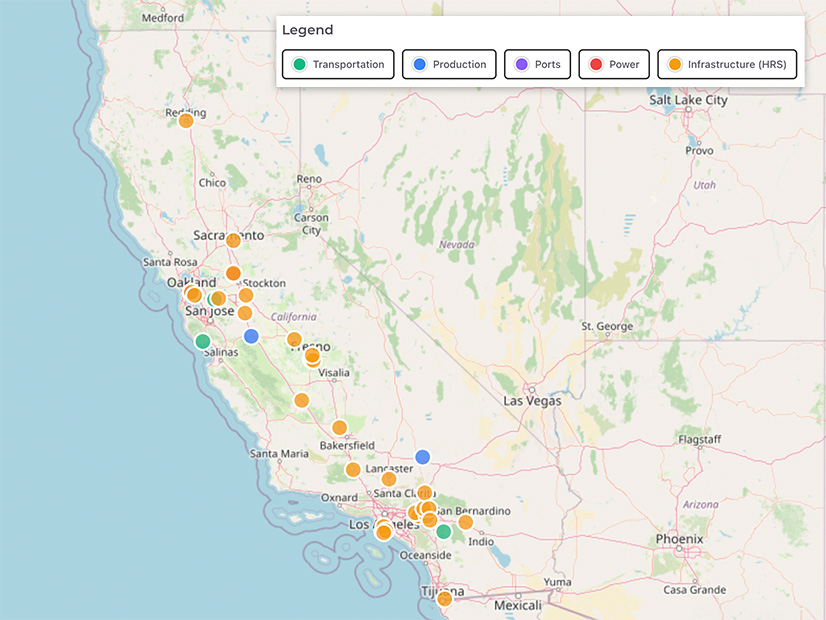
ARCHES — Alliance for Renewable Clean Hydrogen Energy Systems — is one of seven regional hydrogen hubs created amid a Biden-era push to develop hydrogen as an energy sector; it was focused on building a green hydrogen ecosystem in California.
ARCHES H2 LLC was the biggest loser in the October 2025 tranche of DOE grant terminations, at $1.2 billion.
ARCHES CEO Angelina Galiteva decried the termination when it went public Oct. 1, but said the initiative would continue to advance in collaboration with state leaders and the private sector. However, a month later, ARCHES said it would pause hydrogen hub activities due to the federal funding cuts and hand administrative oversight to GO-Biz and the University of California.
It has laid off its entire full-time staff, according to California’s lawsuit.
GO-Biz demanded on Jan. 15 that ARCHES file a lawsuit seeking to remedy harms from the grant termination; the ARCHES board of directors replied that pursuing litigation would be in its best interest but it lacked the financial resources to do so because of the DOE grant termination.
All told, the October grant terminations totaled nearly $2 billion in California.
California’s Feb. 18 lawsuit lists much smaller sums for the 12 other states affected by the DOE grant terminations.
Trump and Calif. Gov. Gavin Newsom (D) snipe at each other often and hard, and the lawsuit hints at that relationship.
“In early October, as the administration sought a cudgel to wield in budget negotiations, defendants deployed this unlawful policy as an opportunistic way to hurt the administration’s political enemies and those associated with them,” the introduction to the complaint reads.
The specific complaints in the California lawsuit are similar to those in the St. Paul case: violation of the separation of powers between Congress and the president, violations of the Administrative Procedures Act, ultra vires action by federal officials, violation of the First Amendment by retaliating against free speech and violation of the Fifth Amendment right to equal protection.
The plaintiffs ask that the DOE memo on which the grant terminations were based be declared unlawful; seek a permanent ban on any future action based on the memo; and ask for reversal of the grant terminations.
They also want a declaratory judgment that the defendants may not terminate or abandon awards based on policy preferences or geographical location.
And they ask for an injunction reinstating the cooperative agreement DOE terminated with ARCHES as it terminated the hub’s grant.