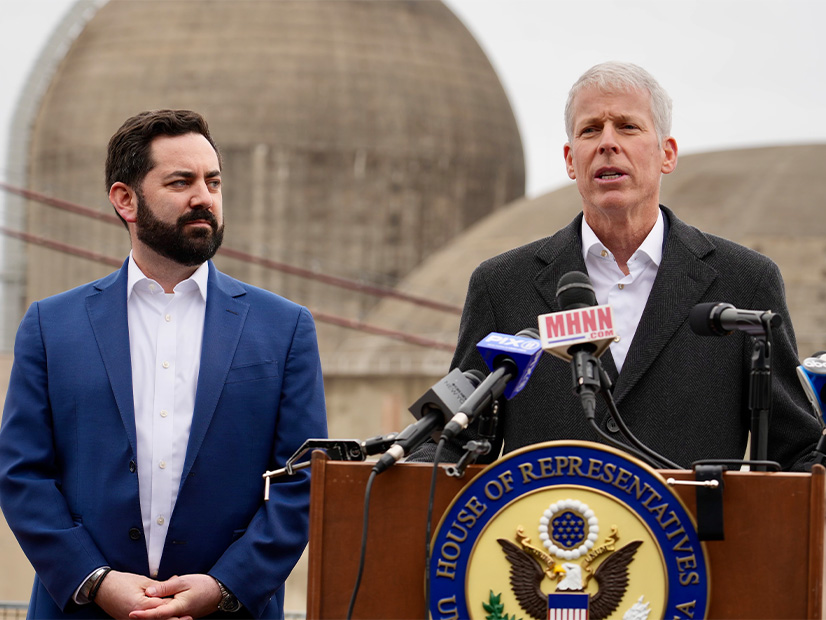
U.S. Energy Secretary Chris Wright and the congressman whose district includes the shuttered Indian Point nuclear plant are calling for the restart of the facility.
But no specifics are being offered, and the site’s owner indicates significant financial and political support must be established before such a move could be considered.
The shutdown of the southern New York facility in 2020-2021 removed 2 GW of high-capacity factor generation from the grid in a region where reliability concerns have since come to fore. It followed a lengthy effort by many activists and state officials worried about the aging plant’s safety and its proximity to New York City.
The owner of the Indian Point Energy Center (IPEC) has said it could consider a proposal to restart two of the reactors. But it has made no public move toward any such attempt, and New York’s governor has not supported the concept.
Wright joined U.S. Rep. Mike Lawler (R) in Buchanan on March 6 to call for a rebuild and restart. Their comments focused on the reasons why Indian Point should be reopened, rather than what it might take to accomplish such a feat — five years, $10 billion and likely vast amounts of political cajoling or arm-twisting.
“Across the Northeast, including in New York, Americans are paying some of the highest electricity prices in the country because political leaders blocked critical infrastructure and prematurely shut down power plants that deliver affordable, abundant power,” Wright said in a news release.
“I’m calling for the rebuilding and reopening of Indian Point Energy Center and for an all-of-the-above energy strategy,” said Lawler, whose 17th Congressional District may become one of the keys to control of the House of Representatives. “That means supporting nuclear energy, approving critical infrastructure like natural gas pipelines and ensuring communities like Buchanan are not left behind after decades of helping power our state.”
A contingent of opponents was on hand outside the plant during the news conference to argue that, no, it should not be restarted.
Entergy agreed in 2017 to shut down Indian Point in 2021 after a long tussle with activists and state officials. It sold the site to Holtec International, which commenced decommissioning.
Holtec caused a stir in September 2025 when it told POLITICO it was getting numerous inquiries about a restart, and said such an effort could cost $10 billion.
But terms of the closure agreement require that village, town, school, county and state leaders unanimously consent to any attempt at a restart.
Gov. Kathy Hochul (D) has indicated previously she opposes a restart.
Westchester County Executive Ken Jenkins (D) doubled down on that after the March 6 news conference:
“Absolutely not. Let me be clear — because apparently I was not clear enough for Congressman Lawler and the Trump administration: Restarting the Indian Point nuclear power plant is not welcome in Westchester County … Our communities fought long and hard to close this facility, and we are not going to reopen that debate now and not ever.”
In a statement released after the news conference, Holtec suggested someone else would have to front the money and build political support before it would consider a restart: “While it remains possible to re-power IPEC, we understand that the joint proposal requires the political will of a number of local political bodies; should the political will and financial means be available that the state wants to see a repower, we would be willing to work towards that goal; otherwise, we will continue on our path to safely decommission IPEC.”
Holtec is on the brink of pulling off the first-ever restart of a retired nuclear plant — the 800-MW Palisades plant in Michigan, another former Entergy asset that is even older than the two Indian Point reactors in question. Palisades had been targeted to resume operations in late 2025, but the project has run into delays.
Complicated Contemplation
IPEC sits on riverfront land once occupied by an amusement park that catered to daytrippers arriving by tour boat from New York City. Unit 1 was commissioned in 1962, Unit 2 in 1974 and Unit 3 in 1976.
With its proximity to a deep-blue metropolitan area of 20 million people — Times Square, the “Crossroads of the World,” is only 35 miles away — Indian Point was a particularly ripe target for anti-nuclear activists. One of Wright’s future Cabinet colleagues, Robert F. Kennedy Jr., helped whip up emotion in a 2004 documentary about security concerns in a post-9/11 landscape.
The state and activists mounted a long battle against the facility. Entergy — which had purchased the facility from Con Edison and the New York Power Authority — capitulated in 2017 but framed the closure agreement as an economic decision.
Indian Point, it said, was unable to compete with electricity generated with the cheap natural gas being fracked out of shale formations.
Unit 2 shut down in 2020 and Unit 3 in 2021. Unit 1, a 1950s design, had been retired in 1974.
Five years later, any discussion of a restart is complicated by politics and economics:
-
- Lawler is seeking re-election in a battleground district that could help determine control of the House of Representatives; Democrats outnumber Republicans 7-5 among voters registered in the four counties in the district as of Feb. 20, though not every part of each county is included in the district.
- Lawler boasts of being one of the most bipartisan members of Congress; he joined nuclear opponents to fight Holtec’s release of slightly radioactive water into the Hudson River and has bucked President Donald Trump by supporting offshore wind power development.
- Electricity is expensive in New York and in short supply downstate, but attempts to add generation capacity are expensive and progressing slowly. (See NYISO’s 2026 to be Dominated by Reliability Concerns.)
- New York’s four remaining commercial reactors, all operated by Constellation Energy, have a combined age of more than 200 years but remain a critical part of the power portfolio, providing 21% of the electricity generated in the state and running at a capacity factor above 90%.
- New York in January extended a ratepayer-funded subsidy mechanism for those four reactors that has been running in the range of $500 million a year and could cost as much as $33.4 billion more through 2049. (See N.Y. Extends ZEC Nuclear Subsidies to 2049.)
- New York’s efforts to develop renewable energy continue to fall short, and the four reactors provide more than 40% of the state’s carbon-free electricity. (See N.Y. Reports Minimal Increase in Renewable Power.)
- Clean energy advocates are unhappy with Hochul’s steps back from the goals of the state climate law as she attempts to balance environmental and economic concerns in an election year; some Republicans are unhappy she has not moved back further from the climate law. (See NYSERDA Lays Out High Cost of Climate Law Compliance.)
Lawler is hedging his bets on an Indian Point restart — on March 4, he introduced legislation in the House to provide economic relief to communities impacted by nuclear plant closures. He noted that the Buchana area has lost tax revenue and high-paying jobs with the closure of Indian Point.