Stakeholders Discuss SATA Proposals
PJM, Constellation and the Independent Market Monitor plan to bring competing proposals to define rules for operating battery storage as a transmission asset (SATA).
The PJM and Constellation packages would allow batteries to be brought as solutions to transmission violations, while differing on how they would be compensated. The Monitor plans to bring a proposal to explicitly prohibit storage from being defined as transmission.
The PJM proposal would define payment and cost allocation for SATA projects through the transmission enhancement credits language, with payments made through energy settlements according to injection and withdrawal. The RTO would establish when the storage can be charged or discharged and the owner would be required to maintain the state of charge and submit offer schedules. The voltage would be set by reliability studies conducted by planning staff.
Constellation underscored that SATA should be limited to being operated to resolve transmission violations and would compensate owners through cost-of-service mechanisms. The battery would be prohibited from entering the interconnection queue.
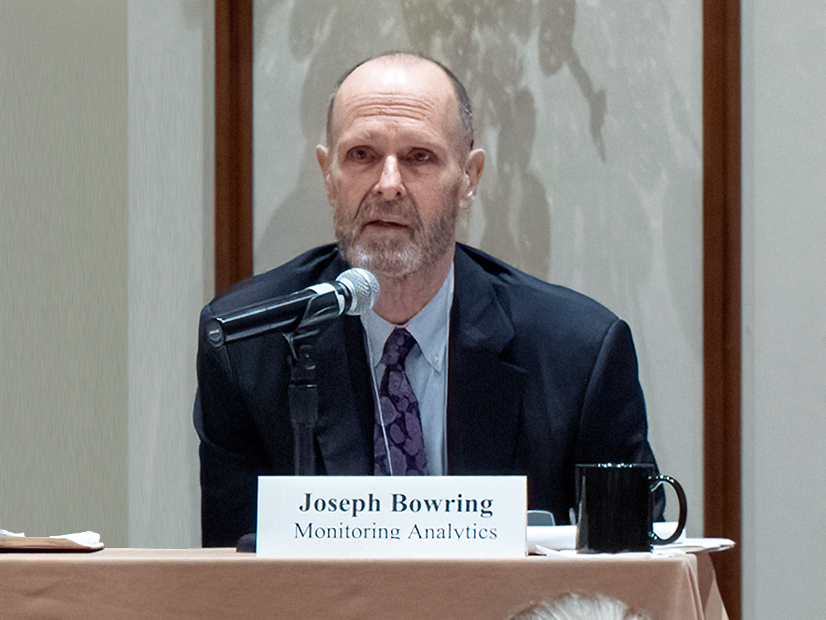
Monitor Joe Bowring said allowing SATA would be a step back toward regulated markets, arguing the logic used by SATA supporters for putting batteries in a transmission owner’s rate base also could justify rate-basing combustion turbines. He pushed back on comments that the proposals from PJM and Constellation would gate the batteries to being used as transmission, unlike other RTOs, by stating that PJM cannot be compared to regions where most of the generation are cost-of-service assets.
The Monitor had sought to bring a proposal that simply stated batteries cannot be transmission assets but was told that would not be a valid package. The Monitor will bring a proposal opposing the SATA treatment of batteries as part of a transmission owner’s rate base.
“It is a slippery slope towards reregulation which some transmission owners are already advocating for all types of generation,” he said in an email to RTO Insider. “Once batteries are in a rate base, there is nothing stopping the transmission owners from arguing they should be allowed to operate as market assets. In fact, some have already made that argument.”
Stakeholders responded that batteries could be used as a temporary transmission solution, as the units can be installed quickly and moved between sites in a way that generation cannot.
Bowring said there is nothing about the actual functionality of a battery requiring it to be a regulated transmission asset, rather than a market asset.
“SATA means putting batteries in a regulated transmission company’s rate base with a guaranteed capital recovery and rate of return. The issue is not whether a battery or a generator can contribute to resolving issues on the grid. The issue is whether PJM will continue to rely on markets. Batteries are market assets in PJM now, and more batteries are in the generation queue and scheduled to go into service soon,” Bowring said in an email. “SATA is not about how batteries are used. SATA is about who owns batteries and how they are paid.”
February Operating Report
PJM saw an average hourly forecast error rate of 1.76% and slightly lower 1.71% error rate for peak hours across February, according to PJM’s monthly operating report. Four days exceeded the RTO’s 3% peak forecast error benchmark: Warm temperatures pushed the peak load on Feb. 3 down by 3.21% and on Feb. 4 by 4.12%. Cold temperatures led to the Feb. 17 peak being 3.06% under-forecast and 3.38% below target for Feb. 20.
There were two spin events, three shared reserve events, one conservative operations alert, two cold weather alerts, 34 shortage cases and 20 post contingency local load relief warnings issued. A dozen shortage cases Feb. 9 were attributed to higher-than-expected temperatures pushing the morning peak higher than forecast, with a similar dynamic at play behind nine cases on the morning of Feb. 2 and six on the morning and evening of Feb. 6.
A spin event was initiated at 11:49 a.m. Feb. 3 and lasted 4 minutes, 24 seconds; 1,969 MW of generation was assigned, with a 32% response rate, and 292 MW of demand response (DR) assigned, 62% of which responded. The second spin event was at 2:06 a.m. Feb 23 and lasted 6 minutes, 52 seconds. It saw 2,305 MW of generation assigned, with a 61% response rate, and 452 MW of DR assigned and 32% responding.
Security Report
PJM Senior Director of Cybersecurity Jim Gluck said the Cybersecurity and Infrastructure Security Agency is recommending utilities review their infrastructure and remove devices that have software no longer being supported by the manufacturer. The request comes in the wake of a cyberattack that disrupted communications on the Polish electric system. The infiltration was possible due to vulnerabilities in software that no longer is being patched.