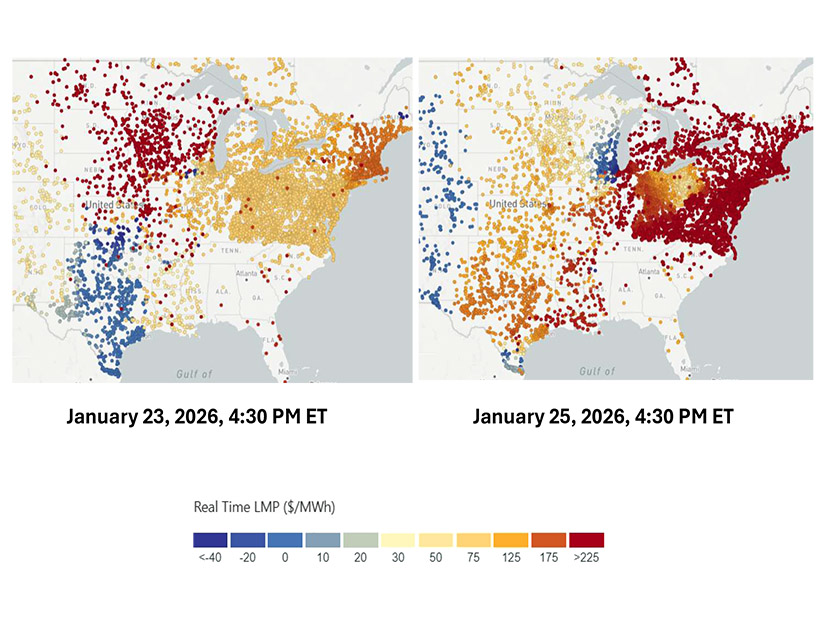
NERC CEO Jim Robb said in congressional testimony that while the bulk power system made it through the late January winter storm reliably, the weather highlighted how at risk it is.
“A system bordering on the edge during winter extreme should not be normalized,” Robb told the House Energy and Commerce Subcommittee on Energy on March 17. “A larger, colder, longer storm would have had far more consequence.”
To shore up the system, NERC has four primary recommendations, and the first is to effectively address permitting reform at the federal, state and local levels. Efforts to add new resources to the grid need to be accelerated; the industry needs to figure out how to reliably integrate large loads; and more work needs to be done to better coordinate the electric and natural gas systems, Robb said.
While the BPS did not see any major incidents, millions of consumers around the country lost power because of issues on the distribution system. American Electric Power’s Southwestern Electric Power Co. saw 200,000 of its customers lose service, utility President Brett Mattison said.
To submit a commentary on this topic, email forum@rtoinsider.com.
“Our experience during Winter Storm Fern and other recent winters reaffirm a core principle: Reliability depends on being able to call on a resource when it’s needed for as long as it’s needed, regardless of the weather,” Mattison said. “During the storm, coal supplied more than half of SWEPCO-owned generation supported by on-site fuel that ensured steady performance.”
Natural gas units provided needed flexibility, but they depend on pipeline delivery. SWEPCO also benefited from wind power, but Mattison said its intermittency means it cannot substitute for round-the-clock power.
Mattison’s testimony was in line with messaging from the Trump administration shortly after the storm arguing that the grid was saved by fossil fuels while renewables did little. (See DOE Touts Fossil Fuels’ Role in Meeting Peak Energy Demand This Winter.)
Grid Strategies Executive Vice President Michael Goggin argued the opposite, saying wind and solar exceeded expectations, while fossil-fired plants suffered a high level of outages.
“Wind and solar resources performed well during Winter Storm Fern and other recent events, while fossil generation did not,” Goggin said. “Second, in all recent cold snap events, natural gas accounted for the majority of generator outages, followed by coal. We also saw natural gas prices spike during Winter Storm Fern and these other events, costing consumers billions of dollars.”
A diverse mix of generation offers an economic hedge against spiking natural gas spot prices and helps maintain reliability as well, Goggin argued. Wind and solar made up 20 to 25% of power at peak demand in ERCOT, MISO and SPP during the peak demand hours of the storm, he said.
“Wind and solar provided over 38,000 MW, nearly twice the 21,000-MW output they are compensated to provide and are expected to provide during peak demand events,” Goggin said. They picked up the slack, as gas underperformed by 52,000 MW and coal by 7,000 MW, he added.
“Coal generators that the Department Energy has mandated remain online also performed poorly during Winter Storm Fern, consistently delivering only 29 to 42% of their capacity, according to the Department of Energy’s own numbers,” Goggin said. “In contrast, a largely complete Vineyard Wind project, which the administration has repeatedly attempted to halt by retroactively revoking its permits, operated at a 75% capacity factor.”
Robb had a different take on the plants operating under DOE’s novel interpretation of Section 202(c) of the Federal Power Act, saying they were needed “to keep the lights on.”
“There’s no question about that,” he said. “The second thing is that those facilities create the special sauce that keeps the grid operating. They create frequency; they create voltage; they create the ability to control those within very tight parameters, which is what allows the high-voltage transmission system to operate.”
For now, the grid would be inoperable without those reliability services, he said. Eventually, newer technology like grid-forming inverters could provide them, but they are not “ready for prime time,” Robb said.
Robb and Goggin agreed that more transmission could have helped, with the NERC chief saying the ERO’s Interregional Transfer Capacity Study showed more transmission would enable regions to better share reserves. (See FERC Declines to Suggest Interregional Transfer Requirements.)
That study used data from 2023, which was just before the industry started to see demand growth pick up from large loads such as data centers.
“I honestly can’t tell you how it changes, because areas … that showed deficiency probably are showing more deficiency,” Robb said. “Areas that might have been able to export may also be in deficiency now because of the load growth.”
Focusing on economics, Goggin said more transmission would have eased spiking prices as the storm blew through the Eastern Interconnection from the west.
“In Winter Storm Fern, a modest transit transmission expansion between western and eastern PJM would have saved ratepayers in the Eastern U.S. around $90 million,” Goggin said. “Customers across the Midwest, similarly, could have saved tens of millions of dollars with stronger transmission ties among those grid operating areas.”
Those benefits happen because even different parts of the same RTO experience peak demands at different times: When demand was highest in western PJM, flows from the east could have significant costs, while the reverse would be true just hours later, he added.