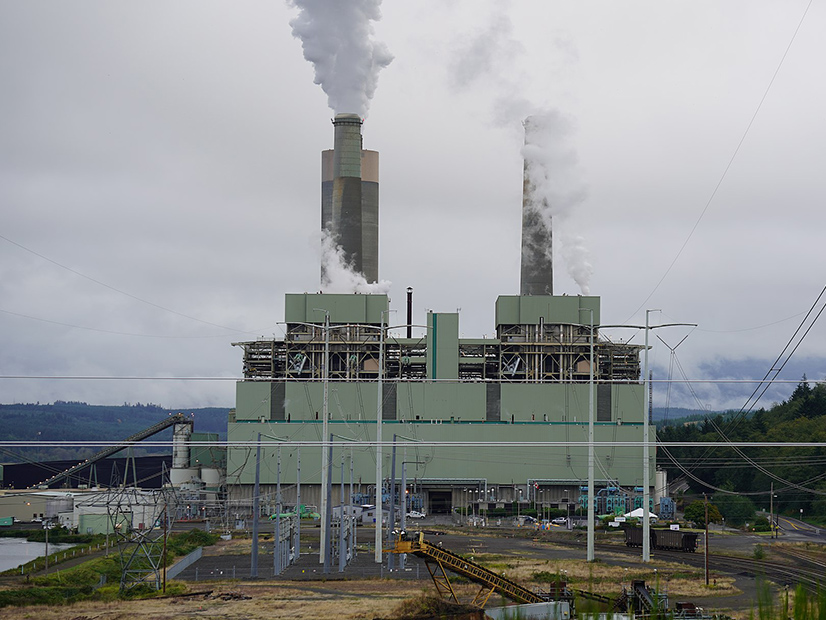
The U.S. Department of Energy has extended an order that will continue to keep Washington’s last remaining coal-fired plant open past its long-scheduled retirement at the end of 2025, setting it up for a pitched legal battle with the state and environmental groups.
Once again citing an energy “emergency” in the Northwest, DOE on March 16 directed TransAlta to keep Unit 2 at the Centralia Power Plant available for operation for another 90 days — until June 14, following on a similar order issued in December requiring the unit to stay online for the winter. (See DOE Orders Retiring Wash. Coal Plant to Stay Online for Winter.)
The unit had been slated for closure Dec. 31 based on a 2011 Washington law and subsequent agreement between TransAlta and the state.
“The reliable supply of power from the Centralia plant is essential to maintaining grid stability across the Northwest, and this order ensures that the region avoids unnecessary blackout risks and costs,” the department said in a press release announcing the order.
The action is part of a broader Trump administration strategy to use the DOE’s emergency powers under Section 202(c) of the Federal Power Act to extend the life of retiring coal plants across the U.S.
That effort has provoked criticism and lawsuits by states and environmental groups — and a procedural protest by one affected utility. (See Wash. AG, PIOs Sue to Overturn DOE Order to Keep Centralia Plant Running and Fight Heats up over Colorado’s Craig Coal Plant Extension.)
The new Centralia order recounts many of the points DOE made in justifying in the original one, including NERC’s 2025-2026 Winter Reliability Assessment, which placed WECC’s Northwest region among seven in North America that were at “elevated” risk for grid outages during “extreme weather” during the season.
But the updated order adds new justifications that suggest keeping Centralia open indefinitely, including NERC’s 2025 Long-Term Reliability Assessment, which found the Northwest was among six regions at “high risk” of energy shortfalls over the next 10 years (the order states five years). (See NERC Warns of ‘Worsening’ Resource Adequacy Through 2035.)
“The assessment notes that peak load in the region ‘is forecast to increase by 6.6 GW (19%) over the next 10 years, driven by an influx of data centers into the Pacific Northwest,’” DOE wrote in the order. “Additionally, while over 10 GW of new variable resources are in development, the assessment warns that ‘additional resources will be needed to avoid shortfalls in planning reserves and prevent energy risks from emerging.’”
DOE pointed to a U.S. District Court judge’s Feb. 25 preliminary injunction ordering the U.S. Army Corps of Engineers and Bureau of Reclamation to increase spill at dams in the Federal Columbia River Power System to improve salmon and steelhead runs. (See Judge Orders Spill at Northwest Dams to Aid Salmon, Despite Energy Concerns.)
“The restrictions imposed by the preliminary injunction will impact power and transmission system reliability, grid stability and the ability to meet reserve requirements in the WECC Northwest assessment region,” DOE wrote. “The District Court did not give adequate consideration to the impacts that the preliminary injunction measures will have on the Bonneville Power Administration’s ability to provide reliable power and transmission services.”
Roadblocks?
The Centralia order faces opposition on two fronts.
On the first front, Washington’s attorney general and public interest organizations (PIOs) in early March filed separate lawsuits in the 9th U.S. Circuit Court of Appeals seeking to overturn the order.
“Trying to force Washington to restart a defunct power plant is not only illegal but would also jeopardize public health. Washington state will not be bullied,” Washington Attorney General Nick Brown said in March 3 statement announcing his office’s suit.
Led by Earthjustice, other parties to the PIOs’ suit include Northwest Energy Coalition, Washington Conservation Action, Climate Solutions, Environmental Defense Fund and Sierra Club.
“The Department of Energy cannot twist the law to suit its preference for dirty, inefficient coal plants. TransAlta has never said it wants to keep the coal plant open, and the people of Washington don’t want unreliable energy and more pollution,” Patti Goldman, senior attorney at Earthjustice, said in a statement in response to the second order.
On the second front, Washington Gov. Bob Ferguson on March 11 signed a new law intended to make it prohibitively expensive for TransAlta to generate and sell power from the Centralia plant.
House Bill 2367 does this in three ways:
-
- Revokes Centralia’s exemption from the state’s cap-and-invest program, which will require TransAlta to purchase emissions allowances at state auctions to cover any carbon emissions from the plant.
- Subjects the plant to more stringent greenhouse gas performance standards from which it previously was exempt based on its retirement agreement.
- Removes sales and use tax exemptions for coal used to generate power at the plant, meaning that coal will be subject to Washington’s sales tax.
TransAlta did not oppose the bill as it moved through the legislature. The company did not respond to a request for comment for this article in time for publication.