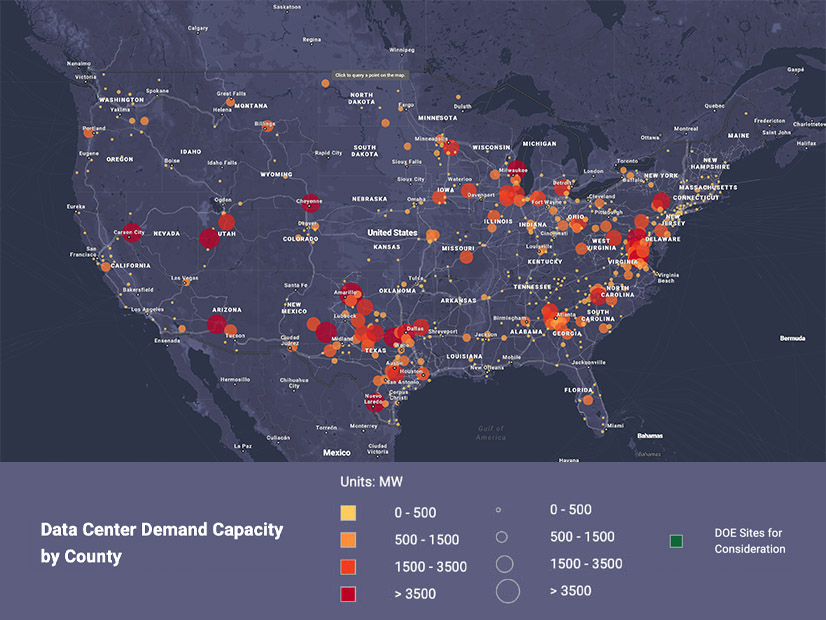
A new study quantifies some of the benefits that could come from more fully using the existing capacity of the grid before expanding the grid to meet demand growth from data centers and other large loads.
A new study quantifies some of the benefits that could come from more fully using the existing capacity of the grid before expanding it to meet demand growth from data centers and other large loads.
The Brattle Group prepared The Untapped Grid for GridLab and Utilize, an industry coalition formed to push for state-level policy changes to use the existing grid more completely to reduce interconnection delays and potentially save ratepayers more than $100 billion over the next decade. (See Utilize the Grid Better to Save $100B+, New Coalition Urges.)
The report released March 19 is based on a central characteristic of the U.S. grid and some converging factors surrounding it:
It is sized to handle peak loads, so only about half its capacity is used on average through the year. Significant new load is anticipated at a time when electricity rates already are soaring and there are concerns that expanding and modernizing the grid to serve the new load will be painfully expensive.
But some of the demand can be met with grid management or peak shifting — and the technology that would enable this has begun to mature and scale.
“We’ve heard a lot about affordability of electricity in the last year,” Utilize Executive Director Ian Magruder said during a March 18 presentation on the Brattle study. “There are a lot of solutions being proposed. But our view is that this solution of grid utilization is one of the only near-term solutions that can meaningfully reduce the cost of electricity at scale in short order.”
“The Untapped Grid” models a mid-sized utility with a 3,000-MW peak demand experiencing 1,000 MW of load growth — 500 MW of it transmission-connected (such as a data center) and 500 MW of it distribution-connected (such as electric vehicles and heat pumps).
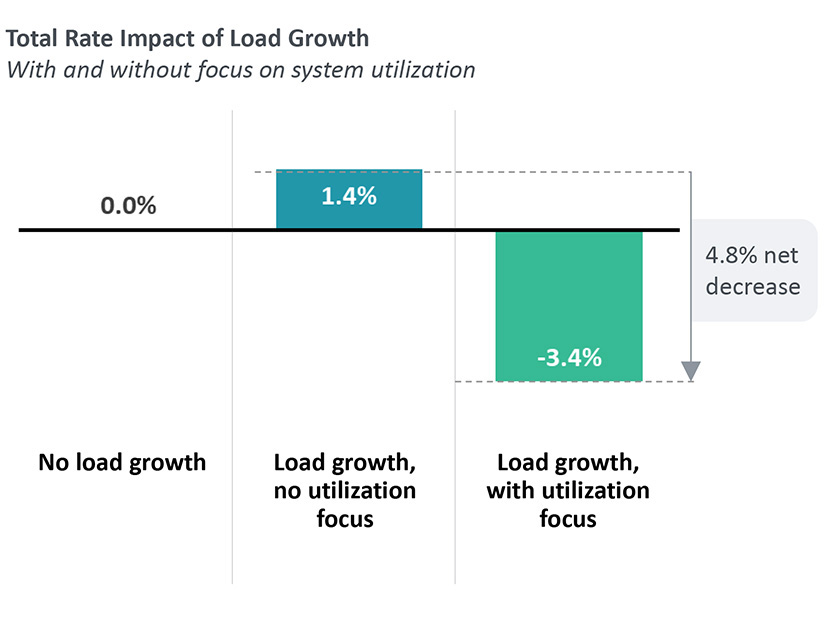
Status quo grid management would result in a calculated 1.4% all-in average rate increase. A 10% increase in annual system utilization would result in a 3.4% rate decrease.
The authors caution that not every circumstance in every utility or market is factored into the calculation, nor other cost-influencing factors, such as aging infrastructure that needs to be replaced or fuel price fluctuations.
GridLab Executive Director Ric O’Connell said some grids are better used than others, but the opportunities to do better are expanding.
“We actually can shape demand and get higher utilization of our existing grid and really use that asset — that very expensive asset — better,” he said. “And so I think that’s going to be incredibly important for affordability going forward.”
Lead author Ryan Hledik said the first step of any effort is to determine the spare capacity on the existing system.
“Studies that Brattle and others have done in the past have shown that nationally, there’s a lot of potential to do this,” he said. “We’ve estimated that with demand flexibility alone, there’s over 200 GW of untapped potential to create capacity across the power system.”
The analysis does not propose specific policies or programs to make better use of that 200-plus GW.
Aligning Incentives, Opportunity
A question was posed during the presentation: Are there factors or circumstances that stand out as obstacles?
Hledik said a fear of the unknown and the financial structure of the utility industry have been problems.
“Current regulatory models typically don’t do a great job of aligning utilities’ incentives with this opportunity. Utilities are financially incentivized to go out and make capital investments in traditional infrastructure,” he said. “They’re not incentivized to go out and pay their customers to use less.”
Hledik added: “There is sometimes a tendency, a perceived risk associated with doing something new, relying on grid flexibility or distributed energy resources to provide the same types of grid services that traditional infrastructure has provided historically. So we need to continue to demonstrate to the industry that this is a reliable option.”
But other things are working in favor of grid flexibility and demand response, particularly the proliferation of battery energy storage systems, which allow energy supply to be moved chronologically to meet demand, rather than demand being moved to match supply.
“The coincidence of batteries getting cheap and load growth coming back make this inevitable, even in the current regulatory model,” said Pier LaFarge, CEO of Sparkfund, which is part of the Utilize coalition.
“There are a lot of tools that are available to do this — batteries, air conditioning, load control, EV charging control, smart panels, time-varying rates, energy efficiency, grid-enhancing technologies,” Hledik said. “There are a lot of options that have really just emerged at scale over the last five years or so … to create the type of capacity that we need for this all to pencil out.”
Another audience question was about concerns that greater grid utilization would reduce the headroom needed during extreme weather events or other crises.
No one is proposing a reduction of reserve margins or revision or grid structures or changes to NERC standards, O’Connell said — the goal is better utilization with the new tools available.
LaFarge said the investments being advocated would create more dispatchable resources that would boost reliability metrics during peak stress periods. He added: “If anything, we’re very intentionally designing this version of grid utilization to advocate for things that directly align with that concern.”
The authors calculate that scaling the report’s model nationally could save ratepayers $110 billion to $170 billion over 10 years, with additional benefits for those who participate in incentivized peak-reduction programs.
“The Untapped Grid” is the newest of many analyses pointing out the value grid optimization and flexibility.
The American Council for an Energy-Efficient Economy offered strategies for demand-side growth management; EPRI laid out scenarios under which new large loads could reduce costs for other grid users; and an analysis modeled the benefits awaiting hypothetical large loads that agreed to partial curtailment.
Efforts to turn policy into action include EPRI’s DCFlex; strategic load siting; and large loads being used as grid assets. (See EPRI Launches DCFlex Initiative to Help Integrate Data Centers on the Grid.)
As many observers have concluded, efforts to optimize the grid through means such as flexibility have become a recurring theme. (See Why 2026 will be the Year of Flexibility.)