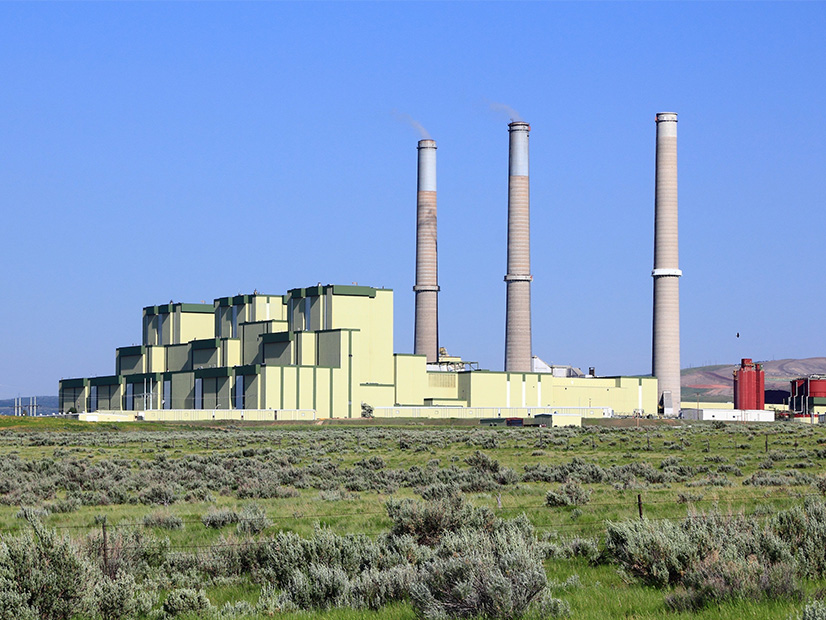
Challenges are piling up to Trump administration orders to keep retiring coal plants online, as the Colorado attorney general and environmental groups have filed petitions to overturn an extension of Craig Station Unit 1.
The petitions for review were filed March 18 in the D.C. Circuit Court of Appeals: one by Colorado Attorney General Phil Weiser and a second by Sierra Club, Environmental Defense Fund and Earthjustice on behalf of Vote Solar.
Craig Station Unit 1, in Moffat County, Colo., had been scheduled to retire on Dec. 31, 2025. On Dec. 30, the U.S. Department of Energy issued an order to keep the unit available for operation for 90 days, saying the extension was needed “to prevent blackouts.” (See DOE Blocks Retirement of Another Coal-fired Plant.)
The DOE order was issued under Section 202(c) of the Federal Power Act, saying emergency conditions existed due to increasing demand and shortages from the accelerated retirement of generating facilities.
Weiser disputed the DOE’s assertion that there was an energy emergency.
“The long-anticipated retirement of Craig Unit 1 and replacing it with cleaner and more affordable energy resources was the result of a carefully planned process that was driven by economics,” Weiser said in a statement.
Craig Unit 1 wasn’t operational at the time of the DOE order due to a failed valve. Tri-State Generation and Transmission Association, which is the operator and a co-owner of the unit, made the needed repairs. The unit was available to operate by Jan. 20. While complying with the order, Tri-State has said it’s worried about the costs to its members.
A Tri-State spokesperson said March 19 that Craig Unit 1 had not been called upon to run since the DOE order was issued.
“Tri-State continues to evaluate our options moving forward,” the spokesperson said.
On Jan. 29, Tri-State and Unit 1 co-owner Platte River Power Authority petitioned the DOE for a rehearing on the order. Weiser’s office and environmental groups filed their own petitions for rehearing. (See Fight Heats up over Colorado’s Craig Coal Plant Extension.)
The requests for rehearing were denied, opening the door for the parties to file petitions with the federal appeals court.
Ted Kelly, director and lead counsel for U.S. clean energy at the Environmental Defense Fund, called the Craig unit “extremely costly, highly polluting and unreliable.”
“Forcing this coal unit to stay online needlessly jacks up electricity bills and toxic pollution,” Kelly said in a statement.
Other Coal Plant Petitions
The DOE has issued similar orders to extend the life of retiring coal plants in Michigan, Indiana, Washington and Pennsylvania. Those orders in most cases have led to petitions for review in federal appeals courts.
Earlier in March, the Washington state attorney general and environmental groups filed separate lawsuits in the 9th U.S. Circuit Court of Appeals to overturn a DOE order requiring TransAlta to keep running the Centralia coal-fired plant past its scheduled retirement. (See Wash. AG, PIOs Sue to Overturn DOE Order to Keep Centralia Plant Running.)
In addition to its initial 90-day emergency order, the DOE on March 16 extended its emergency order for Centralia for another 90 days. (See DOE Extends Order to Keep Centralia Coal Plant Online.)
On March 16, environmental groups filed a petition at the D.C. Circuit to overturn DOE emergency orders to force two coal-fired power plants in Indiana to continue operating past their scheduled retirement dates. In December 2025, the DOE halted the planned retirement of the last coal units at the R.M. Schahfer power plant and one of the coal units at the F.B. Culley generating station. (See Groups Contest Indiana Coal Plants’ Emergency Extensions at D.C. Circuit.)
The challenge came from the Sierra Club, the Environmental Law and Policy Center, and Earthjustice, representing Citizens Action Coalition of Indiana, Just Transition Northwest Indiana and Hoosier Environmental Council.
On Dec. 19, 2025, environmental groups led by the Sierra Club and Earthjustice filed a brief at the D.C. Circuit to overturn DOE orders extending the life of the J.H. Campbell coal plant in Michigan. The order was issued in May 2025 and has been extended every three months since then.
In its first substantive brief in the case, filed March 17, the DOE defended its Campbell order, saying its use of Section 202(c) is well within its authority in response to an ongoing emergency on the grid. (See DOE Defends Use of Emergency Orders in Court Filing.)