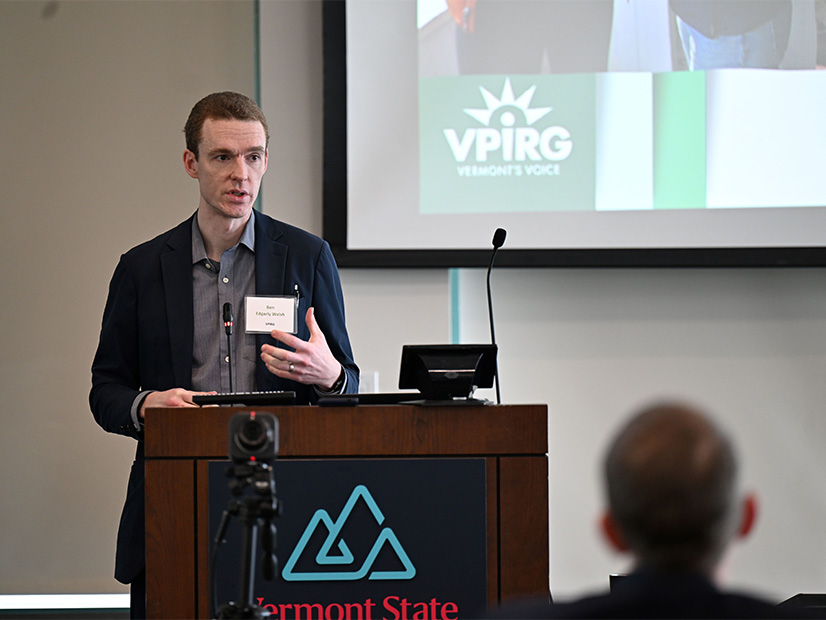
The spring quarterly meeting of the ISO-NE Consumer Liaison Group revolved around the growing risks of extreme climate-driven weather events in Vermont and New England.
As extreme weather events increase, speakers at the meeting said hardening the grid, investing in efficiency and adding distributed resources will become increasingly important.
The state experienced dramatic flooding in the summers of 2023 and 2024 that caused widespread damage, along with more limited flooding in 2025. Catastrophic flooding is not a new phenomenon in the state — a massive flood in 1927 killed 84 people, including the lieutenant governor, and flooding during Tropical Storm Irene in 2011 killed seven people and caused nearly $750 million in damage.
But scientists warn that man-made climate change is increasing the likelihood of extreme precipitation in the Northeast.
To submit a commentary on this topic, email forum@rtoinsider.com.
At the CLG meeting on March 25 in Randolph, Vt., residents and activists stressed the importance of planning to protect infrastructure from future extreme weather events and decarbonization to avoid exacerbating those events.
“Climate change disasters are coming for us in New England,” said Shawna Trader, a community organizer who was heavily involved in the response to the 2023 flood. “This is not the time to rest. … This is the time to innovate.”
Discussions about climate change no longer center around hypothetical effects on future generations, said Ben Edgerly Walsh, climate and energy program director at the Vermont Public Interest Research Group.
For Vermonters, “the climate crisis is something that they have shoveled out of their neighbor’s or their church’s basement. It’s something that’s washed away their home,” he said.
Following the 2023 flood, Efficiency Vermont was able to access leftover federal funds from the American Rescue Plan Act to pair home rebuilds with home weatherization and efficiency upgrades for low-income residents.
Dave Westman of VEIC, administrator of the Efficiency Vermont program, said home rebuilds pair well with weatherization. But continuing this approach over the long term will require lawmakers and state officials to find a new source of funding, he said.
“We know that Vermont isn’t going to be immune from future climate risks,” he said.
Edgerly Walsh highlighted a 2024 state law requiring major fossil fuel companies to compensate the state for greenhouse gas emissions to help fund climate resilience and recovery efforts.
“Vermonters deserve to have a chance to not foot the whole bill — they can’t afford to,” he said.
“As a result of these investments, we could see really significant benefits to the electric grid,” he added, noting that money collected from fossil fuel companies could help harden the grid, develop microgrids and lower storm charges on electric bills.
But the law has an uncertain future. It faces legal challenges from the Trump administration, the U.S. Chamber of Commerce and the American Petroleum Institute, which argue the state’s attempt to penalize global companies for emissions dating back to 1995 violates the U.S. Constitution.
New York has passed a similar “climate superfund” act, which the Trump administration has challenged. The outcomes of these legal battles could have major implications for climate resilience and recovery in Vermont and throughout the country.