TORONTO — Generating power flow analyses in minutes that formerly took weeks. Using high-resolution weather data to create probabilistic operational plans. Running a million Monte Carlo scenarios to compare potential grid upgrades.
All that is now possible with artificial intelligence, and it will replace most traditional utility planning and operational processes within a decade, says Josh Wong, CEO of ThinkLabs AI.
To submit a commentary on this topic, email forum@rtoinsider.com.
With aging infrastructure and increasing congestion, AI is needed to solve problems that are “orders of magnitude more complex” than what the grid faced 20 years ago, Wong told the Ontario Electricity Distributors Association’s ENERCOM 2026 conference March 23.
“For the past decade, we have been looking at just a corner, a small subset of the [grid], and trying to solve it with, I would say, brute force,” Wong said, citing transmission cluster studies that can cost $250,000 each and take six to 10 months to complete. “We always run studies independently, ad hoc, reactively and repeatedly, and it takes months, and it takes a lot of time, resources, and manpower and budget.”
When Wong was at Toronto Hydro, the utility studied each distribution feeder once every three years. In contrast, AI can continuously update its analysis of the grid the way Google Maps updates travel directions in response to changing traffic patterns.
“So now we have a real-time … copilot sitting in your control room, analyzing every feeder, every single few seconds to look at issues” and recommend fixes, Wong said. “Should you expand this line? Should you add a battery? Should you switch? Should you put a demand response or flexibility contract?”
Wong’s goal: AI running grid operations on “autopilot” with human override.
Wong said his company is working with MISO on how to introduce AI into the control room. “We are teaching AI agents to actually become training simulators to train generation operators,” he said.
The grid is so complex that the “human loop” will always be needed, Wong acknowledged. “But we are fundamentally up leveling the job of the planner [and] the operator from really mundane tasks by giving solutions.”
AI ‘Skunkworks’
Wong turned to AI after founding Opus One, which became a leading distributed energy resource management system, during the first generation of smart grid and smart metering. “I realized that the core of the smart grid, or grid intelligence, is the intelligence piece,” he explained. “It’s not the next gadget, the widget, the piece of hardware, meter, battery, etc.”
After selling Opus One to GE — now GE Vernova — Wong became restless to start something new. He began an AI skunkworks within GE, which in 2024 spun out ThinkLabs.
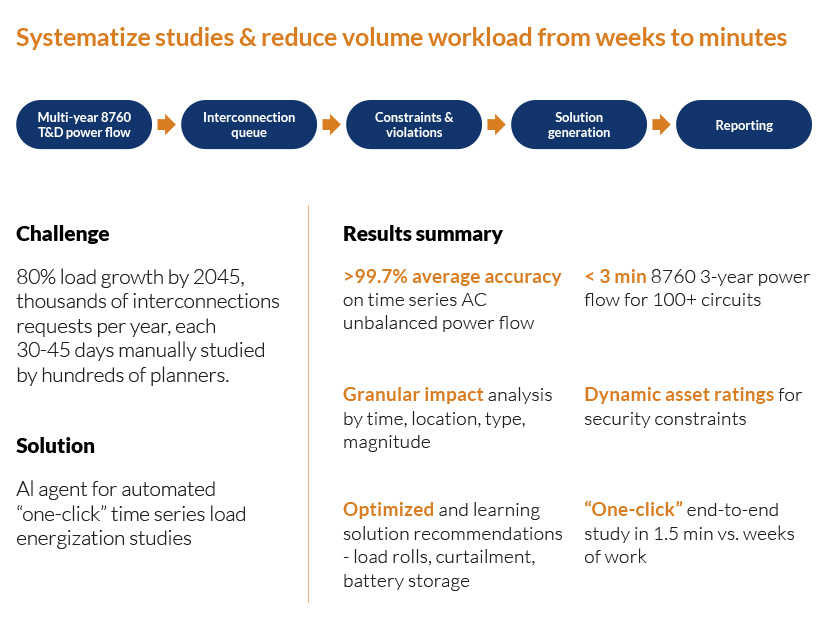
Last year, ThinkLabs teamed with Southern California Edison to build “physics-informed” AI digital twins to address SCE’s load growth, which the utility says will require it to add seven new distribution circuits each year for the next decade.
“They need to process up to 10,000 energization requests each month. Currently … each interconnection and load request takes 30 to 45 days,” he said. “How many … resources and planners do you need to make that happen?”
To help utilities maximize their existing infrastructure, Wong said, AI can enable a shift from worst-case scenario analyses to time series analyses of all 8,760 hours in a year.
Using Microsoft Azure AI Foundry, “we trained sub-transmission AI models. We trained distribution AI models. We had them co-simulate [transmission] and [distribution],” Wong said. “We added all the interconnections. We played it out based on their [interconnection] queue. We found all the thermal violations [and] voltage violations.”
It did not take 30 to 45 days. “We did it for the entire system in two-and-a-quarter minutes,” he said. “So now the joke is: Grab coffee, come back and you can connect.”
NIVIDIA Earth-2
ThinkLabs also is using Nividia’s Earth-2’s weather data to create probabilistic load and solar generation forecasts at a one-kilometer radius.
The output “doesn’t give you one future, it gives you a probability of futures,” he said. “Now, with the right horsepower and the AI models, we can finally get into probabilistic operational planning” that ensures operators are making the right decisions.
“Now, when I do that switching, when I dispatch that battery, I have confidence whether I’m actually solving the problem or not,” he said. “So, this is what high-performance compute gives you: really going from worst-case analysis and hope for the best — ‘spray and pray,’ overbuild — to really be very surgical in how we analyze the system and be very confident in our actions.”
Capital Planning, Power Restoration
ThinkLabs is feeding AI decades of log data from advanced meters and SCADA systems to allow it to help with root cause analyses.
Wong also sees AI taking a major role in capital budgets, allowing planners to run Monte Carlo simulations of alternative grid upgrades.
“I can run … a million scenarios in 10 minutes,” he said. “So can we go to a regulator and say, … ‘We have studied a million scenarios and … the data shows us that this is the most prudent investment.’”
Wong believes AI also can help utilities recover from storm-related outages by matching equipment and crews with tasks and developing key performance indicators affecting estimated time to restoration. “ETRs are a very wild guess these days,” he said.
Moore’s Law — the observation that the number of transistors on an integrated circuit will double every two years with minimal cost increase — applies to grid AI, Wong said. That means that costs will drop and AI insights will be available to small local distribution companies, not just large utilities.
“This is no longer a pipe dream,” he said. “The future is now.”