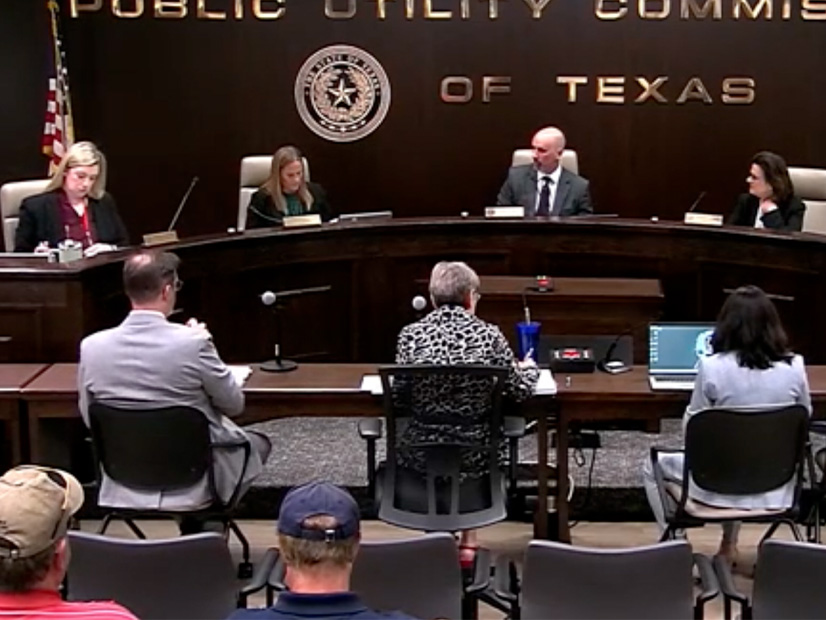
Texas regulators are launching a survey of water use by data centers and crypto miners to address concerns about whether the state is prepared for the potential demand from the large loads’ needs to cool servers and generate electricity.
The survey will be open April 2 through May 28. Public Utility Commission staff have worked with the state Water Development Board (WDB) and industry associations to develop and distribute the survey.
“The whole overall objective here for the data centers … that are either continuing to operate today or are thinking about coming to Texas, is to make sure that everybody has the water that they need,” Commissioner Kathleen Jackson said during the March 26 open meeting. “This is useful information that will help in the planning process and the future build out of additional water infrastructure.”
The Texas Legislature directed the Public Utility Commission to conduct the survey by adding a rider in the 2026/27 state budget. It instructs the commission to focus on industries whose energy demands have an “inverse relationship with their water usage.”
PUC staff will share the survey’s results with WDB and the Texas Commission on Environmental Quality for their own planning and demand purposes. Staff also must deliver a report to the legislature by the end of 2026.
State Rep. Armando Walle (D), who wrote the rider, said the survey is a “critical early step” in the state’s approach to water needs.
“We must find ways to meet the existing data gaps in our state and regional water planning process to ensure local governments — and these businesses themselves — can make informed decisions based on what resources are available, and will be available going into the future,” he said in a statement.
The Houston Advanced Research Center (HARC) said the state is home to 464 data centers and that it expected their water use to continue to rise, according to a report released in January. The center estimated that Texas uses 8 billion gallons of water each year, based on data center energy forecasts. HARC said an additional 70 sites are under development.
ESRs Separated from DRRS Development
The commission accepted staff’s recommendation to separate energy storage resources from ERCOT’s development of Dispatchable Reliability Reserve Service (DRRS) through a protocol change (NPRR1309), avoiding delays in implementing the product’s core functionality (55797).
Chair Thomas Gleeson said that while he believes ESRs should be able to access DRRS revenues, batteries’ “unique issues” would best be handled in a separate protocol change. He said ERCOT staff have told him decisions made in the second change could be rolled into DRRS’ first run.
“Because we can do it on the same timeline, it’s not going to delay DRRS, and battery inclusion in DRRS will not be delayed,” Gleeson said. “I’m comfortable with the recommendation that we separate this out.”
A 2023 law requires ERCOT to develop DRRS as an ancillary service and establish minimum requirements for the product:
-
- reducing the amount of reliability unit commitment by the amount of DRRS procured; and
- eligible resources capable of running for at least four hours and being dispatchable not more than two hours after being deployed.
NPRR1309 meets all statutory criteria and improves an earlier version by allowing online resources to participate in DRRS. The product will be awarded in real time and co-optimize (RTC) its procurement with that of energy and other ancillary services under RTC. The change has been granted urgent status and is due before the board for its June meeting.
The PUC also adopted a rule change for net-metering arrangements between a large load customer and an existing generation resource. The new rule establishes the criteria for ERCOT’s study of the arrangements and sets the procedural steps for completion within 120 days (58479).
The commission will have 60 days to deny or approve a net metering arrangement once ERCOT files its study results and recommendation to the agency.