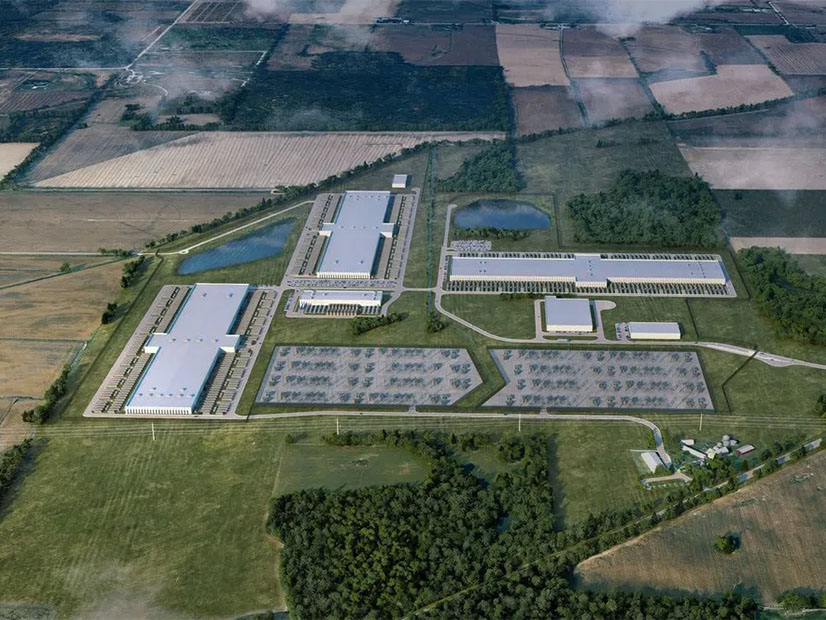
The Michigan Public Service Commission unanimously rejected requests from Attorney General Dana Nessel to reassess DTE Energy’s arrangement to provide 1.4 GW to an Oracle and OpenAI’s Stargate data center south of Ann Arbor.
Nessel, a Democrat, criticized a lack of discussion around the PSC’s March 27 vote that leaves DTE Energy’s agreement in place (U-21990). The attorney general filed a motion to reopen DTE’s application and a petition for rehearing in the docket, condemning “a secret review of the heavily redacted contracts with significant consequences for Michigan utility customers.”
The PSC also rejected Nessel’s request for a contested case proceeding to review six “heavily redacted contracts proposed by DTE for three battery storage facilities throughout the state meant to support the data center project.”
Oracle and OpenAI partnered with the newly formed Related Digital to propose a $7 billion Stargate AI data center in Saline Township in October 2025. It took the PSC less than two months to grant DTE Energy’s redacted large load supply agreement for the project.
Nessel has been challenging the accelerated approval and pushing to review the special contracts in full and verify DTE’s claims of customer affordability under the deal. (See Michigan PSC OKs DTE Energy’s 1.4 GW Data Center Contract, AG Pans Process; DTE Treads Carefully as Michigan Becomes Flashpoint in Data Center Debate.)
“The Michigan Public Service Commission continues to perform a grave disservice to the state of Michigan and the utility customers of this state, to the only apparent benefit of the utility corporations and their new billion-dollar AI customers,” Nessel said in a statement. “Since these secret contracts were first filed in October, I have requested and demanded that my office and other consumer advocates be able to review these contracts and ensure adequate protections for existing utility customers. At every opportunity, the commissioners have shut out everybody, choosing instead to keep DTE’s contract terms top secret, fast track their approval and play fast and loose with the meager terms they claim to put in place.”
Nessel added she has never observed “a process so secretive, rushed and ripe for disaster as what the commission rammed through here.” She vowed her office will continue to explore remaining options to get insight into the agreements’ ratepayer ramifications.
Nessel said the PSC failed to address her contention that DTE wrote in weaker protections for its existing customers than the commission ordered in December.
According to Nessel, the commission instructed DTE to make representations that “payments made by Green Chile Ventures LLC under Rate Schedule D11 and the special contracts will cover the costs to serve Green Chile Ventures LLC such that the costs of serving Green Chile Ventures LLC (including generation, transmission, distribution, or other costs) are not covered by other customers.”
Green Chile Ventures is a subsidiary of Oracle and serves as a development vehicle for Stargate data centers.
Nessel said DTE altered the PSC’s ordered language and wrote that “aggregate revenues generated by the customer [Green Chile Ventures LLC] will cover the costs to serve them.”
Nessel said the rewrite didn’t offer a clear enough guarantee that DTE won’t place the near-term costs of the data center on existing customers. She said DTE dodged accepting the conditions ordered by the PSC.
The AG’s office said, “DTE has only represented that by the end of the 19-year contract that it expects the aggregate payments from the data center to have eventually risen to a sum greater than the company’s own costs to serve the data center.”
In shooting down a reopening of the case, the PSC said it “finds that the reference to aggregate revenues in the acceptance letter does not change or somehow endanger the cost allocations that were placed on the approval.”
The PSC authorized a $242.4 million annual rate increase for DTE in February 2026, which took effect in early March (U-21860). DTE originally requested a $574 million increase.
Five days after the approval, DTE said it would move to raise electric rates again, with a formal filing expected sometime in April and new increases to take effect in March 2027.
Nessel has said she plans to involve herself in the case.
“It’s astonishing that our current system allows DTE to announce their next rate hike case less than one week after locking in a $242 million rate hike, all while the utility projects record profits,” Nessel said. “How many times are Michigan families expected to reach deeper into their pockets to bankroll record profits and shareholder dividends for DTE and Consumers Energy’s Wall Street investors, while reliability and affordability remain out of reach?”
The AG’s office said since 2020, state regulators have greenlit more than $1 billion in annual revenue increases for DTE, “despite continued reliability and affordability concerns.”
“DTE’s special contracts for the Saline Township data center, which the Michigan Public Service Commission approved in December, protect our customers — including ensuring that there will be no stranded assets and our customers will not subsidize data center rates,” DTE Director of Communications Jill Wilmot said in a statement to RTO Insider. “DTE Energy has an obligation to serve any customer, including data centers, that come into our electric service territory in southeast Michigan. That’s why we’ve been so focused on including these customer protections in these agreements.”