In comments filed to FERC, NERC opposes a proposal that would require the ERO and utilities to harden the grid against space radiation and electromagnetic pulse (EMP) attacks, claiming the proponents offers “no new compelling facts” to support their recommendations (EL26-49).
The proposal by the Center for Security Policy (CSP) and the Secure the Grid Coalition (STG) drew support from a range of commenters, including scientists, engineers, lawmakers and lobbying groups. In comments filed March 30, they described the risks raised by CSP and STG as “not speculative” and NERC’s relevant reliability standard TPL-007-4 (Transmission system planned performance for geomagnetic disturbance events) as “a false assurance” that is inadequate to protect the grid.
CSP and STG’s complaint, filed March 9, called for FERC to direct NERC to study electric utilities’ risk exposure to disruption by ground-induced current (GIC) from solar weather and EMPs, and for the commission to incentivize utilities to harden their systems through rate recovery.
‘Catastrophic’ Threat from GICs
The threat from GICs is “both inevitable and catastrophic,” the groups argued, citing testimony to Congress in 2019 in which Joseph McClelland, director of FERC’s Office of Energy Infrastructure Security, warned that such events “pose substantial risk to equipment and operation of the nation’s electric grid.” GIC-related damages to the U.S. power grid cause almost $7 billion in economic losses each year, they continued, referring to a study published in the journal Space Weather, and are likely to grow as the construction of data centers accelerates.
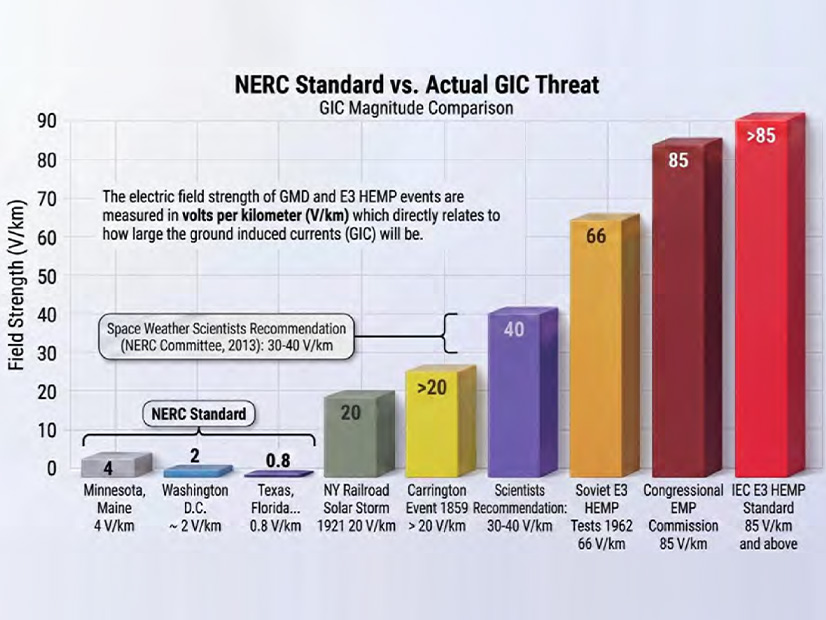
Publications from the U.S. Department of Energy and a U.S. Senate commission on EMPs, as well as the International Electrotechnical Commission’s (IEC) EMP protection standard, support hardening the electrical system to withstand GIC events with a field strength of 85 V/km, the groups observed. But, they continued, TPL-007-4 “does not protect against [GICs] … which routinely damage equipment in the” electric grid.
In fact, the model used to create the standard “purposely excluded” a 1921 solar storm that produced a strength of 20 V/km, the groups alleged, criticizing NERC’s consensus-based standards development process as designed to produce “the lowest common denominator to achieve sufficient votes by the regulated industry.”
To address the GIC threat, the groups asked that FERC direct NERC to survey all registered entities by requiring a “technical assessment of all covered equipment to determine vulnerability to GICs.” They requested the assessment require:
-
- Modeling behavior of equipment under peak magnetic field strength of 20,000 nanoteslas or peak electric field strength of 85 V/km, using waveforms in the IEC EMP standard.
- Assuming GIC exposure with transformers fully loaded.
- Modeling transformer age and condition according to standards of the American National Standards Institute and the Institute of Electrical and Electronic Engineers.
- Determining vulnerability to “half-cycle saturation, GIC-induced harmonics, reactive power consumption, hot spot generation and insulation degradation.”
They also requested that the commission “provide cost recovery for assessment and GIC protection to 85 V/km.”
NERC Claims No Basis for Complaint
NERC’s March 30 response asked that FERC deny the complaint, claiming it “fails to set forth the basis in fact and law for the positions taken and fails to demonstrate the existence of any action or inaction that is inconsistent with applicable laws.”
The ERO wrote that the groups’ objection to TPL-007-4 “appears to rest on an inaccurate understanding” of the standard, which was developed to address the risk of geomagnetic disturbances from solar storms rather than EMP attacks. NERC reminded the commission that “extensive rulemaking proceedings” and studies preceded the adoption of the original TPL-007-1 standard, and that FERC found it and all of its successors to be just, reasonable and in the public interest.
The ERO pointed out that its analysis of a GMD event that occurred in May 2024 showed the electric grid “experienced few … impacts” during the storm. This was the first major GMD event since TPL-007-1 took effect, NERC wrote, indicating that TPL-007-4 and other GMD-related standards “are operating as intended to protect the grid during severe solar storms.” NERC said the complainants’ call for a study, and their focus on the threshold of 85 V/km, was “a collateral attack on matters settled long ago.”
The ERO also asked whether STG and CSP wished to move toward a “technology mandated” approach that prescribes specific remedies, citing a section of the complaint in which the groups called GIC-blocking devices “proven and validated” and suggested requiring it on U.S. grid transformers.
NERC wrote that GIC blockers “are an important tool in mitigating potential GIC risks,” but warned that deploying them at scale requires considerable analysis and potentially increases risks to grid reliability “due to potential issues with installation and misoperation.” The ERO reminded FERC that such factors are why NERC prefers a “technology-neutral” approach that allows registered entities the flexibility to choose their own best solutions.
Most Comments Support Original Complaint
Despite NERC’s defense of TPL-007-4, additional comments filed in the docket overwhelmingly supported the original complaint, indicating widespread concern about the risk of grid disturbances from GIC events.
Individual respondents included Tennessee state Sen. Janice Bowling (R), who wrote that she has “observed a major reluctance of utilities … to address the GIC threat with hardware protection because they are afforded no financial incentives from FERC to do so.” She requested the commission “thoroughly investigate” the issue and make the findings available to the state Senate, where a bill sponsored by Bowling to require investigation of GICs’ impacts on the grid is under consideration.
Similarly, Texas state Sen. Bob Hall (R) wrote that despite “numerous forms of legislation,” the Texas grid remains vulnerable to GICs, for which he blamed a lack of “financial incentives for utilities to take aggressive action.” He also called on FERC to investigate the complaint and “create proper financial incentives” that will allow Texas regulators “to do the same for the utilities under their jurisdiction.”
The Foundation for Infrastructure Resilience (FIR), a nonprofit focused on preparing the U.S. for extended widespread grid failures caused by natural disasters, EMPs or physical and cyberattacks, wrote that “the GIC threat is not speculative” and the “regulatory and financial framework” to support needed resilience measures is not in place. Like NERC, FIR wrote that it prefers technology-neutral solutions and suggested the commission “frame any resulting reliability standard or order in terms of performance outcomes and engineering thresholds.”
Andrew Scott, a geologist affiliated with FIR, observed in a separate comment that geological evidence indicates the Earth has experienced multiple solar storms with field strengths of over 200 V/km. He compared NERC’s current approach to GICs to “placing fire sprinklers in one room of a house rather than across the entire structure, and then claiming the house is fully protected from fire.”
“Much money is saved by installing only one sprinkler, and everything looks great until a fire occurs. But to assume or claim the structure is fully protected and safe is misleading at best, deceptive at worst, and most likely fatal to those trapped inside the structure,” Scott wrote. “The unrealistic NERC TPL-007-4 GMD values must be increased upwards to 85+ V/km to address realistic threats to the power grid.”