While NYISO operated reliably last winter, the season provided “continued examples of limited flexibility on the gas system,” ISO staff told the Operating Committee on March 20.
Temperatures were below average last winter, but there was no need for emergency operations, Aaron Markham, NYISO vice president of operations, said in presenting the cold weather operations report.
There were 16 daily peak loads in excess of 22,000 MW, the most since the 2017/18 winter, with the peak load of the season occurring on Jan. 22 at 23,521 MW. NYISO’s record is 25,738 MW, set Jan. 7, 2014.
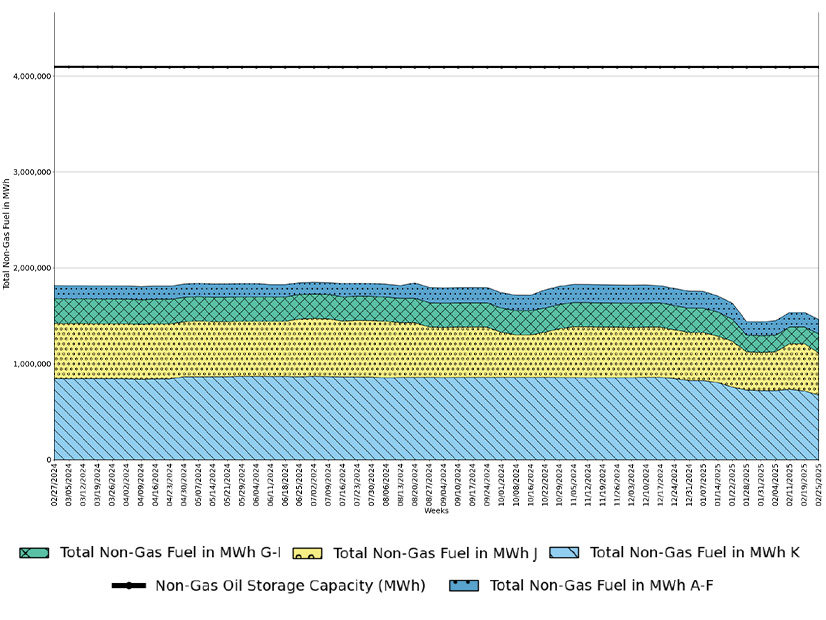
The peak occurred during a cold snap that began over the Martin Luther King Jr. Day weekend. When the peak load occurred during the 6 p.m. hour Jan. 22, about 18% of the fuel mix was natural gas and 27% was oil. Markham indicated that this, and the high rate of oil consumption over the coldest days, showed that there were problems with gas procurement, leading to stored oil use.
“We did see some larger non-firm gas units actually put in derates during the Martin Luther King weekend as a result of a forecasted inability to get gas in response to the day-ahead schedule,” said Markham. “I don’t think we’ve actually seen that before, so that was kind of noteworthy.”
Markham said that the average forced outage rate was higher than average during the winter. It was a challenge to manage unavailable capacity in gas units between the day-ahead and real-time because gas generators did not have their normal operational flexibility. Many dual-fuel units resorted to oil, leading to depleted oil reserves statewide.
February Operations Report
Markham also presented the operations report for February.
While the month was milder than January, cold weather produced a peak load of 22,651 MW on Feb. 18. Toward the end of the month, Markam said there was a forced outage in the Greenwood/Staten Island load pocket in New York City caused by a transformer coming out of service while another parallel circuit was also out. NYISO implemented a targeted demand response program in the area.
Markham also mentioned that NYISO had found the source of curtailments of wind and solar resources in New York’s southern tier. A circuit breaker at a substation in Union was “stuck,” affecting several other lines nearby.
“We were able to work with the transmission owner to implement a strategy to avoid the stuck breaker contingency,” said Markham, who went on to say that the ISO was evaluating whether their solution met the criteria for a facility to be secured in its market models.