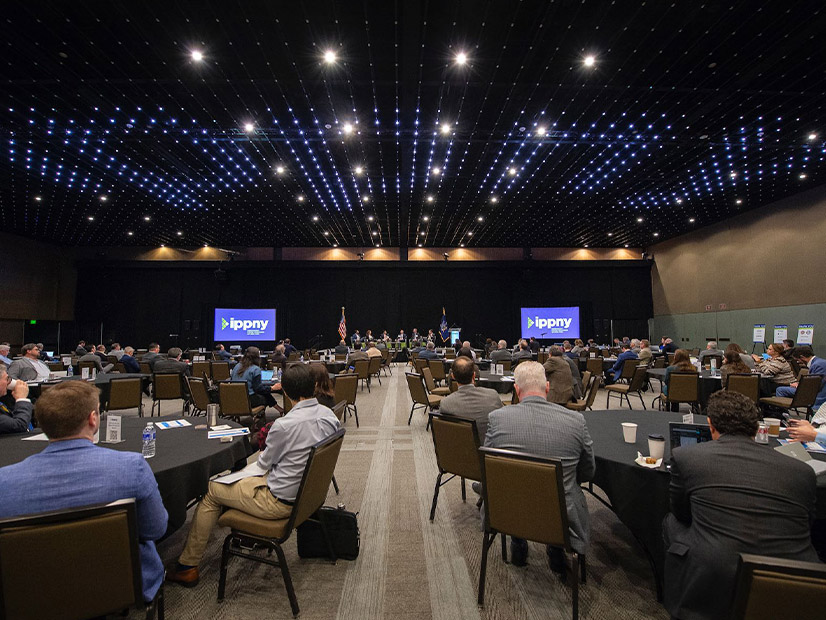
As attendees fussed over their last morsels of breakfast, Emilie Nelson, COO of NYISO, opened the Independent Power Producers of New York Spring Clean Energy Conference with a keynote addressing the strange situation New York’s grid is in, and the need to continue to deliver reliability despite political uncertainty.
“Since the ISO’s inception in 1999, system reliability has been our top priority in the face of great change,” Nelson said. “We maintain that focus [through] societal changes, policy-based or technical issues, or being prepared to manage more frequent, extreme weather.”
Speaking of changes, Nelson was a last-minute substitution for NYISO CEO Rich Dewey, who was called away on short notice to testify before Congress. (See All 7 ISO/RTOs Send Senior Executives to Update Congress on Reliability.) Nelson touched on themes that probably were familiar to the audience: the tension between policy pushes for zero-emission generation, the aging grid, increasing customer costs and concerns about winter peaking.
“It is imperative that during this time of rapid change, … we maintain adequate supply necessary to meet growing consumer demand for electricity,” she said. “Competitive markets continue to provide the most powerful vehicle to speed investment in the grid.”
The message to independent power generators was not lost: The ISO needs them to continue to build more generators to replace retiring infrastructure.
Nelson said building effective wholesale markets has helped facilitate the grid’s transition, reduce power costs and protect ratepayers from development cost risks. Building the market to support future reliability was her “North Star,” she said.
How Things Have Changed
The address kicked off a day of discussion about navigating these treacherous waters. Concern about Donald Trump and Elon Musk’s disruptions came up repeatedly in panel discussions.
“The new administration feels like they’ve been in place for years even though it’s only been 65 days,” Todd Snitchler, CEO of Electric Supply Power Association, said during a morning panel discussion. “Across virtually all of the administrative agencies that impact our work, from FERC to DOE, to SEC to CFTC, all the places that touch the work we do are seeing some sort of disruption.”
Snitchler said some disruption was good and some was bad but all of it was confusing. He was unsure “what the goal” of the administration is.
At the same time, Snitchler said he observed a “tremendous” amount of state-level activity. Some states, like Ohio, are leaning into markets. Other states, like New Jersey, express doubts about the role of markets on the grid.
“New York is potentially in a spot where it needs a reminder about the value markets have provided and how customers have benefited,” he said.

Marie French, an energy reporter for POLITICO who moderated the panel, said she observed New York had slowed some of its climate initiatives. Some of that was due to the withering of federal support for offshore wind and other climate projects. Not all of the delays were because of Trump, in her estimation.
“They’re realizing that all of these things are more complicated to implement and a little more expensive than they had hoped,” French said.
IPPNY CEO Gavin Donohue remarked that until roughly six months ago, there had been a lot of conversation statewide about climate change, climate justice and carbon pricing. After the election, that conversation shifted abruptly.
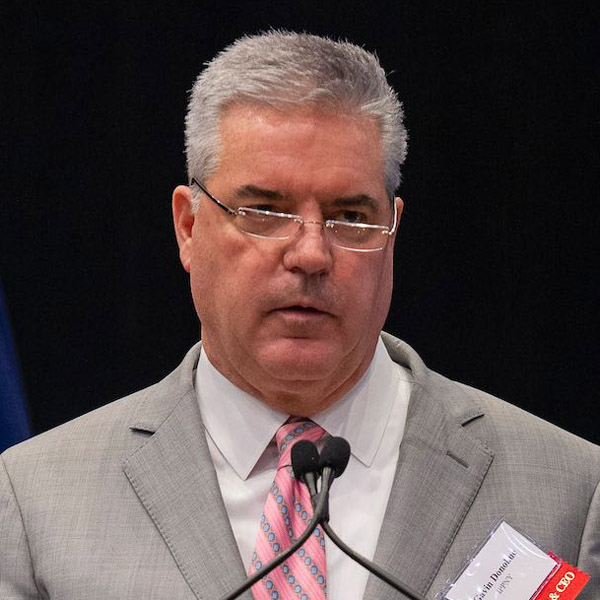
“Everything has switched to be about reliability and affordability,” Donohue said. “With the economic development backdrop, we have data centers, chip fabs, just a new interest in economic development where we have to build a grid out to three to four times the size.”
Donohue said discussions about nuclear power also suddenly became prominent and that the state needs to build the market to attract all kinds of new generation technologies. He mentioned hydrogen and geothermal, which seem to have fallen out of the discussion, to his disappointment.
“Everything is going to collide, and we just need to be ready,” he said. “We need to make sure that we promote policies that are in the best interest of ratepayers and competitive markets.”
How Do You Build New Nuclear?
There’s renewed interest in building new nuclear power plants in New York. (See NY Takes a Closer Look at Advanced Nuclear.) Panelists said one key element is finding a community that wants a nuclear power plant.
Philip Church, Oswego County administrator, said that since 1969, the county has been home to the Nine Mile Point nuclear plant. The operator, Constellation, has been a good safety and economic partner, he added. “We’re the home of three nuclear power plants; 75% of New York’s nuclear plants are in our hometown.” If Church had his way, there would be a fourth nuclear unit in Oswego County.
Despite the optimism, the history of new nuclear in the U.S. is plagued with huge cost overruns and lengthy delays. The first new reactors built in the U.S. since 2016, Vogtle’s two units in Georgia went online seven years late and $17 billion over budget. (See NIA: Cost, Risk Sharing Needed to Grow Advanced Nuclear Pipeline.)
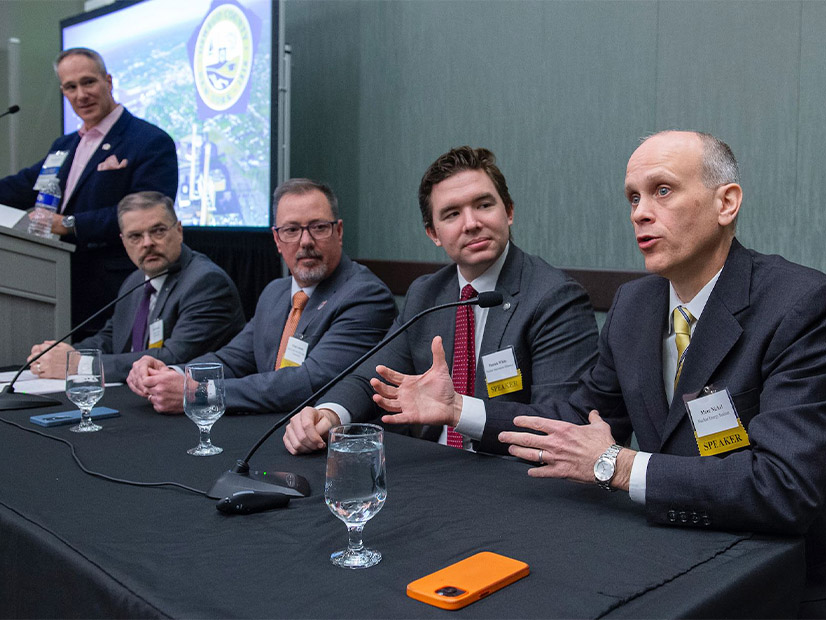
Patrick White of the Nuclear Innovation Alliance said new technologies are making nuclear power safer, more flexible and more appropriate for more locations. He cited small modular nuclear reactors, high-temperature gas reactors and sodium liquid metal reactors. Some of these are just smaller form factors of existing reactors, but others, like the liquid metal reactor, can generate enough heat to support a thermal energy battery.
“You start to see other options of how we can think differently about nuclear technology and how can it fit into a system to complement renewables,” White said.
At the same time, smaller reactors theoretically can help bring down construction costs and reduce safety concerns. If most of the components of a small reactor are built offsite and shipped to the building site, that can reduce costs. Smaller reactors run on less fuel and could be more easily contained.
While new technologies are often expensive, the panelists said this could be offset with federal, state or inter-company agreements to buy in, derisk and reduce construction costs for new technology.
“When you buy a piece of any other technology, you’re paying the average cost of what they’re able to produce it at,” White said. “Imagine how much more it would cost to buy an iPhone if you had to pay for the first iPhone’s development costs, the factory, the shipping, the supply chain, upfront.”
The panelists said co-purchasing between four to six units could hit “the sweet spot” to reduce the cost of an individual reactor.
IPPNY Study: Competitive Generation Reduces Costs
At the final event of the conference, IPPNY unveiled a study commissioned by the New York Affordable Clean Power Alliance about the impact of competitive markets on the cost of electricity. The Alliance is a new group formed out of IPPNY, the Alliance for Clean Energy New York, the New York Battery and Energy Storage Technology Consortium, and other renewable energy organizations.
Multiple Intervenors, a consortium of large industrial interests and large electrical consumers, issued a press release shortly after the conference, supporting the study.
“This report affirms Multiple Intervenors’ position that private investment in power generation results in lower electricity costs, greater reliability and improved environmental performance,” said Michael Mager of Multiple Intervenors. “Returning to utility-owned generation would only increase financial burdens on businesses already navigating challenging economic conditions.”
The study used the same data as an earlier Brattle Group study, funded by Con Ed, that made an argument for allowing utilities to build and own generation. (See Brattle Paper Weighs Pros and Cons of Utility-owned Generation in NY.)
“Nearly 30 years ago, the New York PSC adopted a set of principals … starting with the premise that competition in the electric power industry will further [the] economic and environmental well-being of New York state,” said Shannon Maher Banaga, senior managing director of FTI Consulting, the study authors. “That premise holds true today.”
Members of FTI Consulting walked through their findings. After the introduction of a competitive generation market, the state’s electricity prices dropped steadily over the past 30 years. Meanwhile, the price of delivery increased steadily.
“If you compare the past five years of data to the five years prior to restructuring, total generation costs since are roughly 35% lower,” said Robert Kaineg, managing director of FTI. “But those of us that have been watching the news and are sensitive to these issues know that has not translated into lower bills for customers.”
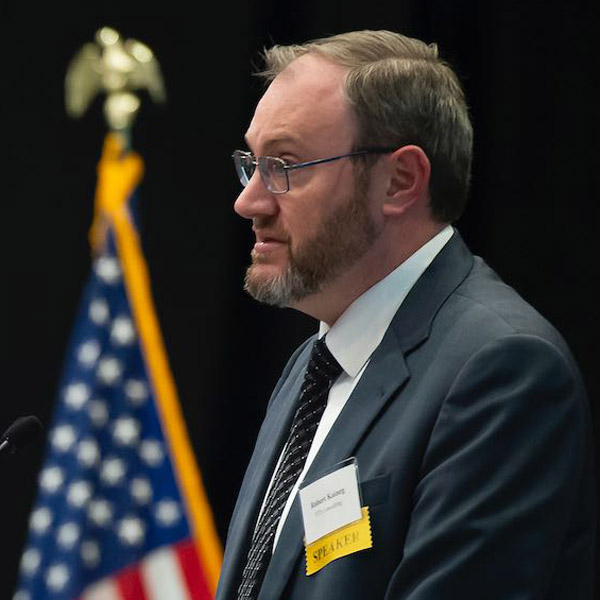
Kaineg said he found the costs of transmission and distribution had risen over time and that state policies supporting energy efficiency and clean energy further escalated costs.
“We’ve seen this come to a head recently with an announcement by Con Ed that it was going to increase its rates by 11.4%, but that buried the lead because they were raising delivery rates by more than 19%,” Kaineg said.
Kaineg added that private developers were less expensive in almost every case than utilities. Utilities faced all the same challenges that private developers did, and since restructuring, they didn’t necessarily have any in-house generation-building expertise.
“There really isn’t a reason to expect, from a cost or development perspective, that utilities are going to enjoy any advantages in asset development,” he said.
IPPNY’s Donohue said some of the increases in transmission and distribution costs fell on an overall lack of investment in the basic necessities of energy infrastructure.
“We have avoided making tough decisions on transmission and generation,” Donohue said. “When you wait 10 years to put a new line in, it’s obviously going to be a lot more expensive than it was 10 years earlier.”
ACE NY Executive Director Marguerite Wells said everyone expects more of the power system now than 50 years ago. More things are electronic; more things require electricity to work.
“We have to pay the piper to do stuff that’s been deferred for a long time,” Wells said. “But the truth of the matter is that it has nothing to do with the source of the electricity and … everything to do with serving the needs that people want from their power system.”