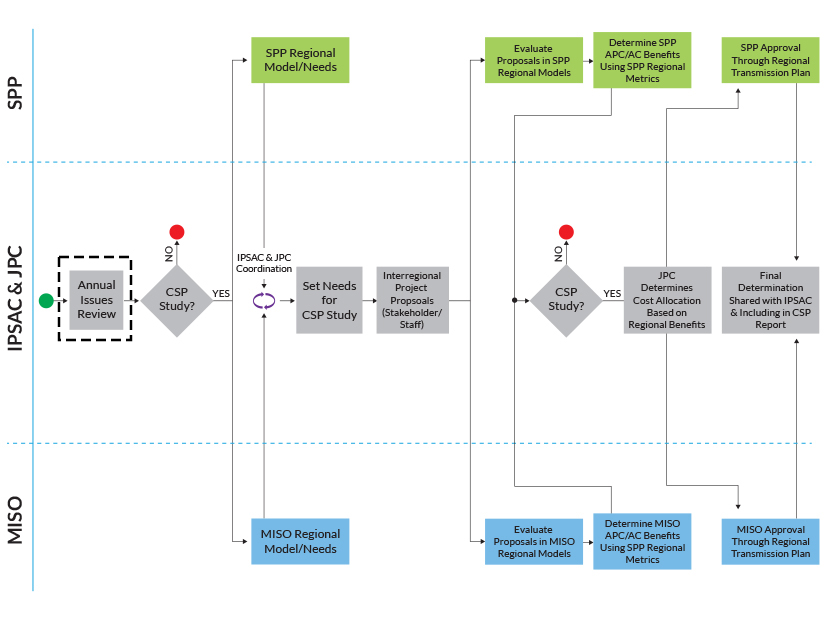
MISO and SPP staff asked for input on a joint system study in 2025 during their annual transmission issues evaluation March 28 with their Interregional Planning Stakeholder Advisory Committee (IPSAC), which was only too happy to discuss stakeholders’ issues with the current process and suggest improvements.
Missouri regulators called for examining the region encompassing southwest Missouri, southeast Kansas, northeast Oklahoma and northwest Arkansas, rather than just Oklahoma and Arkansas. Clean energy groups urged the RTOs to increase the bidirectional interregional transfer capacity along the seam they say will generate billions of dollars in regional benefits. A transmission developer recommended the staffs follow its road map in working with FERC to enable the “timely development” of interregional projects.
The staffs will use the feedback in determining whether or not they conduct a Coordinated System Plan (CSP) this year. They told the IPSAC in December they will not perform a CSP in 2025 but will accept transmission issues for their annual review, as per their joint operating agreement (JOA). (See MISO, SPP to Revise Joint Agreement, Focus on TMEP Process in 2025.)
MISO’s Jon George reminded stakeholders the RTOs have proposed expanding the CSP’s scope to yield a more robust and comprehensive interregional planning process in the 2024/25 planning cycle. They’re focusing on identifying “immediately actionable” system upgrades that improve reliability and resilience and strengthening transfer capability between the two systems.
The study incorporates reliability, economic and transfer analyses using forward-looking 10-year models and assumptions. It aligns with key elements of FERC Order 1920, staff said.
SPP and MISO have filed a waiver request with FERC for certain multiyear modeling and benefit valuation requirements in their JOA. Staff said they believe the study can proceed as scoped, but that certain JOA provisions may prove challenging.
Stakeholders reacted positively to the RTOs’ 2034 blended models for issue identification and benefits evaluation: economic, light-load reliability, and extreme hot and cold events. The blended models also were used in the 2023 CSP.
The Sustainable FERC Project and Natural Resources Defense Council’s Natalie McIntire said the RTOs should be focused on building a bigger grid, given the increase in extreme weather.
“We really urge the RTOs to focus on the full seam for future comprehensive interregional studies,” she said. “Things are changing so rapidly that we need to keep our focus on all parts of the seam and how we can optimize that for all consumers. The focus in this interregional transfer capability and resilience study on resilience during the extreme weather is great. We support that, but we think there’s further work that can be done to really move away from the prior silo transmission planning frameworks that have been undertaken across the seam in the past.”
The CSP builds on each RTO’s respective regional process. The RTOs then coordinate on model development, issues identification and technical analysis throughout the evaluation process.
“We’re already in a solution-submission window for the 2025 [SPP Integrated Transmission Planning portfolio], but to the best we can, we will definitely cross reference solutions from these studies,” SPP’s Spencer Magby said. “If we see something promising in these regions in the 2025 ITP, we’ll be sure to screen them through this study as well.”
The JOA, which was updated in 2019, requires that a CSP be performed every two years. Stakeholders have until April 23 to submit their final issues. At that point, the RTOs’ Joint Planning Committee, which comprises staff from both grid operators, will meet and determine whether a study will be conducted.
Five previous CSP studies have failed to produce any joint projects over differences in allocating costs. That led the RTOs to try a different approach with the Joint Targeted Interconnection Queue, which identified a five-project portfolio estimated to cost as much as $1.6 billion that could support up to 29 GW of interconnecting generation along their seam.