ERCOT, Oncor and the Texas Public Utility Commission have asked FERC to deny a petition from Puerto Rican company Pluvia to bring the territory under the commission’s Federal Power Act jurisdiction (EL25-57).
Pluvia seeks a finding from FERC that its proposal to transmit power to Puerto Rico via batteries on cargo ships could make it subject to the commission’s regulations. (See Petition Asks FERC to Potentially Claim Jurisdiction over Puerto Rico.)
The parties all filed similar motions, but none of them were aware of the petition, filed in early February, until after the due dates for comments, they said.
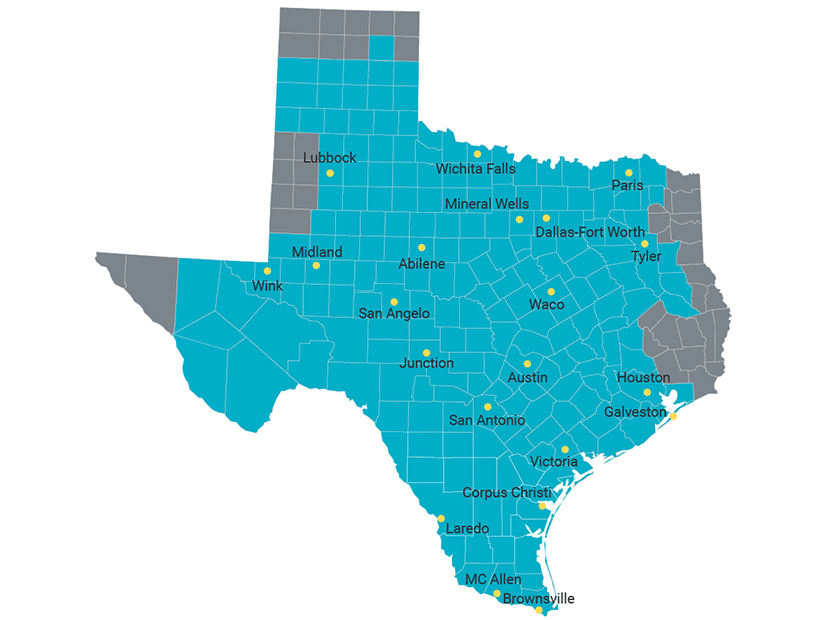
If the commission granted Pluvia’s petition, the precedent would threaten ERCOT’s jurisdictional status, in which its few connections to the rest of North America’s grid do not give FERC jurisdiction over its markets, the Texas grid operator said April 8.
“ERCOT recognizes the immense challenges the people of Puerto Rico have endured since Hurricane Maria and supports efforts to rebuild and modernize the island’s electric grid,” it told FERC. “Yet, as explained below, Pluvia’s petition is not the right path to achieve these crucial goals.”
Granting the petition would require an unprecedented reinterpretation and expansion of FERC’s licensing jurisdiction under FPA Part I, which authorizes the commission to license non-federal hydroelectric projects on federal reservations or affecting navigable waters of the U.S., and under another section that gives FERC power to grant preliminary permits for such projects.
But using storage to transmit power is not a hydro project; the proposed sites in Puerto Rico are not considered federal reservations; and the transportation of cargo from the mainland to the territory would not involve crossing navigable waters of the U.S., ERCOT argued.
“Such a radical change could have serious implications for the jurisdictional independence of Texas’s intrastate ERCOT grid,” said the PUC, which oversees ERCOT’s markets in the same way FERC regulates others in the U.S. All the transmission between it and other states is provided pursuant to FERC orders under sections 210 and 211 of the FPA.
“Because Pluvia’s proposal does not involve any physical flow of electric energy between states, Pluvia presents no valid basis for the requested declaration,” the PUC said. “What Pluvia requests would be a radical redefinition, contrary to precedent, of the meaning of ‘electric energy’ under the FPA to include stored potential energy that would later be converted into electric energy. And it would redefine ‘transmission’ under the FPA to include the shipment of charged storage devices that does not involve the flow or comingling of electric energy in interstate commerce. …
“This ‘clarification’” — as Pluvia said in its request — “is contrary to law and totally unjustified: It would require the commission to ignore the plain text of the FPA and depart from well-established precedent analyzing the same issues in the context of the ERCOT market.”
Oncor had filed to intervene in late March, making similar arguments, and Pluvia had asked FERC to deny the late intervention.
Oncor responded that while it was late, Pluvia’s project is in early stages and FERC actually weighing the merits of its earlier filing would not burden it. FERC has been liberal in allowing late interventions in cases involving its jurisdiction, Oncor said.
“Even if Oncor had not moved to intervene in this proceeding, the commission still would need to assure itself that it has statutory authority to grant the relief Pluvia seeks,” the utility said. “As such, Oncor intervening to raise jurisdictional arguments does not unduly prejudice or burden Pluvia.”