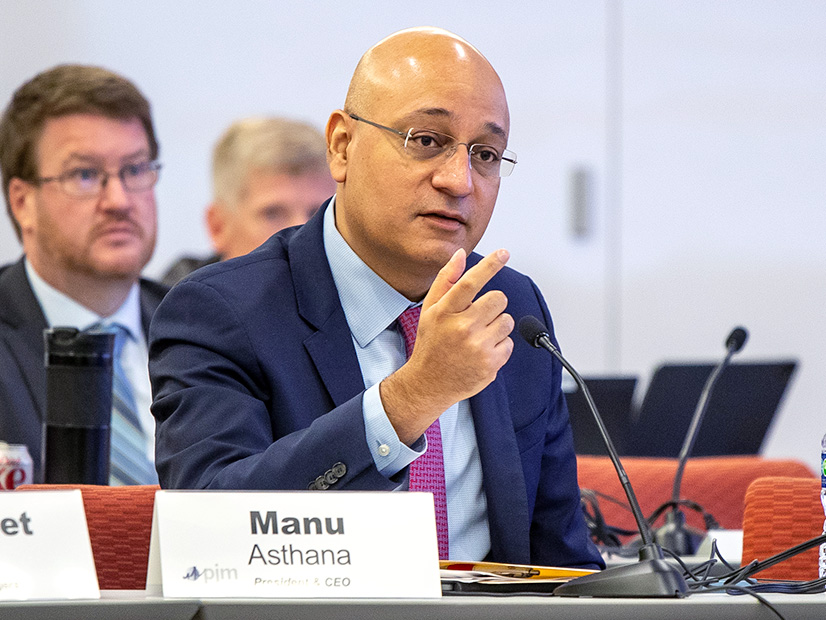
PJM CEO Manu Asthana on April 14 said he will resign from his position at the end of 2025 after more than five years of leading the RTO.
“My five-plus years at the helm of PJM have been some of the most fulfilling of my career,” Asthana said in a statement. “I am especially appreciative of the opportunity to have led PJM’s remarkably talented, diligent and committed people, who work hard every day to keep the power flowing for 67 million people.
“The time has now come for my wife and me to move back to be closer to our family and friends in Texas. I look forward to continuing to lead the organization through the end of the year and to helping facilitate an orderly transition to my successor.”
Asthana relocated to Pennsylvania when he took over as the head of PJM on Jan. 1, 2020, in the wake of the GreenHat Energy default, which led to the resignation of several PJM executives. (See PJM Taps Ex-Direct Energy Exec as New CEO.)
Mark Takahashi, chair of the PJM Board of Managers, said Asthana guided the RTO through several significant changes, including the shift to studying interconnection requests with a cluster-based approach and an overhaul of capacity market rules following Winter Storm Elliott in December 2022. (See FERC Approves 1st PJM Proposal out of CIFP.)
“The PJM board is grateful to Manu for his strong leadership during a time of tremendous change in the electricity industry,” Takahashi said in a statement. “Under his leadership, PJM successfully navigated the COVID-19 pandemic, significant market reforms, interconnection process enhancements, the buildout of a robust risk management function and the delivery of world-class grid reliability through a variety of extreme weather events.”
Takahashi said Asthana has worked with the board to develop “PJM’s internal succession pipeline.”
“We have a strong executive team, including internal succession candidates. We will also consider external candidates for this role,” Takahashi said.
The board has formed a search committee to identify a replacement in the next year. That process will be aided by consulting firm Korn Ferry with input from the RTO’s membership and stakeholders. Asthana is set to stay on as a senior adviser until June 2026.
Electric Power Supply Association CEO Todd Snitchler said Asthana led PJM through a time of rapid change.
“We have appreciated working with him and his willingness to listen to the input of the generator community as he navigated how to deliver reliable power while addressing the challenges posed by varying state and federal policy preferences; a rapid rise in energy demand; and external factors like supply chain hurdles and onerous permitting policies that impede infrastructure development,” Snitchler said.
He said EPSA hopes to see PJM continue to address planning and interconnection queue issues, and “strongly support” a market that balances input from stakeholders and market participants and “provides reasonable certainty and a fair opportunity for a return on investment for resource developers.”
Glen Thomas, president of GT Power Group, said “leading PJM is a challenging job, and Manu led PJM through some very challenging times, from COVID to the data center demand boom. He remained calm, accessible and diligent no matter what the challenge. We look forward to working with PJM to find a successor that can lead PJM to meet its mission to deliver reliability through markets.”
D.C. Public Service Commission Chair Emile Thompson, current president of the Organization of PJM States Inc. (OPSI), pointed to several capacity market changes PJM pursued in recent months that consumer advocates have argued would ward off inappropriately high prices. (See PJM, Shapiro Reach Agreement on Capacity Price Cap and Floor.)
“CEO Asthana has been a tremendous partner to work with during my tenure as the president of OPSI,” he said. “Together, we worked to implement a number of reforms in response to the most recent Base Residual Auction. I look forward to continuing to work with him through the remainder of his tenure as we tackle issues such as resource adequacy, sub-annual capacity markets, transmission planning and issues surrounding co-location.”