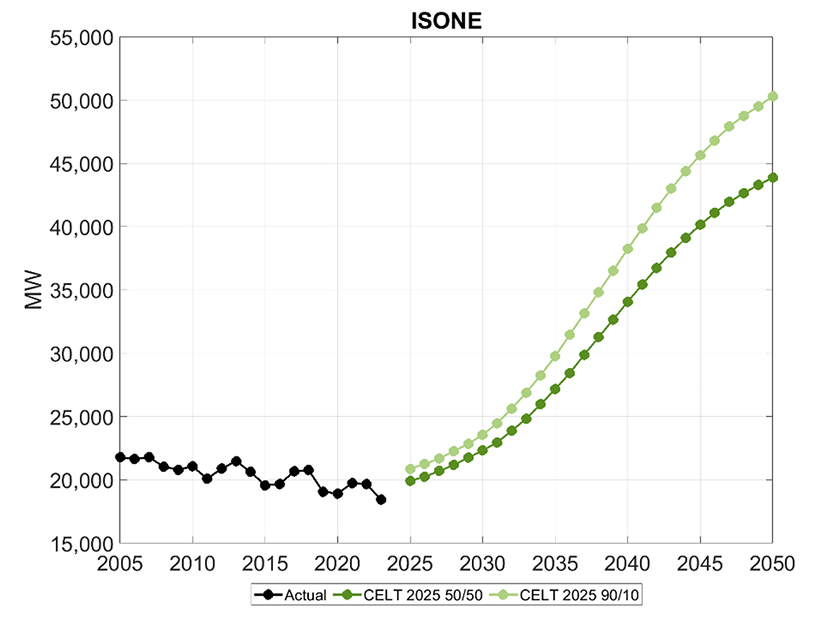
ISO-NE plans to cut its winter peak load projection for 2033 by 7.2% and its summer peak projection by 1.8%, Victoria Rojo, supervisor of load forecasting at ISO-NE, told the NEPOOL Reliability Committee (RC) on April 16.
The cuts are driven largely by significant reductions to ISO-NE’s electrification projections for heating and transportation, which Rojo discussed at length with stakeholders at the RC in March. (See ISO-NE Scales Back Vehicle, Heating Electrification Forecasts.)
The RTO has broadly overhauled the methodology behind its Capacity, Energy, Loads and Transmission (CELT) reports to incorporate more granular hourly demand forecasting and climate-adjusted weather data across 70 weather years.
While ISO-NE still anticipates that demand growth will accelerate in the coming years, the results show a significant drop in expected demand relative to the RTO’s forecasts from the past few years. Compared to its 2024 forecast, ISO-NE has cut its 2033 summer peak projection by 474 MW and its 2033 winter projection by 1,937 MW. It also reduced its annual net energy projection for 2033 by 9.3%.
Rojo also presented the RTO’s final draft forecast for behind-the-meter (BTM) solar. ISO-NE anticipates that BTM solar production will nearly double between 2025 and 2034, growing by about 570 GWh annually.
ISO-NE plans to use its previous load forecasting methodology to calculate the installed capacity requirement for its 2026/27 and 2027/28 annual reconfiguration auctions. It will roll out the new methodology for the 2028/29 capacity commitment period in coordination with a proposed overhaul of its capacity market. (See ISO-NE Gives Updates on Prompt, Seasonal Capacity Market Changes.)
Because the new methodology incorporates energy efficiency into the base forecast and eliminates the need to separately forecast energy efficiency, using the old methodology will prevent “unintended market outcomes that could arise from a midstream transition,” the RTO wrote in a memo published in late March.
The forecast values are subject to change; ISO-NE plans to finalize and publish its CELT forecast May 1.
Regional Energy Shortfall Threshold
Also at the RC, ISO-NE said it plans to focus its regional energy shortfall threshold (REST) on the most extreme 0.25% of modeled reliability scenarios, a risk level that equates to one event occurring every 90 winter seasons.
The REST is intended to quantify New England’s “level of risk tolerance with respect to energy shortfall during extreme conditions in a season” and help “inform regional decision-making about managing potential energy shortfalls.”
ISO-NE has proposed metrics related to shortfall duration and magnitude, which it will use to evaluate shortfall risks for the most extreme 21-day cases ISO-NE models. (See ISO-NE Details Regional Energy Shortfall Threshold Metrics.) Jinye Zhao said basing the REST threshold on the 0.25% tail of cases would enable the RTO to focus on high-impact cases that have a reasonable chance of occurring.
The RTO plans to propose initial threshold values for these duration and magnitude metrics at the RC in June.
Operating Procedure Changes
Also at the meeting, the RC voted to support changes to the RTO’s operating procedures for transmission outage scheduling and metering and telemetering criteria.
The metering changes would allow an increased equipment temperature range “if data center-type HVAC redundancy is in place,” and add new automatic voltage regulator rules for composite units.
The transmission outage scheduling changes would “clarify that Long-Term Transmission Outages may be approved without having to first be interim approved at the discretion of the ISO,” Anthony Stevens of ISO-NE said.