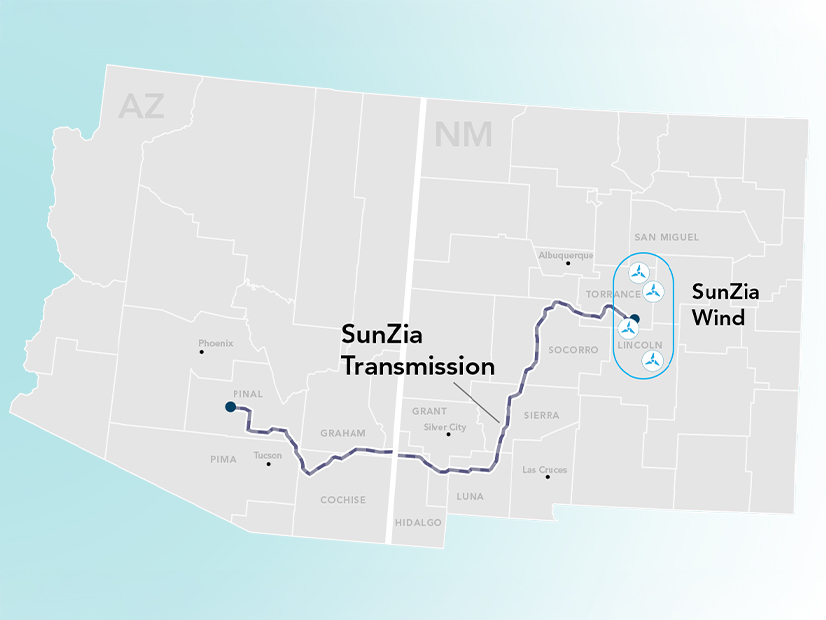
FERC on April 17 approved the non-rate terms of SunZia Transmission’s proposed transmission owner tariff but sent the tariff’s non-subscriber usage rate to a settlement process and potential hearing (ER25-170).
Pattern Energy is developing the SunZia transmission line, a 552-mile, 500-kV DC line that will carry wind power from New Mexico into Arizona. The SunZia line, with a planned capacity of 3,021 MW, is expected to begin operations in 2026.
SunZia plans to join CAISO’s balancing authority area as a subscriber participating transmission owner (PTO). The subscriber PTO model allows transmission developers to join CAISO without the transmission project being selected through CAISO’s transmission planning process.
Developers of subscriber PTO projects are responsible for funding the transmission project, rather than recovering their transmission revenue requirement through CAISO’s transmission access charge (TAC). FERC approved the subscriber PTO model in March 2024. (See CAISO Wins FERC Approval for Subscriber-funded Tx Plan.)
In the case of SunZia, the transmission system’s existing capacity has been committed to Pattern subsidiary SunZia Wind, which has entitlements with Salt River Project, Western Area Power Administration and Tucson Electric Power to send its wind power beyond SunZia Transmission’s Pinal Central terminus to Palo Verde, which connects with the CAISO system.
In the subscriber PTO model, transmission capacity not used by subscribers is available to CAISO market participants. CAISO will pay the subscriber PTO for that usage based on a non-subscriber usage rate (NSUR).
The NSUR in SunZia’s proposed tariff drew protests from a group of utilities — Pacific Gas and Electric, Southern California Edison, and San Diego Gas & Electric — as well as from a group of six California cities.
One complaint about SunZia’s proposed NSUR was that it was developed using the Appalachian methodology, which came from a 1987 FERC case involving Appalachian Power Co. As described by FERC, the methodology is “premised on the assumption that a customer using the transmission system for the 16 peak hours of the day should pay the same contribution to fixed costs as a customer who has reserved capacity on a daily basis.”
The protesters also said SunZia hadn’t provided support for an annual escalation factor of 0.5%.
While FERC found the escalation factor to be just and reasonable, it shared the protesters’ concerns about use of the Appalachian methodology in calculating the NSUR.
Under FERC’s order, the chief judge will appoint a settlement judge within 45 days and a settlement conference will be held to try to resolve the NSUR matter. If a settlement can’t be reached, the issue will go to an evidentiary hearing.
Expedited Action Requested
SunZia initially filed the proposed transmission owner tariff Oct. 21, 2024, and a month later asked for a decision by Dec. 21.
Citing its obligation to investors, lenders and customers, SunZia Transmission filed a renewed request for expedited treatment March 14, asking FERC to issue an order by April 30.
“If the commission does not provide expedited action, SunZia Transmission will be forced to divert its resources to an alternative plan that would require it to form its own balancing authority area (“BAA”) rather than joining CAISO’s BAA,” SunZia said in the filing.
Forming its own BAA would take several months and require “a significant commitment of resources” from SunZia, NERC and WECC, the filing said.