If FERC Order 1920 is implemented correctly, it could expand the role of grid-enhancing technologies (GETs) and high-performance conductors (HPCs) to help meet surging power demand in the near term, according to a report prepared by the Brattle Group for the American Council on Renewable Energy.
Demand forecasts have grown significantly since FERC started the rulemaking process that produced Order 1920, report lead author and Brattle Principal Bruce Tsuchida said on an April 22 webinar. That comes on top of the underlying need to replace aging transmission, which the report estimated would cost $10 billion annually over the next decade.
“If you’re a state right now, and you’re looking at the wave of infrastructure that’s coming down the pipe to meet load growth, you probably are wondering, ‘how much is this going to cost me?’ And maybe, ‘how could I shave off some of that cost? How can I save some money?’” GQS New Energy Strategies Principal Liz Salerno said. “And advanced transmission technologies come right to the rescue here.”
GETs and HPCs are mature, proven technologies, and the report’s analysis found they can provide all seven benefits required for consideration under Order 1920, Tsuchida said in a statement.
“Transmission providers can use a holistic evaluation method when assessing various benefits and comparing potential transmission solutions,” he added. “These technologies will likely shine through as a lower-cost option to ensuring reliable, affordable power for ratepayers.”
Many utilities have not adopted advanced transmission technologies (ATTs) because they are unfamiliar with them, and their investment incentives are not aligned well with the technologies, Tsuchida said.
“There’s also the fact that a lot of the cost associated with transmission — for example, if there’s an outage, or if there’s congestion, or if there’s more investment needed — that is passed through to the end-use customers, while the transmission service providers may not necessarily feel that immediately,” he said.
Transmission needs are growing rapidly, so much so that the pace of traditional transmission development cannot keep pace. Traditional wire projects can take five to 10 years to develop and often are hindered by regulatory delays, the complexity of interregional coordination, cost allocation and permitting, the paper says.
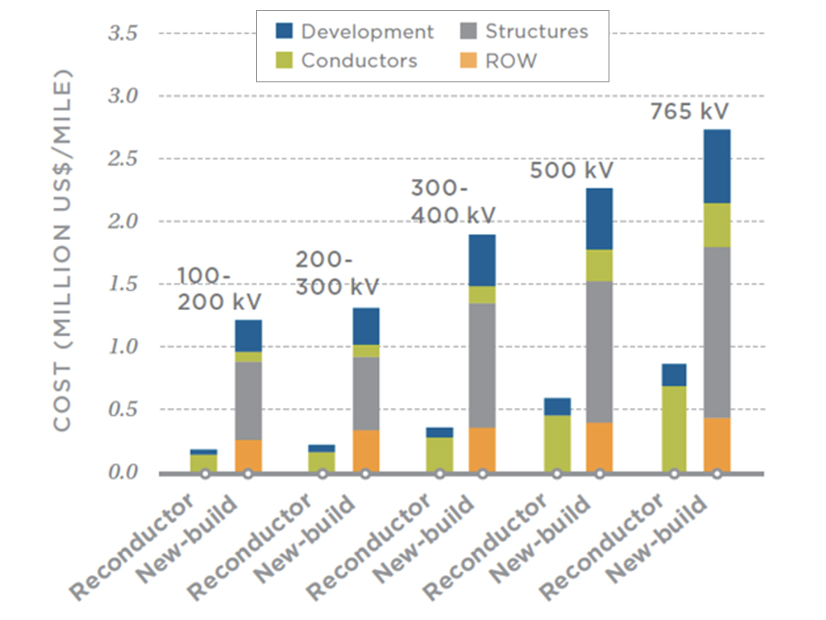
“Because of the three characteristics discussed above (lower cost and speedier installation, complementarity to existing equipment, and portability and reversibility), ATTs can provide cost-effective solutions in a shorter schedule than relying solely on the traditional wires-based solutions,” the report says. “Additionally, the fragmented nature of transmission planning and cost allocation often stalls large projects; HPCs, through reconductoring, can reduce the scope of new upgrades, while GETs can offer incremental upgrades that align with the scenario-based, collaborative approach emphasized in Order 1920.”
ATTs need to be used in short- and long-term planning, with the report saying that splitting the various solutions into those two time frames (or even more granular ones) will allow planners to address challenges that span immediate needs and flexible goals.
GETs can provide near-term relief to transmission congestion and improve grid efficiency without the delays of traditional transmission investment. Both GETs and HPCs can help modernize the grid, integrate new technologies, and prepare for future demand and renewable growth in a cost-effective way, the report says.
Order 1920 requires grid planners to consider seven benefits of new transmission, two of which are temporary, such as lowering congestion from outages, and the mitigation of extreme weather events and unexpected system conditions. Assessing their benefits will require planners to consider shorter time frames than normal, the paper says.
“Associated with the new temporal scenarios to analyze, transmission providers will need to develop methodologies on how to consider benefits (and costs) over varying timelines,” the report says. “For example, evaluating a potential solution could require analyses over multiple timelines to capture the benefits and associated trade-offs among benefits (a solution could impact several benefits) over different timelines.”
Compliance with Order 1920 is proceeding at different paces in some regions, with FERC having granted some extensions. In PJM, Maryland Public Service Commissioner Michael T. Richard said on the webinar the RTO is working with states and stakeholders on complying with the new rule.
“I do think we need to make sure this is not going to be just status quo; a new kind of [Regional Transmission Expansion Plan] that is just extended,” Richard said. “And in fact, it is going to be a planning opportunity with the states at the center. The core of the plan for the future needs to be how the states envision their resources … and then we can work to make sure that we all have the same goal: keep the lights on.”
While compliance is proceeding, GQS Principal and former FERC Chair Richard Glick (who launched the rulemaking process that led to Orders 1920 and 2023) said in a statement that those efforts will take time.
“In the meantime, action is needed to address more immediate threats to reliability and affordability,” Glick said. “This report shows that GETs and HPCs offer a near-term capacity solution while grid operators continue to plan the regional transmission lines needed to meet future challenges.”