Stakeholders and state energy officials continue to raise concerns about a CAISO draft proposal that would adjust how congestion revenues are allocated in its Extended Day-Ahead Market, with the ISO aiming for a vote on the final proposal in the coming weeks.
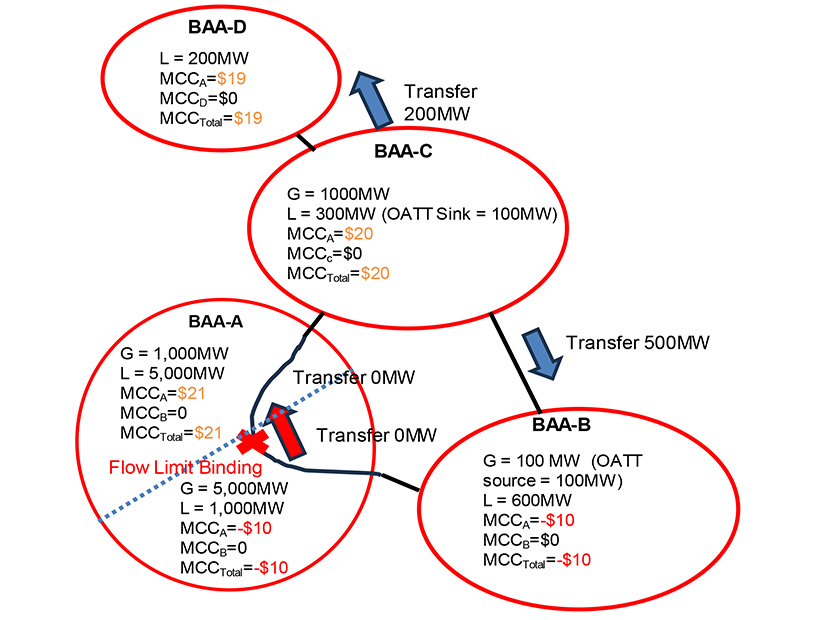
The draft proposal, released last week, addresses how the EDAM will allocate congestion revenues when a transmission constraint in one EDAM balancing authority area causes parallel flows in a neighboring BAA.
CAISO has said the draft proposal will be “transitional” over the next three years, after which time it plans to implement a more permanent design.
The proposal is a product of the past two months of focused work on the subject. In March, CAISO launched an expedited initiative to address stakeholder concerns, and this week, the agency held an all-day meeting to review the proposal with the more than 150 participants who joined the call.
At the April 24 meeting, California Public Utilities Commission regulatory analyst Michele Kito asked if the ISO had a sense of where the major parallel flows currently take place on the system.
“I would imagine that we can look at historical system data,” Kito said. “Do we have any sense of what those [parallel flows] are and what the effects each of these proposals have in terms of revenue allocation?”
“We haven’t looked at specific parallel flow impacts,” George Angelidis, CAISO executive principal, said at the meeting. “There are well-known transmission bottlenecks in the ISO system, like Path 36 and Path 15, but in general, any kind of flow in the system will experience what we define as parallel flow.”
Parallel flow is the impact on the flow gauge of transactions that are external to that BAA, Angelidis said. They can be infinite: Any path will have parallel flows, so CAISO has not looked at potential parallel flow results on specific flow gauges, he said.
Cathleen Colbert, senior director of Western markets policy at Vistra, added, “I will give a little extra support to Michele’s questions. Do we not have any sense of how these parallel flows work on internal constraints? I do think there’s a case for you guys to provide some additional kind of forward-looking information.”
CAISO will study these parallel flow effects over the three-year period of the new design, said Milos Bosanac, ISO regional markets sector manager.
“As entities join the EDAM, we will be modeling transmission constraints on their system that may not necessarily be reflective today,” Bosanac said. “I think it’s difficult to surmise the effects at this point in time of constraints that might not yet be modeled. [However], we will be modeling the new design on PacifiCorp’s system, and as other entities join, we will model those effects [too].”
Middle Approach
Under current EDAM market rules, Open Access Transmission Tariff (OATT) customers in one BAA will end up paying costs for congestion for parallel flows caused by binding transmission constraints in neighboring BAAs. However, under the draft final proposal, parallel flow congestion revenues collected in a BAA that result from a binding constraint in a neighboring area will be allocated first to the BAA in which the overflow congestion occurs and the revenues are collected.
In an example reviewed at the meeting, $135,800 in congestion revenue was collected and distributed to three balancing areas: BAA A, BAA B and BAA C. Under the current design, all $135,800 would be distributed to BAA A. However, under the draft proposal, BAA A would receive $132,800 in revenue, BAA B would receive $1,000, and BAA C would receive $2,000.
The final draft proposal supports EDAM entities’ capacity to provide congestion cost protection for transmission customers exercising firm OATT rights, Bosanac said. The draft also addresses stakeholder concerns about a balancing area being exposed to congestion costs when providing counterflow effects in relation to constraints, he said.
The draft would apply only to the day-ahead market, not to the real-time market. The real-time market retains the congestion revenue allocation in effect today in the WEIM “in order to minimize the impact on the WEIM participants,” Bosanac said.
If approved, CAISO will implement the draft final proposal by collecting data and monitoring the congestion effects over the first one to two years of the transitional approach. CAISO then will prepare a permanent design after the three-year period.