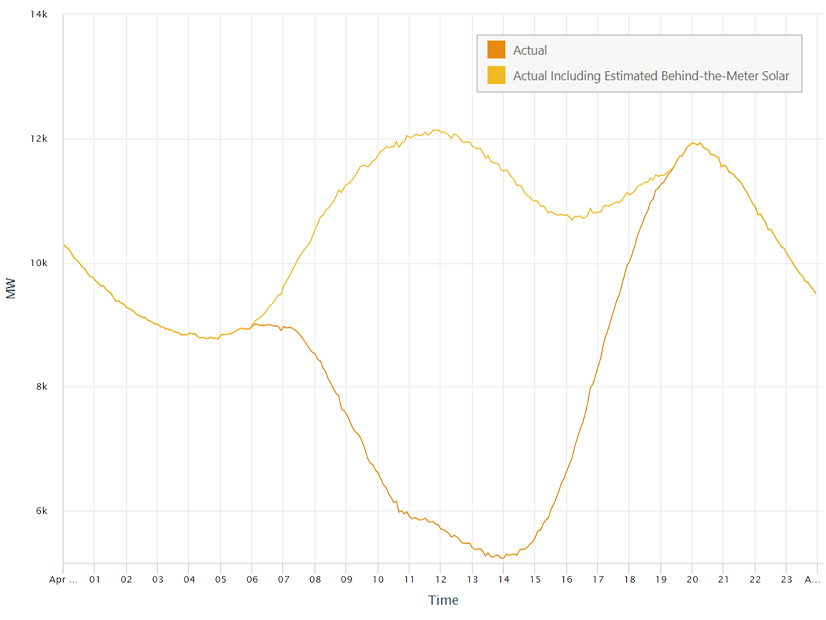
ISO-NE experienced record-low demand on Easter Sunday because of mild temperatures and high behind-the-meter solar output, making 2025 the fourth consecutive year the RTO has set a low-load record.
The 5,318-MW minimum load April 20 was a significant drop from the previous record low of 6,596 MW, set in April 2024. ISO-NE estimates that BTM solar production reduced systemwide demand by about 6,600 MW.
Steven Gould, director of operations at ISO-NE, said the RTO anticipated the low-load conditions days in advance and was able to forecast the minimum load with great accuracy.
“It was a very quiet day because we prepared and we communicated,” Gould said. He added that the impact of declining minimum loads is “something that we are continuously looking at. We’re fine now, but we want to be proactive, and that’s what we’re doing.”
The region’s solar boom has led to an increasing amount of duck curve days, which are defined as days when daytime demand drops below nighttime demand. In 2024, New England experienced 100 duck curve days for the first time in its history.

Largely driven by state policy, the region recently has added about 700 MW of BTM solar capacity per year, Gould said. Solar growth has been strongest in Massachusetts and Connecticut, which are home to about two-thirds of the BTM solar generation in the region.
Gould said the “biggest concern at light loads” is the creation of high-voltage conditions on the transmission system. He said ISO-NE coordinates with the region’s transmission owners ahead of forecasted light-load periods to ensure the system has resources available to reduce the voltage on the system.
Light-load conditions also create the need for significant ramping capabilities as solar production wanes in the evening. On April 20, natural gas generation dropped from over 4,700 MW in the early morning to about 1,800 MW between 10 a.m. and 3 p.m., before increasing in the evening to over 5,000 MW as the systemwide peak grew to about 11,800 MW.
“We have the resources to [ramp back up] at this point in time, and we’re able to do it quite easily,” Gould said.
Power system emissions, which largely are driven by natural gas generation, especially during warmer months, were cut roughly in half during this midday period, before increasing again in the evening.
Nuclear generation, which lacks the ability to quickly increase or decrease production, remained steady at 2,115 MW throughout the day. In the future, Gould said he does not expect low loads to create operational issues for nuclear resources because the region can export power to neighboring regions during extreme low-load conditions.
On April 20, ISO-NE went from importing about 1,500 MW in the morning to exporting power midday to NYISO as New England’s real-time hub LMP dropped to as low as ‑$31.7/MWh. Imports climbed back to about 1,000 MW in the evening.
Looking forward, Gould said he expects the growth of transportation electrification and electric storage to eventually drive up midday demand, helping to mitigate potential low-load concerns.
“We think battery storage and electric transportation and heat pumps will be able to curb the light load, because that will be the lowest energy price for those resources to charge their systems,” Gould said. “If you look at Texas and California, they’re very much ahead of us for battery storage, but that’s what they’re doing.”
Over the next decade, ISO-NE anticipates BTM solar production to nearly double, growing at a rate of about 570 GWh per year. ISO-NE expects this growth to push the system peak load later in the day but does not expect it to have a major impact on peak loads levels. By 2034, ISO-NE expects BTM solar growth to reduce the summer peak by an additional 140 MW and the winter peak by about 400 MW.
However, Gould emphasized the difficulty of forecasting system conditions years in advance, “especially when you go from one [federal] administration to a new administration,” pointing to the struggles and uncertainties surrounding offshore wind development.
“Things are dynamically changing,” Gould said. “We’re doing lots of studies. … We’re taking about light loads; we’re looking at ramping; we’re looking at intermittent resources; we’re looking at forecasting irradiance; we’re looking at forecasting wind and forecasting demographic behavior, and putting it all together to make sure we have adequate resources in our market on a daily basis.”