The cost of electricity in California could be reduced if energy providers were allowed to trade power by the hour, a new study by the California Community Choice Association says.
The cost of electricity in California could be reduced if energy providers were allowed to trade their resource adequacy products by the hour, a new study by the California Community Choice Association (CalCCA) says.
Currently, load-serving entities submit annual and monthly RA reports to the California Public Utilities Commission. In the reports, each LSE must demonstrate it has procured 90% of its system RA obligation for the five summer months of the coming compliance year and that it meets 90% of its flexible RA obligation for all 12 months. Under existing regulations, California LSEs are limited to trading RA products that cover an entire month.
In 2024, CPUC started the first “Slice of Day” (SOD) RA program in the U.S. The program requires each LSE to demonstrate sufficient capacity in all 24 hours on CAISO’s “worst day” in a month, i.e., the day of the month that has the highest forecast peak load.
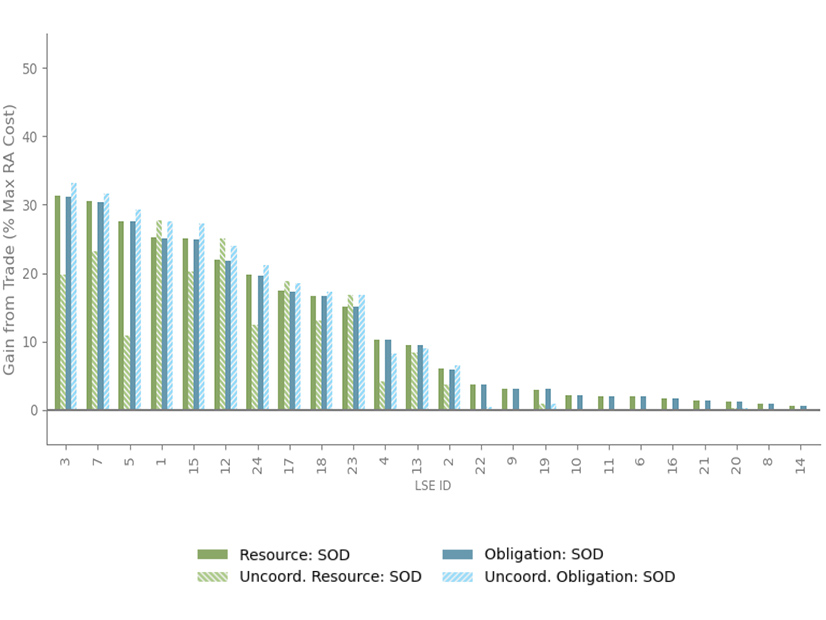
However, in the SOD program’s first year, many LSEs had more resources than needed, while other LSEs did not have enough, CalCCA’s paper says. This outcome “suggests there are additional opportunities for trade that are currently unrealized due to regulatory barriers,” it says. It therefore argues for an hourly obligation trading model in order to reduce costs to consumers.
“This is about fairness and common sense,” CalCCA CEO Beth Vaughan said in a press release. “Let’s stop making energy providers buy more capacity than they need, and let’s stop making Californians foot the bill.”
CalCAA estimated that average RA prices could decrease by $1/kW-month for every 1-GW demand reduction in the new hourly model. The reduced demand for RA products on the market lowers the price of RA and the cost of meeting RA obligations for all California LSEs.
Reducing the cost of RA in California has grown in importance in recent years following the rapid increase in RA prices, the paper says. For example, the weighted-average RA price was $2.77/kW-month in 2019 but increased by a factor of nine to $26.26/kW-month in 2024, according to the paper.
Policymakers should support the development of effective trading mechanisms that go hand in hand with the transition to SOD, CalCCA’s paper says. Otherwise, the SOD program will drive up costs for consumers with no direct benefit to reliability.
But CalCCA noted that its study is based on simulations and that a “real-world” implementation would require a much more in-depth investigation.
“Implementing an effective trading mechanism with the SOD program will not be easy,” the paper says. “Trading in the SOD policy environment is six to nine times more complex than that of the legacy monthly RA product and will require a greater volume of trades, more transactions and more trading partners.”
A key principle of CPUC’s current RA program is balancing addressing hourly energy sufficiency with advancing California’s clean energy, greenhouse gas emissions-reduction and air pollution-reduction goals, spokesperson Terrie Prosper told RTO Insider. With increasing penetration of renewable resources, CPUC sought to construct the SOD framework to better manage reliance on use-limited resources in meeting reliability needs, Prosper said.
Trading RA obligations at the hourly level would not influence natural gas generation in California, Prosper said. The RA framework — both the previous structure and the SOD — is a planning construct and does not directly determine how much gas generation will be dispatched in the energy markets.