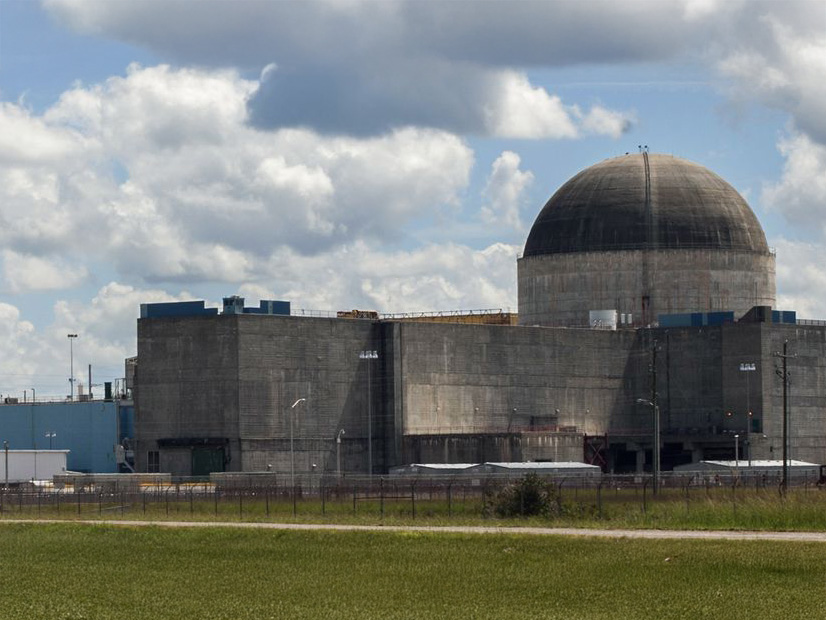
Past talk about a nuclear renaissance has mostly produced aborted projects. But with demand growing and some in the industry still focused on climate change, utilities again are considering the resource for their long-term plans.
After the Fukushima accident in Japan — and the advent of cheap shale gas — the only two nuclear projects to move forward were the Tennessee Valley Authority’s Watts Bar Unit 2, completed in 2015, and Southern Co.’s Plant Vogtle Units 3 and 4, completed in 2023 and 2024.
A neighboring utility, Duke Energy, recently submitted a report to the North Carolina Utilities Commission outlining what reactors have been developed and built around the world recently, as well as detailing its own plants and where it could build new ones. The firm is not moving ahead with any major investments yet, but its integrated resource plans contemplate adding more than 11,000 MW of new nuclear capacity in the Carolinas by 2050, Duke spokesperson Anne McGovern said.
“The deployment of any new technology will be contingent on ensuring safety, affordability and reliability,” McGovern said. “To move forward with a decision on new nuclear generation, we will need to address several key items: the maturity of the technology and the supply chain to support it; cost overrun protection to protect our customers; federal tax credit certainty; and the ability to recover costs on a more timely basis to lower the overall costs of these projects for customers. We will have an opportunity to update state commissions on our progress regarding the potential for future new nuclear investments later this year.”
Duke has selected a 1,000-acre site near the Belews Creek Steam Station in North Carolina for a potential advanced nuclear deployment, and it could submit an early site permit application to the Nuclear Regulatory Commission in late 2025. The utility also has kept its combined license from the NRC for its canceled W.S. Lee III plant in Cherokee County, S.C., which gives it the option to build two Westinghouse AP1000 units (the kind used at Vogtle 3 and 4) at the site, McGovern said.
The Lee plant, first proposed in 2007, was part of the last wave of interest in nuclear energy. Around the same time, Progress Energy Carolinas asked the NRC to approve a combined operating license application for additional reactors at the Shearon Harris Nuclear Plant site in North Carolina. Duke merged with Progress several years later, and it has kept the permit request effectively on life support, where it could advance it in the future, according to the report filed with the NCUC.
Even at the Lee site, the report notes, the license would need to be revised to update it for lessons learned from the construction of Vogtle Units 3 and 4.
Plant Vogtle’s initial price tag of $14 billion already was high, but the final bill was more than $30 billion, which helped scare other utilities away from building nuclear plants as natural gas and renewables are far cheaper. The experience there has many who watch the industry focused on small modular reactors for the next wave of nuclear development.
“We’ve seen that it’s very expensive right now,” Brattle Group Principal Dean Murphy said in an interview. “The promise for SMRs is that they’re small enough that we’ll be able to build them in a factory and deliver them on a barge or a rail car and install them. And maybe that’s true, and maybe that’s the pathway to get the cost down by a lot.”
In the long term, Murphy is bullish on nuclear energy’s future, but he predicted it would take decades for it to ramp up to where it is being installed at scales similar to gas plants, solar or wind today. The next plant built is likely to be expensive, but if it works out, more will follow and costs should drop. That, however, could take until the second half of the century to ramp up in a major way.
Part of the reason Vogtle cost so much was because it was starting construction after a 30-year pause in the U.S., Georgia Public Service Commissioner Tricia Pridemore told the Electric Power Supply Association’s Competitive Power Summit in early April.
“Please, can we get more nuclear before that workforce and that supply chain that we struggled and bled for to bring up for Vogtle Units 3 and 4 atrophies?” Pridemore said.
Murphy said the rest of the industry would need to see a new nuclear plant — or two or three — successfully developed and then run for a while before it is confident enough to move ahead with others. That might lead to a second wave that is five times as many as the first small batch.
“Then those are going to have to go pretty well before people jump in and commit on a broad scale,” Murphy said. “And that gets you out to sort of midcentury before we’re really engaging heavily in building a whole bunch of nuclear.”
Vogtle was planned well before artificial intelligence moved from the pages of science fiction novels to the business press, but its completion came just as demand growth started to take off.
Demand growth helps when you are making big, lumpy investments in new generation such as nuclear because it almost always is overbuilt somewhat, Murphy said.
“If demand is growing faster, you’re going to catch up much sooner, and you’re not hanging out with an excess of capacity for nearly as long,” he added.
Both Southern Co. and Duke are vertically integrated firms, which Murphy said could help them in their efforts. A large investment in infrastructure needs some guarantees on its future revenue, and state regulators in those states can push costs, including overruns, through to ratepayers.
“But then, even in a vertically integrated market, regulators might put some limits on how much cost you can pass through, and if you overrun that limit, then that can come back to bite you,” Murphy added.
North Carolina also has another key policy Murphy sees as important for nuclear development: a climate law, HB 951, that requires net-zero emissions by midcentury.
“A greater focus on clean energy and climate change could increase the value of nuclear, because it’s about the only thing that can provide clean energy and provide firm capacity,” Murphy said.
Even states like California and New York could turn to nuclear in the future to meet their midcentury climate targets, which also include meeting new demand from electrifying heating and the growth in electric vehicles, Murphy said. While much of that work can be done with technologies that are cost competitive today, the industry needs some kind of dispatchable, emissions-free resource to get to a 100% clean grid, he said.