The California Energy Commission approved three integrated resource plans for publicly owned utilities as the state prepares the grid to meet peak loads this summer.
The California Energy Commission (CEC) approved three integrated resource plans or publicly owned utilities as the state prepares the grid to meet peak loads this summer.
The first IRP approval went to Burbank Water and Power (BWP), which has more than 105,000 residents and is expecting electricity demand to increase in coming years due additional commercial development and electric vehicle chargers, the CEC’s report says. BWP’s peak demand is estimated to increase from 277 MW in 2023 to 323 MW in 2030 — or about 2.7% per year, CEC staff said.
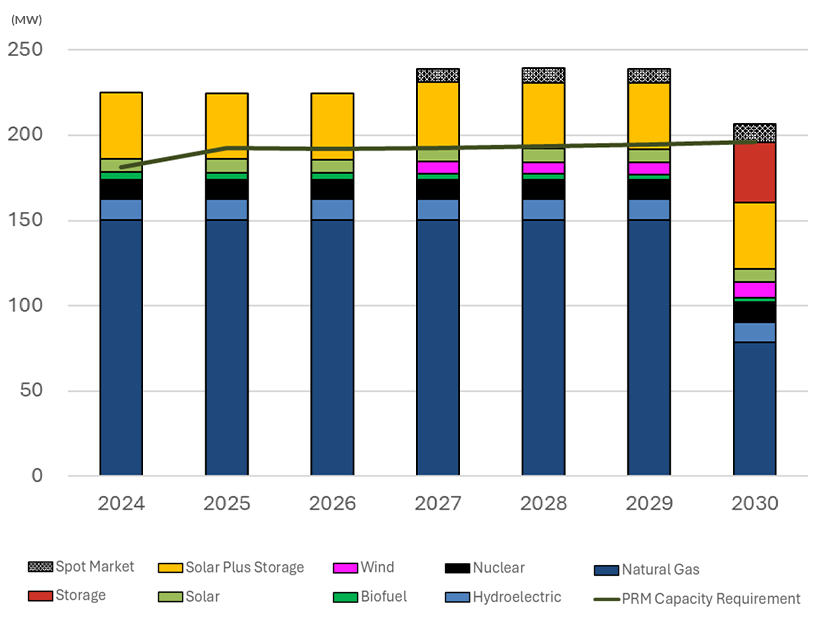
From 2025 to 2027, Burbank will fall short of meeting its own capacity requirements, but it has an agreement with the Los Angeles Department of Water and Power allowing it to purchase reserve resources from LADWP. A critical project for the utility is a 3-MW solar plus storage project located at the Burbank Airport, scheduled to turn on in 2027.
The CEC also approved an IRP for Vernon Public Utilities (VPU), which has about 1,900 customers and a peak load of about 189 MW. In 2022, VPU terminated all three of its transmission contracts with Southern California Edison and LADWP, saying these contacts were not economical for its ratepayers, the CEC report says. VPU’s peak load occurs between 10 a.m. and 2 p.m. Monday through Friday, and during these hours CAISO has recorded some of the lowest emission intensity values, including zero, as increasing amounts of solar generation are connected to the system, according to the report.
The final IRP approval went to Redding Electric Utility (REU), which has about 45,000 customers. REU’s forecast peak demand in 2030 is 227 MW — down from 241 MW in 2018 and 253 MW in 2006. Redding utilities connect to California’s transmission grid through two substation facilities owned by the Western Area Power Administration. In August 1995, REU signed a 40-year transmission agreement with WAPA. REU plans to procure 60 MW of energy from a solar project beginning in 2026.
The commission also has amended a $30 million grant with Form Energy, reducing the grant to $25 million, decreasing the project’s energy storage system size from 5 MW to 1.5 MW and increasing match share from $6 million to $25 million.
The project size was adjusted to better align with the charging capacity of the Mendocino substation, a Form Energy spokesperson told RTO Insider. An original study of the project indicated the site could support a discharge capacity of 5 MW and charge capacity of 4 MW, but a secondary study completed in 2024 found the interconnection charging capacity was closer to 1.5 MW on average, the spokesperson said. The project initially was estimated to come online by 2025 but now is expected to come online in 2026, the spokesperson said.
If completed, the project will be the first multiday energy storage project in California. The project grant is funded by the CEC’s Long Duration Energy Storage program, which is for non-lithium technologies with more than eight hours of energy storage.