Editor’s Choice is a curation of timely opinion writing on energy and the electric grid. Here’s some of what we found interesting this week:
The April 28 blackout in Spain is a clear warning that pushing the grid toward 100% inverter-based resources can lead to a grid that is vulnerable to major blackouts, writes energy analyst and author Meredith Angwin.
On her Substack, “The Electric Grandma,” Angwin wrote: “The Iberian grid was depending heavily on solar, and the solar was depending heavily on switches. The switches have a fancy name (inverters), but at the core, they are still switches. Thermal (gas, coal, nuclear) power plants and hydro plants run on a different system: They have huge spinning generators, not inverters. The generators are big; they are spinning; and they want to keep spinning. They have inertia.”
(For more context, see CNBC coverage: “Spain’s Unprecedented Power Outage Sparks a Blackout Blame Game over Green Energy.”)
Angwin likens the Spanish outage to the Odessa incidents in Texas in 2021 and 2022. “During the first one, in May 2021, a surge arrestor tripped at a combined cycle power plant, and the power plant (192 MW) went offline. Quickly following the power plant going offline, 1,100 MW of [inverter-based] wind and solar went offline.”
She continues: “How does the Texas situation compare to the situation in Spain? In Spain, total power was supposed to be about 25,000 MW online. At the time of the blackout in Spain, wind and solar PV (IBRs) provided 72% of the power, and synchronous plants provided 28%.
“In other words, Spain had too many IBRs (switches) and not enough traditional (spinning) generation.”
Texas Heat and Legislative Priorities
Doug Lewin, president of Stoic Energy and host of the Energy Capital podcast, writes frequently about the Texas Legislature’s activities in “The Texas Energy and Power Newsletter” on Substack.
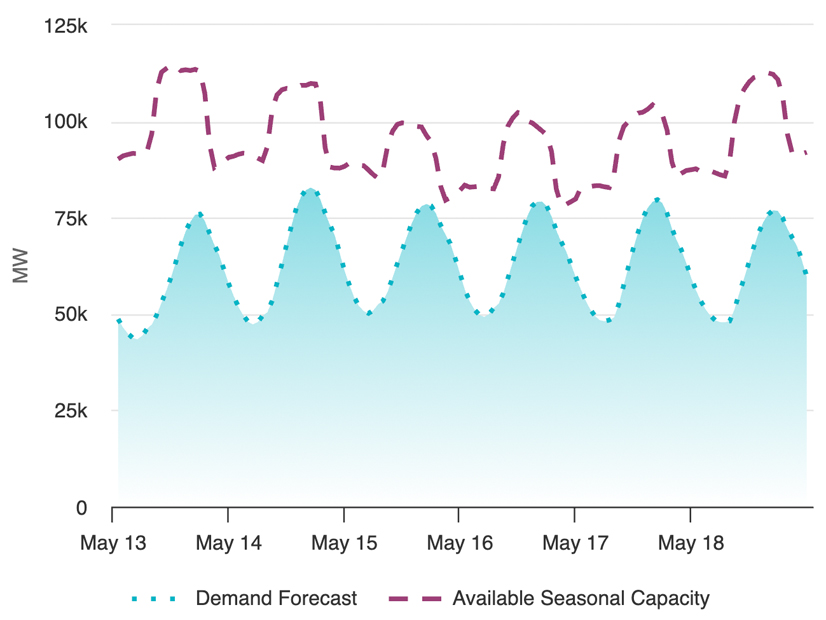
Writing May 12, he says ERCOT is forecasting a peak of over 84 GW, “which would shatter the previous May record of 77 GW and even threaten the all-time demand record. ERCOT expects plenty of extra capacity despite large thermal power plant outages; solar power is expected to deliver well over 20 GW.
“Even at peak, ERCOT expects outages to remain above 16,000 MW. These kinds of spring heat waves are becoming more common, and renewables and storage are a major part of preventing outages.”
However, bills advancing in the Legislature to promote fossil fuels and discourage renewables could make a huge difference, he maintains. “Should various anti-energy bills (SB 715/HB 3356, SB 388, SB 819) become law, these kinds of events would almost certainly create energy emergencies.”
He writes: “The idea among some policymakers and advocates that you can run the whole system on thermal power plants and reduce the risk of outages ignores the reality that there were outages in 2006 and 2011 before renewables were very significant.”
Solar energy naturally peaks during a heat wave when air conditioning is needed most.
“Solar output is expected to be over 21 GW at the time the peak is reached. There is only a small chance of a conservation call, much less an energy emergency, despite the high levels of thermal outages so late in the outage season.
“Grids are systems, and renewables and gas strengthen each other and help us avoid emergencies.”
Large Power Transformers and Tariffs
The Trump administration and China seem to have entered a (temporary, at least) truce in the ongoing trade war over tariffs.
Another Substack writer, Mary Geddry, draws attention to the importance to the grid of large power transformers, and how they are mostly produced overseas. “America’s electric grid may be one weather event or rifle shot away from catastrophe.
“These behemoths, up to 800,000 pounds each, are essential to high-voltage transmission. Only about 20% of the United States’ transformer needs are met domestically.”
She continues: “And if a Carrington-class solar flare or coordinated sabotage event hit the grid, there is no strategic reserve of spares. The result would not be a power outage. It would be a systemic collapse.”
She describes a close call: “In 2013, a few small-caliber bullets fired at a California substation nearly triggered a blackout across the Western U.S. That wasn’t a fluke. It was a warning.
“A single point of failure in the grid, like the destruction of a high-voltage transformer, can ripple outward, tripping automatic shutdowns and overloading parallel systems in a cascading domino effect. Hospitals, data centers, emergency services and water treatment plants can go offline. Traffic grinds to a halt. Supply chains stall. Even brief outages can result in billions in losses.”
If you have opinions you would like to share, follow the Stakeholder Soapbox guidelines.