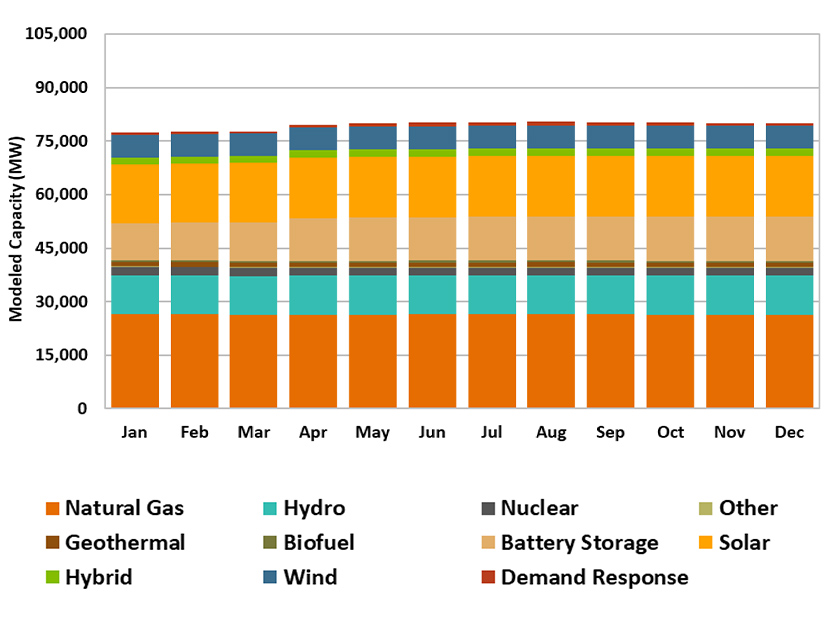
California is expected to meet its peak demand this summer under most weather conditions due to thousands of megawatts of new energy resources — almost all battery storage — that have come online in the past year, CAISO said May 12.
Over the past eight months, more than 3,300 MW of new resource capacity have been added to CAISO’s operating area, and an additional 2,163 MW of new capacity are expected online by the end of June. These additional resources will help the state meet a projected peak demand of about 46,000 MW in September and have 1,451 MW left over for meeting a one-day-in-every-10-years loss-of-load event, a May 5 report from CAISO found.
Almost all the new resources that have been connected to the grid over the past year have been battery and solar: 3,634 MW and 1,122 MW, respectively. An additional 219 MW of wind and 5 MW of biofuels have been added over the same time.
Every year, CAISO publishes a summer loads and resources assessment, which now is based on a probabilistic methodology rather than a deterministic evaluation of anticipated summer conditions, the report says. Summer assessments do not account for extreme events, such as extreme drought, wildfires and the potential for widespread regional heating events and other disruptions, the report says.
CAISO will monitor demand forecasts seven days in advance to determine if it has enough resources and look for potential grid impacts, Nathaniel Brown, CAISO senior customer readiness trainer, said at a summer readiness meeting May 12.
“Picture for a moment that you check the weather in your phone app,” Brown said. “Usually, you get a seven-day outlook, right? This is basically what we are trying to do … with our seven-day resource adequacy trend.”
“We’re trying to get ahead and forecast everything we can,” Brown continued. “Will there be high temperatures? Will there be a shortage of some kind? Will there be a transmission line down somewhere? If we can find out early, that’s when we want to find out.”
At the meeting, Brown asked resource providers to notify scheduling coordinators of any resource performance issues through email. Scheduling coordinators then are responsible for coordinating with resource owners and scheduling desks to ensure corrective actions are being taken, he said.
Communication between scheduling coordinators and providers will be key this summer to ensure control of resources, Brown said. Providers also will need to respond to operating instructions in a required amount of time based on tariff requirements; submit detailed outage cards reflecting physical limits; and be ready to respond to emergency notifications, among other requirements, he said.
During a grid emergency, CAISO could issue emergency notifications, such as flex alerts, asking customers to conserve power. If firm load shed is required, the associated balancing authority will restore firm load as soon as system conditions allow, Brown said.
Additionally, during an extreme weather event, California could restart a set of once-through-cooling (OTC) gas generation plants. In August 2023, the State Water Board decided to keep open the Alamitos, Huntington Beach and Ormond Beach OTC generating stations for three more years until Dec. 31, 2026. The plants offer about 2,800 MW combined of generation capacity and would be available as part of California’s Electricity Supply Strategic Reliability Reserve Program during extreme weather events, the report says.