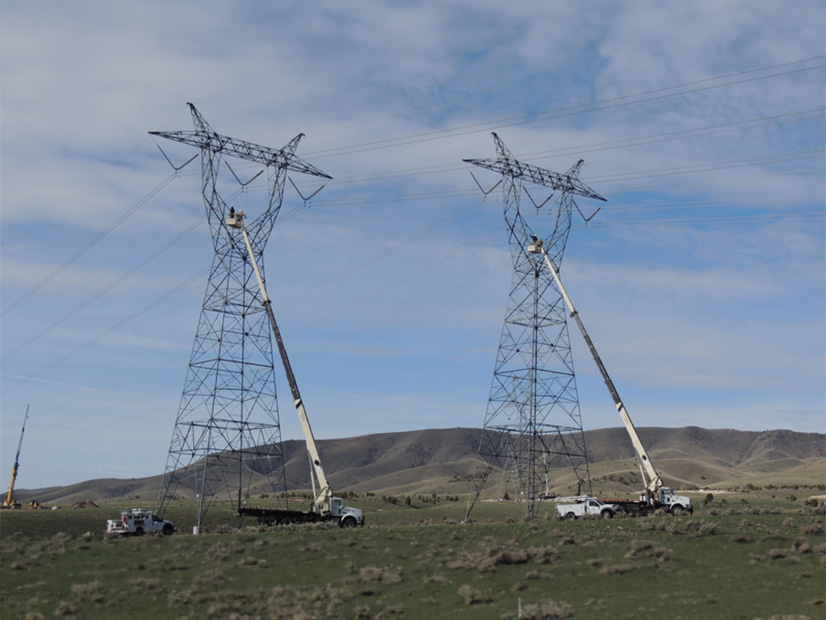
FERC has approved transmission incentives for Valley Link Transmission, which is building a portfolio transmission project to bring more power to serve data centers in Virginia (ER25-1633, EL25-77).
Valley Link is a joint venture between Dominion Energy, FirstEnergy and Transource Energy, the last of which is its own joint venture between American Electric Power and Evergy. The lines will connect the AEP system in western PJM to Virginia and include two greenfield, multi-zonal 765-kV transmission lines and four greenfield substations.
The $3 billion portfolio represents 417 miles of new transmission and will cut across Maryland, Virginia and West Virginia with Valley Link subsidiaries set up in each state. It was approved by PJM under the 2024 Regional Transmission Expansion Plan to help deal with load growth from data centers.
Valley Link proposed forward-looking formula rates, a base return on equity of 10.9%, an abandoned plant incentive allowing developers to recover all costs if the project fails, a 100% construction work in progress (CWIP) incentive, a 50-basis-point adder for participating in PJM and recovery of all prudently incurred precommercial costs.
Though it approved the portfolio’s incentives, FERC established hearing and settlement judge proceedings to examine the proposed formula rates for the venture’s subsidiaries, saying it had not shown they were just and reasonable.
The Potomac-Appalachian Transmission Highline, a project in the same region that also was meant to increase west-to-east power flows but ultimately canceled in 2011, came up repeatedly in the case. Both were 765-kV lines that crossed the same three states, and developers of the failed project invested significant ratepayer funds before even winning approval from states. One of the sections of Valley Link follows a path similar to the older project. (See Christie Blasts FERC Transmission Incentives in PATH, Brandon Shores Orders.)
Some protesters argued Valley Link could suffer the same fate as PATH if projected data center demand comes in lower than expectations, or more local generation is built to serve that load.
“Like with PATH, PJM approved Valley Link to solve a static snapshot of speculative need, and that long-term and uncertain planning, combined with overly generous transmission incentives, is what cost ratepayers more than $250 million in the PATH case,” FERC said in summarizing the arguments of Keryn Newman, a citizen activist who successfully challenged AEP and FirstEnergy’s cost recovery for the abandoned project.
Valley Link said waiting to grant the abandoned plant incentive until it gets state permits goes against the Federal Power Act and FERC’s regulations. Comparisons to PATH are without factual basis, it argued: The only similarity is both projects are designed to improve west-to-east flows.
FERC rejected the company’s hypothetical capital structure of 60% equity and 40% debt, but it also set the matter for settlement hearings. The commission found that the 60/40 proposal would not ensure just and reasonable rates.
Valley Link’s request was approved May 13 by just three of the four FERC commissioners, with Lindsay See not participating, and Chair Mark Christie and David Rosner filing partial dissents. Christie, who has protested transmission incentives since joining the commission, opened his dissent with a Yogi Berra quote: “It’s like déjà vu all over again.”
“As I have said repeatedly over the past four years, it is long past time for this commission to do its job of protecting consumers by cutting back on its unfair practice of handing out ‘FERC candy’ without any serious consideration of the impact on consumers already struggling to pay monthly power bills,” Christie wrote. “The statute simply does not mandate such lavish generosity to developer interests at the expense of consumers.”
Specifically, Christie dissented against granting the CWIP, the abandoned plant incentive and the RTO participation adder.
“The present case graphically illustrates the fundamental unfairness of the commission’s practices regarding incentives,” Christie said. “First, it is noteworthy that in this case — just as in PATH — no necessary state approval to construct has been awarded to the project.”
The majority justified handing out “candy” because FERC previously found that projects approved through regional transmission planning will help solve reliability and/or congestion issues.
“Reliance on regional transmission planning in lieu of state approval to construct is a significant problem with FERC’s policy,” Christie said. “This practice is indefensible and always has been.”
Beyond the lack of regard for states that have siting authority, Christie said granting incentives has become a check-the-box exercise at FERC.
“Every transmission developer seems to cite the same reasons for the same incentives — e.g., the CWIP incentive mitigates the impact on the developer’s financial metrics, and the abandoned plant incentive mitigates regulatory risks, etc.,” Christie said. “Coincidentally, this is one of the reasons identified in Order No. 679 and parroted by developers in every proceeding.”
He repeated his argument that it’s time for FERC to change its incentive policies under a workable compromise that balances consumer protection and developer interests. That would involve granting them to projects that have been approved by states “because the project would have been deemed needed and cost-effective in a serious state CPCN proceeding, and, should it ultimately not be built due to reasons beyond the control of the developer, recovery of the costs of the project to date along with incentives would presumptively be fair to the developer who proceeded with due diligence to build the project with the state’s imprimatur,” Christie said.
Rosner’s dissent was over the proposed capital structure, saying he would have approved it because it made sense for a newly formed joint venture entity and calling the rejection a departure from precedent.
“Rather than adhering to that precedent, today’s order appears to introduce a new evidentiary standard for approving a hypothetical capital structure, without prior notice to the applicant that it would be subject to new criteria, and applies that new standard to reject Valley Link’s request,” Rosner said. “Further, the majority departs from precedent even though it is unclear if a majority of commissioners will agree to do so for the next similarly situated request.”
Rosner said he agrees that FERC can grant incentives in a way that ensures just and reasonable rates, but that only enforces his arguments about precedent. Changing policies on a one-off basis with no notice and underdeveloped records is not the way to do it, he said.
“I do not support changing the commission’s transmission incentives policies piecemeal, without fully understanding how those changes may affect investments in transmission infrastructure — particularly when many projects that request these incentives are needed to maintain reliability,” Rosner said. “Doing so introduces regulatory uncertainty and risks undermining Congress’ purpose in enacting FPA Section 219, all at a time when it is clear that the nation badly needs significant investments in new transmission infrastructure to meet the largest demand growth that the country has seen in a generation.”
The Valley Link portfolio is meant to avoid disturbances on the grid, which heighten the risk of power outages that could occur if the load growth shows up without the transmission, Rosner said.
“Reliability benefits cannot be much clearer than this,” Rosner said. “Thus, to carry out the commission’s paramount duty entrusted to it by Congress — to ensure the operational reliability of the bulk power system — and to satisfy Congress’ directive in FPA Section 219 to unlock investments in transmission projects that enhance reliability, it follows that the Valley Link project portfolio should be eligible for incentive-based rate treatments, including, among others, a hypothetical capital structure within the range that the commission has previously granted to numerous similarly situated projects. Yet, today, the majority changes course and singles out this project portfolio to be its test case for a novel policy change.”