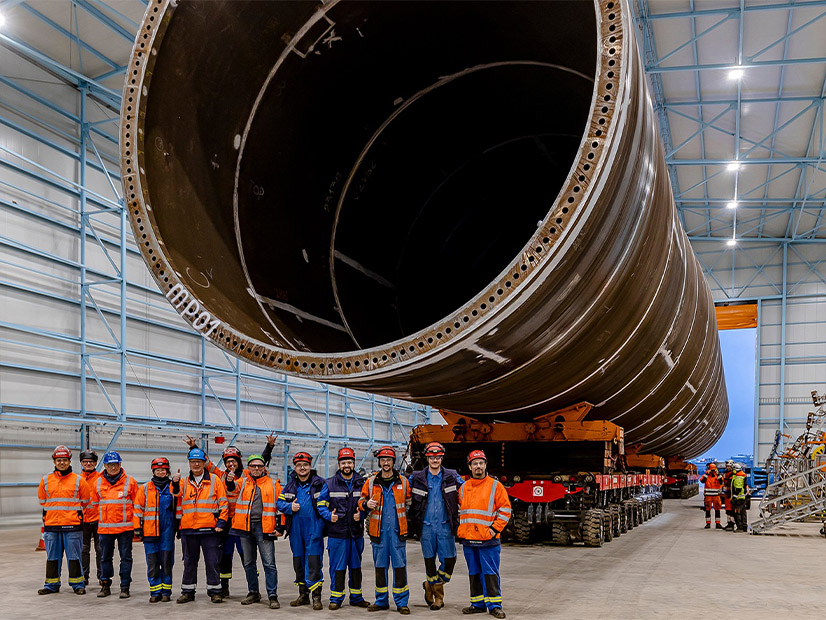
The Empire Wind project off the coast of New York is back from near death after the U.S. Bureau of Ocean Energy Management lifted a stop-work order and its developer Equinor announced it would move forward.
“We appreciate the fact that construction can now resume on Empire Wind, a project which underscores our commitment to deliver energy while supporting local economies and creating jobs,” Equinor CEO Anders Opedal said in a statement May 19. “I would like to thank President Trump for finding a solution that saves thousands of American jobs and provides for continued investments in energy infrastructure in the U.S. I am grateful to Gov. [Kathy] Hochul for her constructive collaboration with the Trump administration, without which we would not have been able to advance this project and secure energy for 500,000 homes in New York.”
The stop-work order was issued on April 16 and was criticized by New York officials and renewable energy advocates. The 810-MW project is planned for just off the coast of New York City and would connect to the grid at a site in Brooklyn. (See Feds Move to Halt Construction of Empire Wind 1.)
Hochul welcomed the change in course from the Department of the Interior, saying in a statement she had spent weeks working with the federal government to ensure the project could move forward.
“Equinor will resume the construction of this fully permitted project that had already received the necessary federal approvals,” Hochul said. “I also reaffirmed that New York will work with the administration and private entities on new energy projects that meet the legal requirements under New York law. In order to ensure reliability and affordability for consumers, we will be working in earnest to deliver on these objectives.”
Interior Secretary Doug Burgum posted he was pleased with Hochul’s comments.
“I am encouraged by Gov. Hochul’s comments about her willingness to move forward on critical pipeline capacity,” Burgum posted on X. “Americans who live in New York and New England would see significant economic benefits and lower utility costs from increased access to reliable, affordable, clean natural gas.”
Burgum is correct directionally, but the project at issue, the Constitution Pipeline, would increase supply for some natural gas customers, while the pricing problem in the Northeast comes in winter at peak electricity demand, when generators cannot access the gas they can at other times of the year.
Trump has spoken publicly in favor of reviving the project, and the executive order setting up the National Energy Dominance Council, which Burgum chairs, calls for approving pipelines into New England.
FERC approved the Constitution Pipeline more than 10 years ago, but it did not get a permit from the New York State Department of Environmental Conservation. Developers effectively asked FERC to overrule the state, but in 2018 the commission denied the request, with three Trump nominees all voting for the order.
Hours before BOEM reversed course, in a talk largely focused on how Trump’s election was leading to more capital flowing to fossil fuels, 1PointSix CEO Terrence Keeley criticized the decision to stop work on the project. Halting work on a permitted project funded by Norway’s state oil company that was about a year from delivering electricity to the grid “seemed punitive,” he said.
“You can say goodbye to foreign direct investments in the United States for any type of project, renewable or unrenewable, when that type of unreliability becomes commonplace,” Keely said.
American Clean Power Association CEO Jason Grumet made a similar point in a statement calling the decision to move forward with Empire Wind good for reliability.
“Fully permitted projects must have policy consistency and certainty to deliver the infrastructure required to meet America’s growing electricity demand,” Grumet said. “Our nation needs all types of energy infrastructure to lower energy prices and support economic growth. In lifting the stop-work order, the administration has honored a principle that is essential to all infrastructure investment.”
At a Federal-State Current Issues Collaborative meeting on gas-electric coordination in April, ISO-NE CEO Gordon van Welie testified that the region has been dealing with constrained gas at peak demand for decades, and it leads to high prices as reliability is dependent on attracting LNG cargoes when demand also is in Europe and Asia. (See FERC-NARUC Collaborative Examines Ongoing Issues with Gas-electric Coordination.)
A decade ago, FERC found a creative attempt by the New England states to require electric utilities to pay for extra pipeline capacity outside of its authority. Since then, states have focused on imports from Canada and offshore wind development to hedge against price volatility in the winter, van Welie said.
“Recently, the issue of affordability has been given more emphasis, and the idea of possibly investing in additional gas infrastructure has resurfaced,” van Welie said. “However, it isn’t clear if there is an available counterparty in New England to commit to the long-term contracts that will be required. So, in summary, any viable solution to the gas constraint issues must involve, and requires the support of, state officials.”
The move to increase pipeline capacity in the Northeast is opposed by environmental groups, with Food and Water Watch noting in a statement that Hochul already has approved major fossil fuel expansions in recent months, including new compressors for the Iroquois pipeline.
“If Gov. Hochul moves to revive the Constitution Pipeline — or any other fracked gas pipeline project — it would be a reckless and unacceptable capitulation to President Trump and the polluting fossil fuel interests backing him,” said Laura Shindell, the group’s New York state director. “This pipeline was defeated already because the overwhelming majority of New Yorkers refused to be collateral damage for the gas industry. Turning her back on communities to appease polluters would be an astonishing failure of leadership. If Hochul decides to go down this foolish path, she will be met at every turn by the full force of New York’s energized climate movement. She will certainly regret it.”