New Jersey legislators have backed a package of clean energy bills to promote small modular nuclear reactors and to better deal with data center issues.
New Jersey legislators have backed clean energy bills that include efforts to promote the development of small modular nuclear reactors and enable the state to better deal with data centers.
The Senate Environment and Energy Committee approved S4423, which would enable the Board of Public Utilities (BPU) to authorize site approval for a small modular reactor (SMR) in a municipality where a nuclear facility previously was located. The agency could supersede municipal and county decisions to authorize reactors able to generate 300 MW of power or less. The reactors would be licensed by the Nuclear Regulatory Commission, and nuclear fuel would be stored on-site.
In a separate vote, the full Senate on June 2 voted 38-0 in support of a third data center bill, A5466, which would direct the BPU to study the “effect of electricity usage by data centers on electricity rates in the state.”
The bill, which goes to the governor’s desk, would require the study to look at:
-
- Cost allocation, to determine if other electricity customers “unreasonably subsidize” the costs of data centers.
- Whether other customers incur “unreasonable rate increases” to support new transmission, distribution or generation facilities that serve data centers.
- Policy alternatives such as “the use of a special tariff to be applied to data centers, that could be used to mitigate or avoid rate increases caused by increased electricity demand by data centers.”
Fixing an Energy Shortfall
The votes come as New Jersey, an importer of energy, searches for ways to boost its generating capacity. Demand for electricity is expected to rise dramatically over the next decade, fueled in part by the growth in electric vehicle use and the needs of data centers. PJM says its region, which includes New Jersey, faces an energy crunch because new generating sources aren’t coming online as quickly as old, fossil-fueled sources are closing.
The nuclear and data center bills were among a slew of bills — including initiatives focused on storage, solar and geothermal energy — aimed at boosting the state’s clean energy resources and curbing energy use.
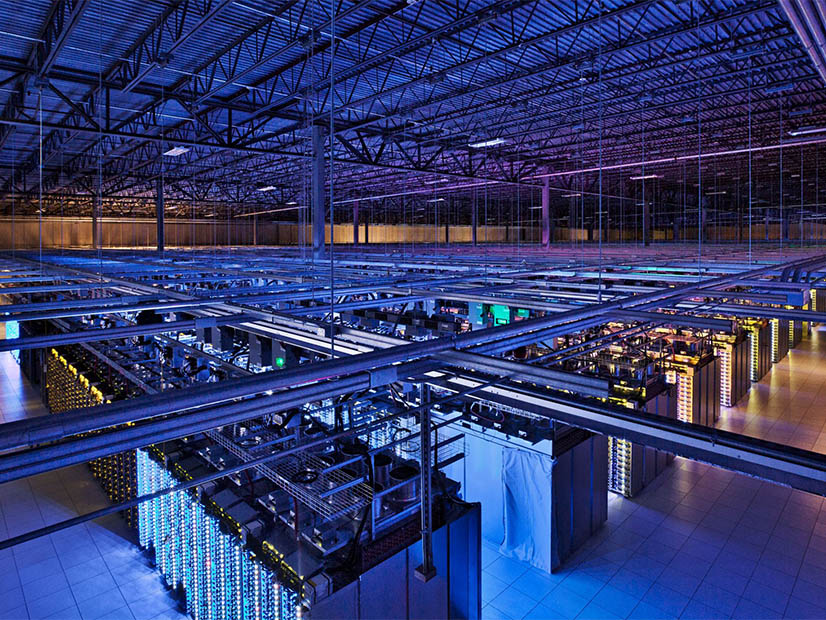
Two bills moved by the Senate committee address the expected arrival of data centers, including those supporting artificial intelligence capability. The committee backed S4293, which would require the owner or operator of a data center to prepare an annual report to the BPU of the facility’s water and electricity use.
The report also should include “basic information” on the facility and “performance calculations and indicators for the data center, including the energy reuse factor, power usage effectiveness, renewable energy factor and water usage effectiveness.”
Opposing the bill, Ray Cantor, a lobbyist for the New Jersey Business and Industry Association, said the bill would needlessly add a burden to data centers that might consider coming to the state. State requirements already ensure water permits are not issued unless there is sufficient water, he said.
“From an energy perspective, these data centers are either bringing their own energy, or they’re using energy off the grid, and that’s all being accounted for,” he said.
“On the one hand, we have policies in the state, and the governor has mentioned this as well, where we want business to come and locate here in New Jersey,” he said. “And then [on] the other hand, we pass legislation like this, which, while it’s not the end of the world from a regulatory perspective — it’s just another thing that’s being required. And it’s another thing that’s being required that doesn’t need to be required.”
Erecting Roadblocks
Cantor said he had similar concerns about another bill later backed by the committee, S4307. It aims to protect ratepayers from shouldering the burden of the development of generation systems that support data centers.
The bill is designed to incentivize data centers to increase energy efficiency, including through the use of technologies that use the heat produced by the data center. In addition, it would require that the BPU review each application to ensure the data center creates and submits a tariff that demonstrates the facility’s compliance with the law.
Cantor said enticing data centers to move into the state would be difficult if “we’re continually putting roadblocks in the way or making it more expensive or problematic to develop here in New Jersey.”
“We recognize that data centers are large energy users,” he said. “But they’re not the only large energy users. We have large manufacturing plants that use as much or more energy than data centers. Even hospitals could use more energy than a data center. And yet we don’t single them out for special treatment.”
Senate Environment and Energy Committee Chair Bob Smith said the bill “is absolutely a response” to a $20 hike in the average electricity bill that took effect June 1. State officials say the increase, set by the state’s Basic Generation Services auction, was triggered in large part by PJM’s capacity auction in July 2024, which included a massive jump in prices compared to the previous auction. PJM officials attributed the jump in part to high-demand data centers.
Doug O’Malley, director of Environment New Jersey, disputed Cantor’s claim, saying data centers can be far larger than community institutions, using as much as 1 million gallons a day for cooling and electricity generation.
“We can’t just rely on what we have right now. That’s why this bill is so important,” he said. “This is a reminder that we cannot have water hogs, (or) an energy hog, that literally spikes electricity rates (for) everybody.”
The committee passed the bill with a 3-2 vote. The bill will go to the Senate Budget and Appropriations Committee.
Fixing an Energy Shortfall
In a separate vote, the Environment and Energy Committee voted 5-0 to back a bill, S4100, designed to simplify and speed up the process by which solar projects are permitted.
State officials say developing more solar is one of the quickest ways to address the pending electricity shortfall. But the bill says “New Jersey has the fifth-slowest-known solar permitting timelines of any state.”
“Vestiges of outdated, overly bureaucratic permitting requirements” cause residents to “significantly delay installation efforts and significantly increase costs incurred in installing residential solar energy storage,” the bill states.
Elowyn Corby, mid-Atlantic director for Vote Solar, in supporting the bill, told committee members that “local solar benefits our entire grid and society.”
“While large-scale solar projects are important, they are often facing multiyear delays in the PJM interconnection queue,” she said. “Local solar, on the other hand, can be rapidly deployed without these delays, addressing our immediate energy needs while giving us breathing room to bring large-scale renewables online.”
To speed up the process, the bill calls for a State Smart Solar Permitting Platform that would automate permitting. It would enhance the ability of a local agency to review permit applications and permit revisions for safety and code compliance. The platform also would enable permitting agencies to release permits and permit revisions for residential solar energy systems, residential energy storage systems and main electric panel upgrades.
The state assembly backed a version of the bill, which goes to the Senate Budget and Appropriations Committee for consideration.
Storage and Geothermal
The Senate committee also backed a bill, S4289, that would authorize the BPU to procure and incentivize transmission-scale energy storage projects capable of storing at least 5 MW and connected with PJM.
Under the bill, the BPU would create an incentive program and then solicit applications for a tranche of projects. At its conclusion, the BPU would evaluate the impact on the sector, and, if needed, launch one or more tranches. The board’s 3-2 vote sent the bill to the Senate Budget and Appropriations Committee.
Bob Gordon, a former BPU commissioner now representing a renewable energy company, argued that storage can save ratepayers money by providing energy to the grid at peak times. With the law in place, he said, New Jersey would have saved $100 million to $200 million in the coming year if the state had 500 MW to 1000 MW of transmission-connected battery storage.
“A state-led competitive-procurement program such as this will put New Jersey on the path to getting resources online and be able to provide the immediate benefits and cost relief for wholesale power costs to New Jersey,” he said.
The committee backed by a 5-0 vote a bill, S4424, that would establish a three-year pilot program to replace aging or leaking natural gas pipelines with geothermal energy infrastructure.
The bill would enable gas utilities to submit plans to the BPU for review of the project size, scope and scale, and the expected benefits. The agency would assess the ratepayer impact and whether the benefits justify the cost.