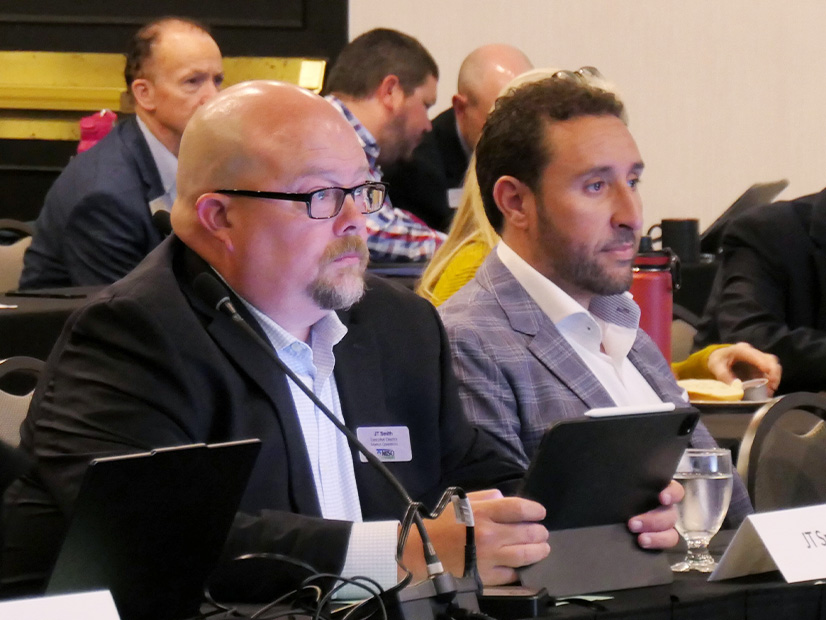
MISO conceded to its Board of Directors that it should have done more to convey the danger it perceived ahead of the late spring load-shedding event in Greater New Orleans.
MINNEAPOLIS — MISO conceded to its Board of Directors that it should have done more to convey the danger it perceived ahead of the late spring load-shedding event in Greater New Orleans.
The RTO reviewed two separate load-shedding events it was forced to take over the spring as part of its quarterly presentation during Board Week: the much discussed 600-MW event in southeast Louisiana on May 25, and the smaller, 27-MW offload it ordered at the MISO-SPP seam in Texarkana as SPP ordered load offline in the Shreveport. La., area April 2. (See SPP Addresses 3rd Load Shed Since March 31; NOLA City Council Puts Entergy, MISO in Hot Seat over Outages; and MISO: New Orleans Area Outages Owed to Scant Gen, Congestion, Heat.)
MISO Executive Director of Market Operations JT Smith said the April and May events were remarkably similar: The load shedding that was required in both cases avoided the potential for voltage collapse, and both events were brought on in part by tornado-ravaged transmission lines and scheduled maintenance being performed on generation in import-constrained areas.
“The spring was incredibly active. It was not one of the easiest springs I’ve seen overall,” Smith told the board’s Markets Committee on June 10. “These were not actions that were taken lightly.” He added that he understood the ensuing frustrations.
Smith said MISO has had time to reflect since the New Orleans outages and has concluded its channels of communication are lacking.
“It surprised everyone, and it should not have. We should have been more out with our membership … and let them know we were in this tight condition,” Smith said. MISO could have warned membership of its grid weakness and told members to ready long-lead load-modifying resources or notified utilities and regulators that public appeals would become necessary, he said.
“That was a failure on our part for not having that communication out there,” he said. “This is one where we probably had more insight than we shared externally, and we need to be better on that.”
However, Smith also said MISO only had a few moments before it became clear shedding load was necessary.
Speaking to the board June 12, MISO CEO John Bear said the RTO had a “challenging” spring. He said the 13 generation outages, six derates and a key 500-kV line outage on May 25 had everyone tense.
Bear said MISO is thinking through declarations and posting of transmission contingencies. He said that while it is good at communicating meager energy, it’s “not so good” at conveying transmission challenges.
A post-mortem analysis is ongoing, and MISO will discuss the event again and strategies to prevent it at the September board meeting in Detroit, Bear said.
Independent Market Monitor Carrie Milton said the load-shed event was “set in motion” much earlier in the spring when Entergy’s 500-kV line in the area was knocked out and the day prior when a conventional steam generator and large generator unexpectedly went offline. She agreed that the whole of spring was “very challenging” for MISO South.
Milton noted that the April 2 event was the result of severe weather that “parked” over the seam, compounded by planned, major transmission outages in SPP that dogged MISO operations in southwest Arkansas.
On May 25, MISO increased transmission demand curves on six different lines in an effort to entice more distant electricity supply to the area to no avail, she said.
The situation was made worse by online resources in the area that did not perform to their stated emergency ranges, she added. Milton also said MISO had no time to pinpoint which LMRs would have helped and said their lead times were prohibitively high anyway.
Milton said MISO should instate penalties for traditional resources that don’t operate according to their stated emergency output values during an emergency, similar to the penalties it assigns to LMRs. “Currently, none exist.”
MISO should also improve its locational awareness of LMRs so it knows which can help local system strain, she said.
Finally, Milton said MISO should set short-term reserve requirements for load pockets and develop a process to decommit resources that have a day-ahead schedule. Those two recommendations were included in the IMM’s previous State of the Market reports.
Transmission Planning Questions Crop up Again
Director Robert F. Lurie asked if the May 25 blackout might spur “investigations on the physical system” in southeastern Louisiana. He asked if MISO would consider expediting some planned transmission projects in the future or use a “blank sheet of paper” method to bring all ideas to the table to ease the constrained, load pocket situation.
Smith said the load pocket contained significant generation outages in addition to an inaccessible 500-kV line.
“It was a combination of so many things that got us to this point,” he said. Nevertheless, he said MISO’s planning team would run the probabilities of a similar situation occurring in the future and adjust accordingly.
In a later public comment period, the Union of Concerned Scientists’ Sam Gomberg seconded the need for probabilistic planning. He said the shifting energy mix and more erratic weather courtesy of climate change demands more probability-based plans.
Former FERC Commissioner John Norris said MISO’s tentative, 2026 start date on MISO South long-range transmission planning means the RTO would be planning regional transmission a full 15 years after Entergy joined. He reminded MISO that its core duty is planning transmission.
Now of counsel with Iowa-based Horizon Group, Norris said that in 2011, commissioners “were being gamed by Entergy,” and since then he has seen “effort after effort to stall transmission” by Entergy. He said there’s an “anticompetitive sentiment” in MISO South states and urged the RTO to recognize and “call out” Entergy’s stalling tactics, which he said include bickering over cost allocation.
Norris said given what he knows now, he would not have cast a vote for Entergy to join MISO. He said at the time, “none of us could have conceived” that it would take 30 years to get new transmission to assist the Midwest-to-South constraint.
The Alliance for Affordable Energy’s Yvonne Cappel-Vickery called on MISO to apply the same amount of transmission planning scrutiny to MISO South as it does to Midwest. She asked the RTO to ensure that “fair-weather load-shed events don’t happen in area that already has enough weather challenges.”
Cappel-Vickery reminded board members that even if MISO gets started on long-term transmission planning in MISO South within a few years, the first transmission lines won’t be energized until about 2040.
Andy Kowalczyk, transmission director at the Southern Renewable Energy Association; said the load shed delivered “a stark reminder” that MISO South needs more than a “reactive posture” to its system reliability risks. He said recent transmission projects proposed by transmission owners there seem to be reactions to risks as they crop up and not “part of a long-term vision.”
However, Bill Booth, a consultant to the Mississippi Public Service Commission, said MISO South utilities have recently invested billions in transmission projects.
The Holiday Weekend ‘Curse’
Director Nancy Lange said she appreciated MISO’s “candor” over its communication missteps. She asked if the RTO is contemplating how the region’s collection of resources could better serve the area.
Smith said that if MISO had its proposed load-modifying accreditation in place, it may have helped. MISO is seeking to sort its LMRs into fast- or slow-start designations and call up slower resources before emergencies occur. (See Stakeholders Ask FERC to Soften MISO’s Proposed DR Accreditation.)
However, Smith said he’s not sure that LMRs would have made a noticeable enough difference for MISO to avoid tapping out generation stores in the area.
“We were fighting congestion and import limitations on the southeast Louisiana system,” he said.
Director Barbara Krumsiek asked if MISO was reconsidering its usual spring outage season.
“We might be moving into a situation where planned outages in late May might have to be rethought,” Smith said. However, he said planned outages weren’t the main problem in this case. He said the unplanned generation outages coupled with the downed transmission were most burdensome.
Krumsiek asked if it was ironic that MISO’s latest emergency again occurred on a holiday weekend. MISO has a long-running joke among its ranks that sticky situations arise on long weekends: Winter Storm Elliott near Christmas 2022, Winter Storm Uri on Presidents Day weekend in 2021 and the Gulf Coast blizzard that began Jan. 20 on Martin Luther King Jr. Day.
Director Theresa Wise joked that MISO is “cursed” on holiday weekends.
At the MISO Advisory Committee’s meeting June 11, Arkansas Public Service Commission Administrative Law Judge Bridgette Frazier said that while the RTO isn’t public-facing, Louisiana regulators are; it could have sent word to them to make public service announcements.
Pelican Power’s Tia Elliott suggested MISO begin circulating one-pagers immediately following blackouts that explain in general terms the triggers and how they unfolded.
Cappel-Vickery said “it feels like a slap in the face” for MISO and Entergy to call the event rare when ratepayers in New Orleans regularly experience power outages.
“The typical consumer is not going to make the distinction that this is a transmission constraint versus this is a distribution-level event caused by, say, a squirrel,” Cappel-Vickery explained.
She asked Entergy, MISO and Cleco Power to make a plan on how to prevent reliability issues going forward.
“We need better answers than ‘we’ll improve communications,’” Cappel-Vickery said.
Beyond Memorial Day weekend, MISO said heavy storms and tornado activity beleaguered its members throughout spring. Load, however, peaked at 95 GW on May 15, the most subdued it has been in years.
MISO’s South and Central regions were under severe weather alerts for the first week of April, with MISO warning of freezing rain, cell formations, tornado outbreaks, high winds and hail. At the end of the month, all of MISO Midwest was under a severe weather alert because of thunderstorms, tornados and hail. Arkansas, southeastern Missouri and southern Indiana bore the brunt of large, long-lived storms.
MISO reported 61 GW of daily average generation outages over spring, the highest they’ve been in at least six years.
Entergy Arkansas reported a peak of 71,300 customer outages April 5 after the service area sustained five rounds of severe weather in a little more than a week. The utility reported widespread damage to substations, transmission towers, poles and wires.