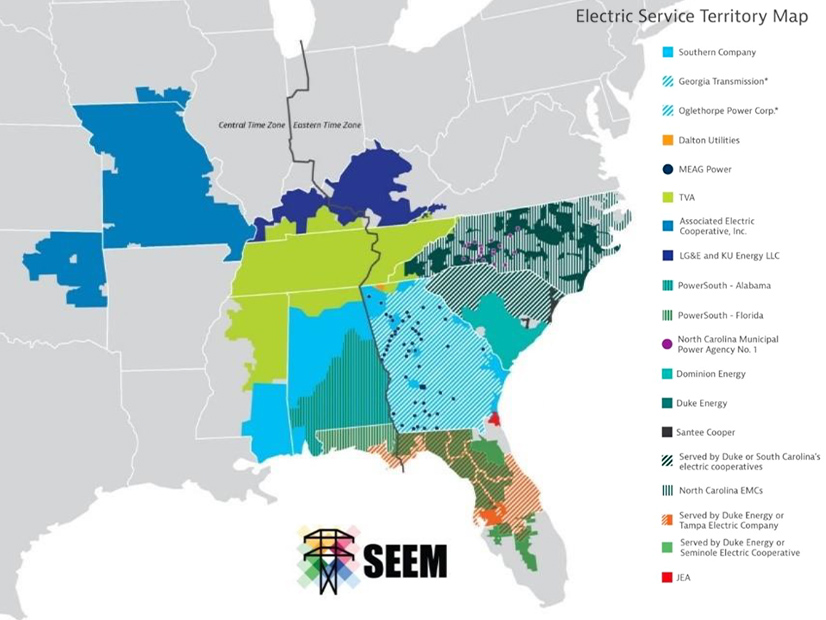
FERC responded to critics of the Southeast Energy Exchange Market, clarifying its use of the comparability standard to justify the market.
In a response to opponents of the Southeast Energy Exchange Market, FERC on June 13 clarified the legal standard it relied on in its March 14 order directing SEEM members to update the market agreement (ER21-1111).
In doing so, the commission also dismissed the opponents’ alternative request for rehearing of the order, arguing it was moot given FERC’s clarification, and improper under the D.C. Circuit Court of Appeals’ 2020 ruling in Allegheny Defense Project v. FERC that rehearing requests could not be granted “for the limited purpose of further consideration.”
The SEEM opponents, a group of 13 organizations including the Sierra Club and the Southern Alliance for Clean Energy filing jointly as the ad hoc Public Interest Organizations (PIOs), filed their request April 14, the same day SEEM’s members responded to the March 14 order. (See SEEM Opponents Urge FERC for Clarification.) FERC’s order mandated updates to the market agreement to clarify its territorial requirements and outline whether pseudo-ties could be used to satisfy them.
The PIOs claimed one part of the order — in which FERC said SEEM’s open access transmission tariff is “consistent with or superior to the pro forma OATT” based on the commission’s comparability standard — was inconsistent with precedent.
According to the PIOs, the comparability standard as first described in 1994 meant that an OATT “should offer third parties access on the same or comparable basis, and under the same or comparable terms and conditions, as the transmission provider’s uses of its system.” However, in the March 14 order, FERC said the standard “requires that comparable service be provided to comparable customers.”
Because the phrase “comparable customers” never has been used in reference to the comparability standard, the PIOs argued the commission effectively invented a new definition to apply to SEEM.
FERC denied it had redefined the standard but agreed it would be “appropriate” to clarify its reasoning. The commission said it was guided by Order 888’s articulation of the comparability standard, which said that “under a non-discriminatory open access tariff, a transmission provider must not only treat similarly situated customers similarly but also provide third parties with comparable service to what they provide themselves.”
“To the extent that … the March 2025 order can be read otherwise, we clarify that these are the standards the commission applied in reviewing SEEM,” FERC said.
The commission went on to “confirm that … SEEM affirmatively meets the comparability requirements because it offers comparable service to SEEM members … and participants, both of which must take service under the same terms and conditions.”
FERC said the question before it in the proceeding was whether all “similarly situated entities” that wanted to participate in SEEM were treated similarly, and that the territorial requirements do not amount to dissimilar treatment because entities outside the SEEM territory “are not similarly situated” to those inside.
Commissioners concluded the clarification of its language “does not impact the outcome of the March 2025 order,” which SEEM members addressed in their April 14 filing. (See SEEM Members File Market Agreement Update.)