CAISO is working on an initiative to improve the visibility of distributed battery storage resources on the grid, especially for when they are needed for resource adequacy purposes.
The additional information will allow operators to see potential real-time operational limitations of the resources on the distribution system, CAISO said in a June 30 presentation.
Part of the challenge is that distributed batteries are often operated by a local utility, which might request placing certain charging and discharging restrictions on them. Sometimes that request conflicts with CAISO’s request for the same resource. When this happens, a battery resource should follow CAISO’s request, unless human safety or electric facilities would be knowingly put at risk, the ISO said in a discussion paper.
Another challenge for CAISO is figuring out how charging constraints are affecting distributed batteries during dispatch times. For example, if a storage resource is restricted from charging in the afternoon, then it might not be able to discharge to its full capacity in the evening, the paper says.
To address this problem, CAISO could identify distributed units in its master data file using a specific flag, the paper says. This approach would provide a good first step in providing needed transparency and was supported by two stakeholders in the initiative, the paper says. However, six stakeholders preferred updating CAISO’s resource modeling tools, such as its real-time telemetered capabilities, and extending the dynamic limit tool, the paper says.
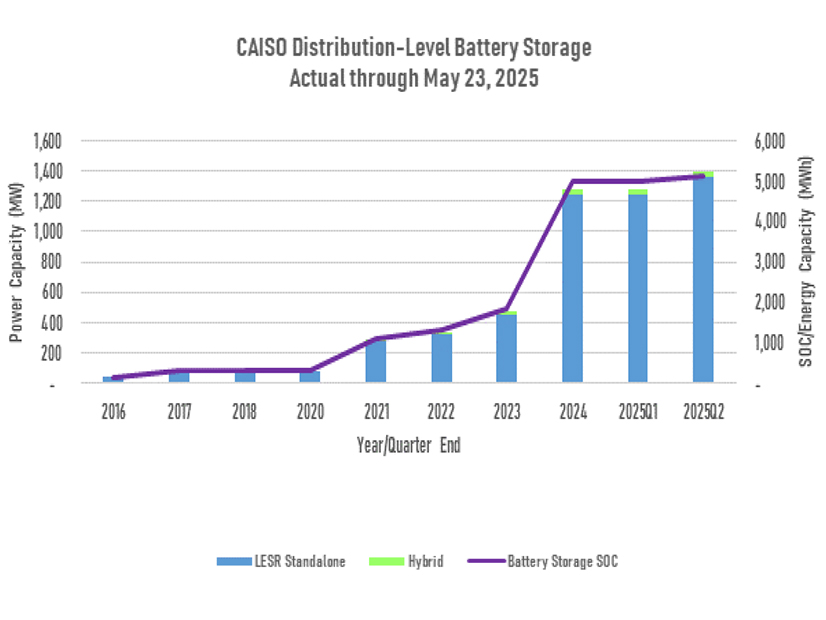
In California, distributed battery storage capacity has grown from about 330 MW in 2022 to about 420 MW in 2023 and nearly 1,400 MW in 2025. It has not grown much over the past year, however: Capacity was about 1,250 MW in 2024.
As part of the same initiative, CAISO is studying the availability of mixed-fuel resources, such as solar and battery storage facilities, on the grid. Currently, the ISO is struggling to obtain accurate and reliable data from mixed-fuel resources, specifically about a resource’s high sustainable limit (HSL). The HSL is an estimate of the instantaneous generating capacity of a variable energy resource. For this problem, CAISO proposed to evaluate how HSLs are developed in its Business Practice Manuals. Doing so could improve short-term forecasts of co-located and standalone variable resources, the paper says.
Comments on the paper are due July 16.