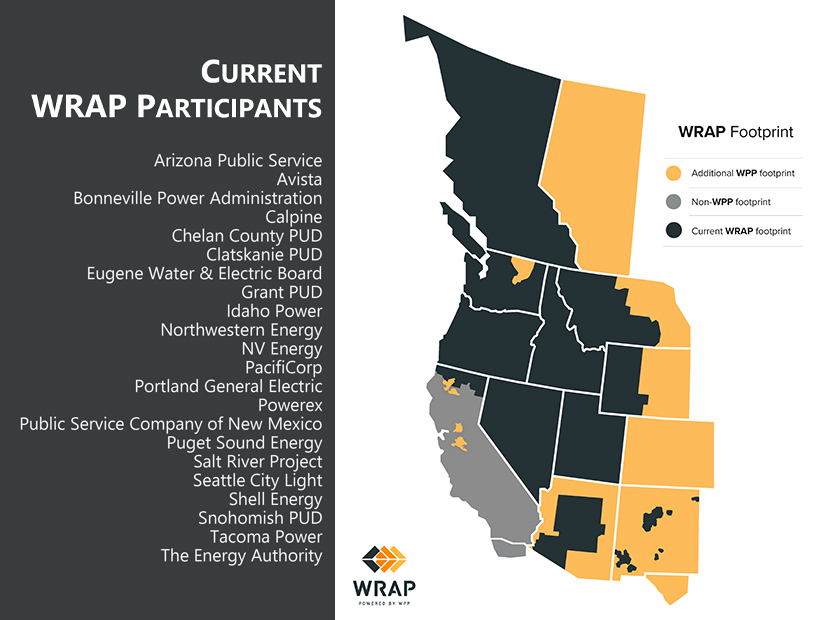
Even in its nonbinding phase, the Western Power Pool’s Western Resource Adequacy Program has been a valuable tool for working toward resource adequacy goals, program participants said.
Even in its nonbinding phase, the Western Power Pool’s Western Resource Adequacy Program (WRAP) has been a valuable tool for working toward resource adequacy goals, program participants said.
“We are really finding that the nonbinding phase is increasing our likelihood of success in the future,” said Camille Christen, resource acquisition, planning and coordination manager at Idaho Power.
Christen’s comments came during an Oregon Public Utility Commission summer readiness workshop June 24 in which WRAP was one topic of discussion.
Idaho Power’s WRAP capacity requirement, which consists of a load forecast plus planning reserve margin, was about 4,100 MW for summer 2025.
Idaho Power did not meet the forward-showing requirement, Christen said, despite its combination of existing and new resources and demand response programs. The utility is now working to resolve the deficiency.
Idaho Power fared better in meeting its internal 1-in-20 forecast of peak summer demand, which is about 4,000 MW. The utility has sufficient firm resources and contracts, including market purchases, to serve load. Idaho Power hit its all-time system peak of 3,793 MW in summer 2024.
Christen noted differences between Idaho Power’s internal modeling and the WRAP model, which is based on regional inputs. Assumptions also vary regarding resource contributions, and the timing of the two analyses differs.
WRAP’s nonbinding phase has provided transparency into regional planning and aggregated resource position, she said. Participants are also gaining experience on the operational side of the program.
In a separate presentation at the OPUC meeting, Dee Outama, senior director of power operation at Portland General Electric, said the utility has enough resources to meet an internal target: a 1-in-2 peak plus a 9% planning reserve margin and 3% contingency. PGE is also in compliance with WRAP metrics for the summer, he said.
In response to a request from RTO Insider, WPP declined to provide details on how many WRAP participants have been meeting forward-showing requirements during the nonbinding phase.
Binding Phase Penalties
Western Power Pool launched the WRAP in response to industry concerns about resource adequacy in the West.
Under the program’s forward-showing requirement, participants must demonstrate that they have secured their share of regional capacity needed for the upcoming season. Once WRAP enters its binding phase, participants with surplus must help those with a deficit in the hours of highest need.
The binding phase also includes penalties for participants that enter a binding season with capacity deficiencies compared with their forward showing of resources promised for that season.
In 2024, the binding phase was postponed by one year at the request of participants, who said they were facing challenges including supply chain issues, faster-than-expected load growth and extreme weather events that would make it difficult for them to secure enough resources and avoid penalties. The binding phase is now expected to start in summer 2027. (See WRAP Members Vote to Delay ‘Binding’ Phase to Summer 2027.)
“What’s fascinating about the challenges that the WRAP is facing in going binding is they sort of prove out that there is a reliability challenge — that in fact folks are short,” OPUC Chair Letha Tawney said during the meeting. “And it’s hard to dig out of that hole in a time frame in the face of all the other headwinds.”
The WRAP’s first nonbinding forward showing season was winter 2023/24; the program’s fifth forward showing, for winter 2025/26, is now underway.
And plenty is happening during the nonbinding phase, according to Michael O’Brien, WPP’s senior policy engagement manager for the WRAP, who gave a presentation during the OPUC meeting.
“[Participants] are giving data to SPP, the program operator,” O’Brien said. “They are going through the forward showing. They are being let know … where they are deficient in their planning.”
Building Consensus
Another WRAP participant that has found the program beneficial thus far is Arizona-based Salt River Project.
“SRP sees significant value in WRAP, as it has provided a regional forum to discuss resource adequacy in the West and how to best address the adequacy challenges posed by load growth and changes to the resource mix,” SRP spokesperson Jennifer Schuricht told RTO Insider.
In addition, WRAP has built consensus around a set of reliability metrics for the region, “which will be increasingly important as the resource mix changes,” Schuricht said in an email.
SRP is on track to fully meet WRAP forward-showing requirements when the program becomes binding, she said.