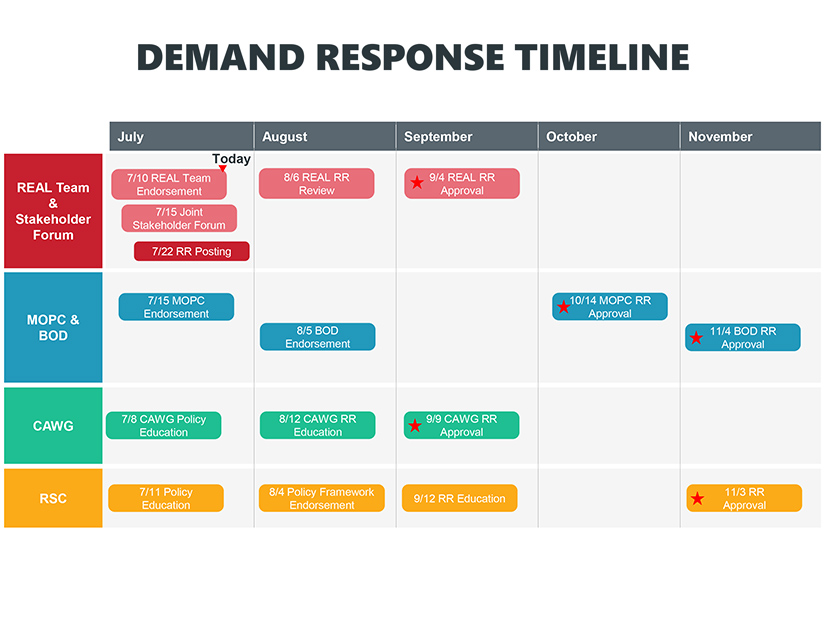
SPP’s Resource Energy and Adequacy Leadership (REAL) Team endorsed RTO staff’s framework for demand response during a special meeting, allowing the grid operator to bring it forward to the quarterly governance meetings in July and August and to then begin drafting the tariff change.
The framework includes various metrics, criteria and thresholds for both reliability and market-registered demand response to reduce consumption during tight grid conditions. SPP has put together what it called a cohort team to gather feedback, including many of the RTO’s working groups.
“We started talking about policy changes to 2017. … We’re coming up on a decade before we implement changes,” Natasha Henderson, SPP’s senior director of grid asset use, said during the July 10 webinar. “That’s kind of scary to think about, but because we have not been able to get consensus through our stakeholder process, the cohort team … helped drive some specific feedback and focused feedback.”
The grid operator also scheduled a demand response engagement forum July 15 before the Markets and Operations Policy Committee to discuss the proposed policy and to gather additional feedback. MOPC will then take up the policy framework for its endorsement.
The current framework includes:
-
- no opt-out for Level 2 energy emergency alert (EEA) testing;
- moving the accreditation lookback from one year to three;
- authorized outages and 50% accreditation within the first year of tests for fully market-registered resources;
- a 100-hour cap for the EEA2 product;
- changing resource accreditation to be grossed up for the planning reserve margin and to allow partial accreditation; and
- a 1,700-MW limit based on the historical remaining capacity in real time, with the allocation method yet to be defined.
- “We have a good structure,” said Omaha Public Power District’s Colton Kennedy, the Supply Adequacy Working Group’s chair. “We’ve had concerns around specific details. I think staff has been very responsive in listening to those concerns.”
SPP is considering an option to allow controllable load modifiers that are not accredited to participate in demand response. Kansas Commissioner Andrew French urged transparency into the load modifiers. He said earlier in the week, Kansas regulators had approved Evergy’s 50% stake into two new combined cycle plants, a deal French said equates to $1.6 billion for 710 MW of capacity.
“So that’s the cost of new capacity right now. It is extremely steep,” he said. “We emphasized in our order it is really going to be important to look at alternatives and to make sure we are maxing out any opportunities for things like demand response as we see the capital costs increase.”
French said load modifiers need to be visible to the balancing authority.
“If you get rid of that and make it non-transparent and it’s just within the load forecast, there is a concern then that you’re immediately increasing the amount of generation and reserves that a utility is going to have to build, unless the state regulator immediately works with them to make sure that they are calling on that to reduce their peaks,” he said. “The other option is that it stays as a load modifier, subject to a lot of BA scrutiny. It makes me nervous to force it into being a registered resource. That’s just a huge paradigm shift.”
The REAL Team passed the measure, 8-6. There were five abstentions.
The DR policy’s approval is contingent on a later endorsement for SPP’s load-resource entity’s peak demand assessment, which has drawn concerns in recent meetings. Staff is not asking for the assessment’s endorsement in July. Assuming MOPC and board approval in October and November, staff intended to file both tariff revisions simultaneously at FERC.
“We’re just moving the DR policy in a faster time frame than that of the LRE peak demand assessment,” Henderson said.
“Here’s a policy that we’re moving forward without analysis of impacts, without a specific methodology, and we’ve done that without bringing it back to the group that has the closest awareness of all the data,” Kennedy said, referring to the LRE assessment and the SAWG. “What staff has proposed here is shifting out the timeline so this MOPC working group really does have more time to understand what’s being done with demand assessment.”