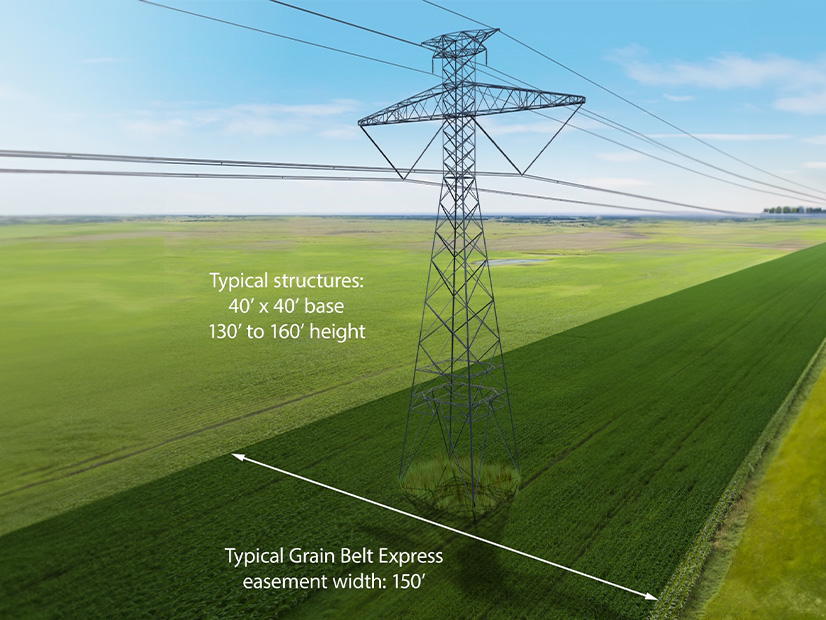
Invenergy is standing by the value of its $11 billion, 800-mile Grain Belt Express transmission project with a letter to Energy Secretary Chris Wright, who is said to have pledged to block the line.
Grain Belt Express Vice President Jim Shield wrote July 11 that Wright should put aside “unfounded noise” and confirm closing of the Department of Energy’s $4.9 billion in federal loan guarantees as Republican leadership in Missouri targets the line’s federal funding.
U.S. Sen. Josh Hawley (R-Mo.) and Missouri Attorney General Andrew Bailey have taken aim at Grain Belt. Hawley sent a letter insisting that Grain Belt’s conditionally approved DOE loan guarantee be pulled, while Bailey has opened a consumer protection investigation into the nature of the line’s development. (See Missouri AG Opens Inquiry into Grain Belt Express.)
In a July 10 press release, Hawley said he secured a pledge from Wright to “halt” the line.
Hawley said in a follow-up social media post the same day that he had a “great conversation” with President Donald Trump and Wright, who he said pledged to “put a stop” to the project. Hawley called the Grain Belt Express an “elitist land grab harming Missouri farmers and ranchers” and claimed it is set to cost taxpayers billions of dollars.
Hawley has demanded for months that the Trump administration terminate government funding for Grain Belt and has questioned the line’s viability.
“Your department should be taking every possible action to stop this loan — not only to save taxpayers’ money, but also to save generational land from being ripped away from families and hard-working farmers and ranchers in Missouri,” Hawley wrote in the June 25 letter to Wright.
‘Open Season’ on New Infrastructure
Shield said it’s unfortunate Hawley and Bailey “are declaring open season on America’s ability to build needed energy infrastructure” and that Grain Belt is the “target of egregious, politically motivated lawfare.”
He characterized Hawley and Bailey’s “crusade” as “unwarranted and unhinged.”
“Recent false accusations from Sen. Hawley and A.G. Bailey saying that the Grain Belt Express will cost America billions instead of saving us billions, whether mistaken or purposefully declared, are misleading at best,” Shield said.
Shield wrote that Grain Belt is a “critical energy security project” that will deliver reliability and savings and is supported by a broad range of stakeholders.
“It is an open-access line that will deliver all forms of American energy based on customer demand and available market power, enhancing the ability of the largest grid operators to share power, including from generators directed to operate under DOE’s 202(c) authority,” Shield said, in an apparent attempt to appeal to the conservative leadership’s pro-business philosophy.
Shield said the line — capable of delivering four nuclear power plants’ worth of electricity and the second-longest line in U.S. history — would connect four of the country’s grid regions while delivering cost savings and reliability to “29 states and D.C., more than 40% of Americans and 25% of Department of Defense installations.”
Shield said recent questions raised by Bailey were addressed through the Missouri Public Service Commission’s “long and rigorous” regulatory process that began in 2022 and concluded in late April. What’s left is “procedural abuse” to roll back state regulatory approval that wastes public resources and harms the public, Shield wrote.
“The state of Missouri was represented throughout these proceedings, yet A.G. Bailey never intervened or otherwise contested the proceeding. Missouri law and constitutional due process protect the Grain Belt Express’ property interest in its permit granted by the MPSC. No amount of political posturing and unrelenting attacks can change that fact,” Shield said.
He said the timing of the “anti-growth” attacks doesn’t make sense given the country’s booming energy demand and that the line is even more important now than when it was conceived in 2010.
The CEO of Associated Industries of Missouri, a pro-business lobbyist organization, said Grain Belt is an “obvious solution,” given demand growth from new manufacturing and emerging technologies.
“It is nonsensical to try to impede a project that will put Missourians to work constructing infrastructure that delivers affordable and reliable power of all kinds to Missouri businesses while enhancing grid security for America,” CEO Ray McCarty said in a statement.
In a separate press release issued by Invenergy, the company questioned whether America has “lost its will to build.”
“If projects can’t count on certainty even after being approved and reviewed upon appeal, America can’t count on ever getting steel in the ground. America will lose the test of its will to build,” Invenergy said. The company lamented “political actors making last-gasp attempts to reopen existing state approvals or halt a yearslong federal review in its tracks.”
Invenergy noted that states lead on transmission permitting and said Grain Belt already has cleared Kansas, Missouri, Illinois and Indiana’s routing processes. It said it made “every effort” to negotiate with landowners.
“Grain Belt Express has among the strongest set of landowner protections and compensation packages, including a code of conduct and agricultural impact mitigation protocol. In fact, the Kansas Farm Bureau called for these protocols to be made a standard for the industry,” Invenergy said. “Living up to our commitment that eminent domain be used only as an absolute last resort, land has been secured through voluntary agreements in all but a low single digit percentage of cases, a rate equal to or better than the utility industry standard.”
Invenergy says it has completed over 95% of land acquisition for Phase 1, the segment connecting Missouri and Kansas. The phase’s construction is scheduled to start in 2026.
Invenergy added that when it acquired Grain Belt from now-defunct Clean Line Energy in 2020, it invested in a redesign and listened to stakeholders’ concerns, ultimately deciding to make more power deliveries to Missouri. (See Invenergy Announces Grain Belt Express Expansion.)