Canada’s utilities are encouraged by the country’s new government but say legislation to fast-track high-priority infrastructure projects does not address needs for permitting relief and more flexible clean energy targets and investment tax credits.
The Building Canada Act (Bill C-5), approved in June, gives the federal government the ability to override some laws, regulations and environmental assessments for projects designated as in the national interest. The bill has sparked opposition and litigation from Indigenous groups.
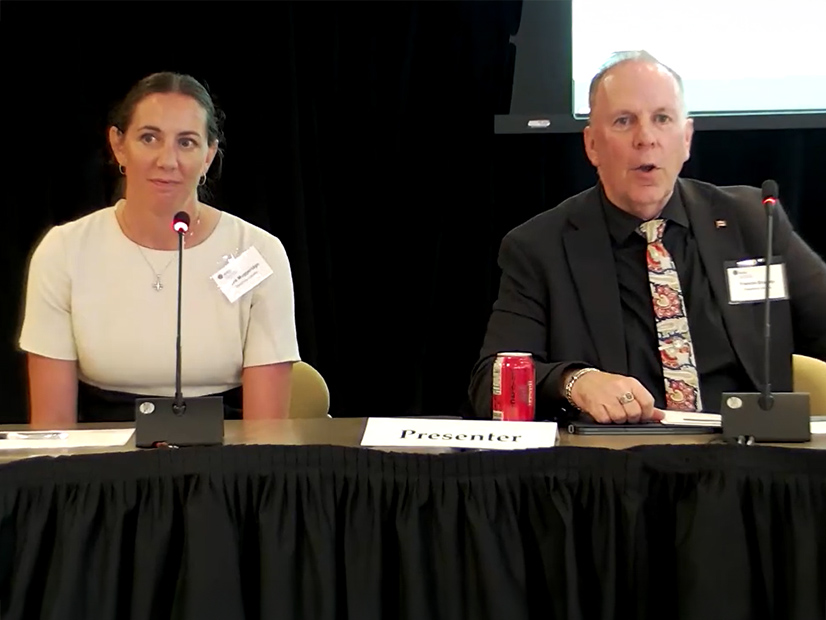
“I think the view generally is C-5 sends a good message, but it does not address any of the fundamental issues that need to be addressed,” Francis Bradley, CEO of trade group Electricity Canada, said during a presentation at IESO’s Strategic Advisory Committee meeting July 16. Electricity Canada, formerly the Canadian Electricity Association, represents 42 generation, transmission and distribution companies in Canada’s 10 provinces and three territories.
C-5 is expected to fast-track permitting for 10 to 12 projects.
“If your project is not on that list, what happens?” Bradley asked. “We have not addressed any of the fundamental challenges that we have with getting infrastructure built in the country. So, we haven’t addressed the Clean Electricity Regulations [CERs]; we haven’t addressed the Fisheries Act; we haven’t addressed the Impact Assessment Act.”
‘Concierge’ Approach
Julia Muggeridge, Electricity Canada’s vice president of communications and sustainability, recalled a meeting with the new Major Projects Office — the hub of a “one project, one review” model to eliminate duplication between federal and provincial governments — shortly after the April 28 federal elections.
“It was a very positive meeting. … They said that there’s going to be this concierge approach to [C-5] projects, but then there’s going to be the second tranche of projects that will have less of a white-gloved approach, but they’ll also be given their own process. We haven’t seen that yet, but it was something that was introduced to us.”
Muggeridge said some of her group’s members are concerned over the speed with which the bill was approved and the lack of consultation with them in advance. “But I believe that’s being rectified throughout the month of July. We’re hoping for positive conversations over the next two weeks, but that’s generally what I’ve been hearing from members who are excited and looking at how they can ensure their projects are on this list of 10 to 12.”
Indigenous leaders, however, were not mollified by a meeting with Prime Minister Mark Carney on July 17, saying consulting First Nations after the legislation had passed was disrespectful.
The 2025 priorities that Electricity Canada will be presenting to the government in August will “look a lot like they did in 2024,” with an emphasis on improving the country’s competitiveness, Muggeridge said.
“It is too difficult to build in Canada,” she said. In “the latest ranking with the [Organization for Economic Cooperation and Development], we were like 64th for permitting in the world.”
The group says CERs’ goal of an emissions-free electric grid by 2035 will harm affordability and reliability, with impacts most acute in Alberta, Saskatchewan, Ontario, Nova Scotia and New Brunswick.
It also is seeking to change investment tax credits to include intra-provincial transmission and revise the definition of eligible small modular nuclear reactors; extend timelines for full value credits from 2030 to 2035; and eliminate the requirement that provinces and territories commit to a net-zero grid by 2035.
‘Startup Vibe’
Muggeridge said the new government has “a bit of a startup vibe.”
“This happened with [Prime Minister Justin] Trudeau in 2015 … an excitement and an urgency. Ministries are being staffed with new young folks that are excited to meet with Electricity Canada. We’re delighted with the engagement that we’ve had with the new government so far.”
Bradley agreed. “Clearly, the tone is different. … Seven or eight months ago, nobody around the Cabinet table would even engage in a conversation about some of these topics. Now, those conversations are at least taking place. … Whether or not it actually results in in making it easier to get good projects moving forward remains to be seen.
“What we need more than anything else is … certainty so that those investments can happen,” he added. “We’d like to remind people that we’re not talking about investments that have a three-year lifespan or a five-year lifespan. We’re talking about investments that that need to be able to stand up to the test of time for 20, 30, 40 years. These are generational investments that are required.”
13 Systems
Bradley said Canada’s electric regulations also are a challenge. “There is not that one electricity system in this country. There are 13 systems. And each of those systems — each province and territory — has constitutional authority over its own electricity regulation. And provincial autonomy often leads to resistance against federal initiatives, including, for example, net-zero targets or national infrastructure projects. In some jurisdictions, it’s principally Crown-owned companies. In other jurisdictions, it’s investor-owned companies. There’s a different level of market access and market maturity.
“I will often hear from folks in the western Canadian context, talking about the interconnection between [British Columbia] and Alberta,” he continued. “Why would one build more interconnection between these two jurisdictions when the current interconnection are not being maximized? Well, the current interconnection is not being maximized because there’s a mismatch between the markets.”